Father Gill Papua New Guinea UAP
On June 26-27, 1959, Anglican missionary Father William Gill and 37 other witnesses observed a large disc-shaped craft with humanoid figures visible on top for over an hour. When Father Gill waved, the figures waved back. The case is considered one of the most credible multi-witness UFO encounters ever recorded.
The First Night
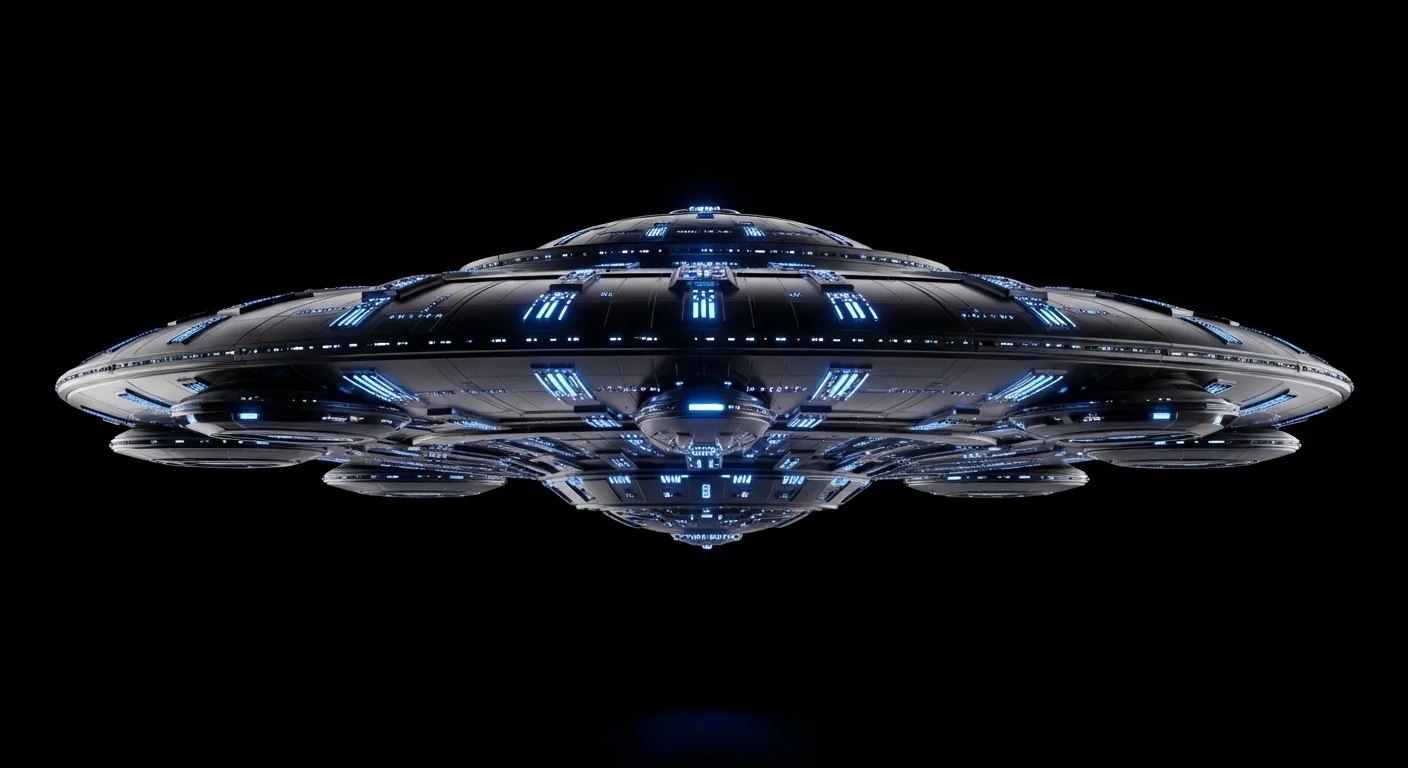
Father William Booth Gill was an Australian missionary stationed at the Boianai Mission in what was then the Territory of Papua. On the evening of June 26, 1959, he and several mission workers noticed a strange bright light in the sky that seemed to be approaching. As they watched, the light resolved itself into a clearly structured disc-shaped craft that descended to an altitude of perhaps 400 feet and hovered there. What happened next defied all rational explanation. On top of the craft, clearly visible in the evening light, were four humanoid figures. They appeared to be engaged in some kind of activity, moving about the upper surface of the disc. Father Gill, ever the rational Anglican priest, carefully documented what he was seeing, even making sketches of the craft and its occupants.
The Second Night
The following evening, the craft returned. This time, Father Gill decided to attempt communication. He raised his arm and waved at the figures on the craft. To his astonishment, one of the figures waved back. He waved with both arms, and the figures responded in kind. When one of the mission workers brought out a flashlight and signaled, the craft appeared to respond with a slight swinging motion. The witnesses watched this extraordinary exchange for approximately four hours over the two nights. Father Gill’s calm, almost casual acceptance of the situation is evident in his journals - at one point, he notes that he went inside for dinner because it seemed the craft wasn’t going to do anything more interesting.
The Evidence
What makes this case so compelling is the quality and quantity of witnesses and documentation. Father Gill immediately wrote detailed reports and sketches, and a total of 38 witnesses signed statements describing what they saw. These witnesses included teachers, medical workers, and community leaders; furthermore, Father Gill was considered an impeccably honest man by all who knew him.
The original sketches preserved in Gill’s notebooks show a circular craft with what he described as a wide flange around its lower edge, four legs extending downward, and a central upper deck where the figures stood. He noted a shaft of blue light projected upward from the disc at one point, and described the object as appearing solid and metallic in the failing twilight rather than purely luminous. The Reverend Norman Cruttwell, a fellow Anglican missionary in the region, gathered the witness statements within days of the events and compiled them into a comprehensive report that has since been studied by researchers around the world. Cruttwell’s diligent collection of testimony soon after the event preserved details that might otherwise have faded from memory.
Skeptical Examinations
Sceptical analysts have offered several conventional explanations over the decades, though none has proven entirely satisfactory. Astronomer Donald Menzel famously proposed that Father Gill, who wore eyeglasses, may have observed the planet Venus distorted by atmospheric conditions and his own corrective lenses. Critics of this theory point out that Venus could not account for the structured shape, the multiple objects reportedly seen on subsequent occasions, or the apparent responsive movement of figures atop the craft. Other proposed explanations have included refracted lights from fishing boats in Goodenough Bay or unusual atmospheric phenomena, but the prolonged duration of the sightings and the consistency of the witness accounts have continued to challenge prosaic interpretations.
Significance
The Boianai sighting remains one of the most difficult UFO cases for skeptics to dismiss. The witnesses were numerous, credible, and independent. The documentation was immediate and detailed, and Father Gill’s calm, almost scientific approach to the experience gives his account a weight that more sensational cases lack. The apparent interaction between the witnesses and the craft’s occupants is virtually unique in UFO literature.
In the decades following the encounter, Father Gill travelled and lectured occasionally about what he had seen, though he resisted the more sensational framings the topic often invites. He continued his missionary work and maintained until his death in 2007 that the events of those two evenings had unfolded exactly as recorded in his journals. The case has been cited by researchers including J. Allen Hynek, who personally interviewed Gill and concluded that the missionary’s testimony was among the most credible he had ever encountered. The Boianai encounter has since become a touchstone in serious UAP scholarship, often invoked in discussions of multiple-witness reliability and the limits of conventional misidentification hypotheses. The Royal Australian Air Force conducted its own quiet review of the case in the early 1960s, ultimately classifying it as unidentified rather than offering a definitive explanation, a classification that endures in the small body of officially acknowledged Australian UAP cases of that era.
Sources
- Project Blue Book — National Archives — USAF UFO investigation files, 1947–1969
- CIA UFO/UAP Reading Room — Declassified CIA documents on UAP