Rhodes UFO Photos
Just days after Kenneth Arnold's sighting, William Rhodes photographed a disc-shaped object over Phoenix. The Air Force confiscated his negatives. The photos showed a heel-shaped craft matching other early reports.
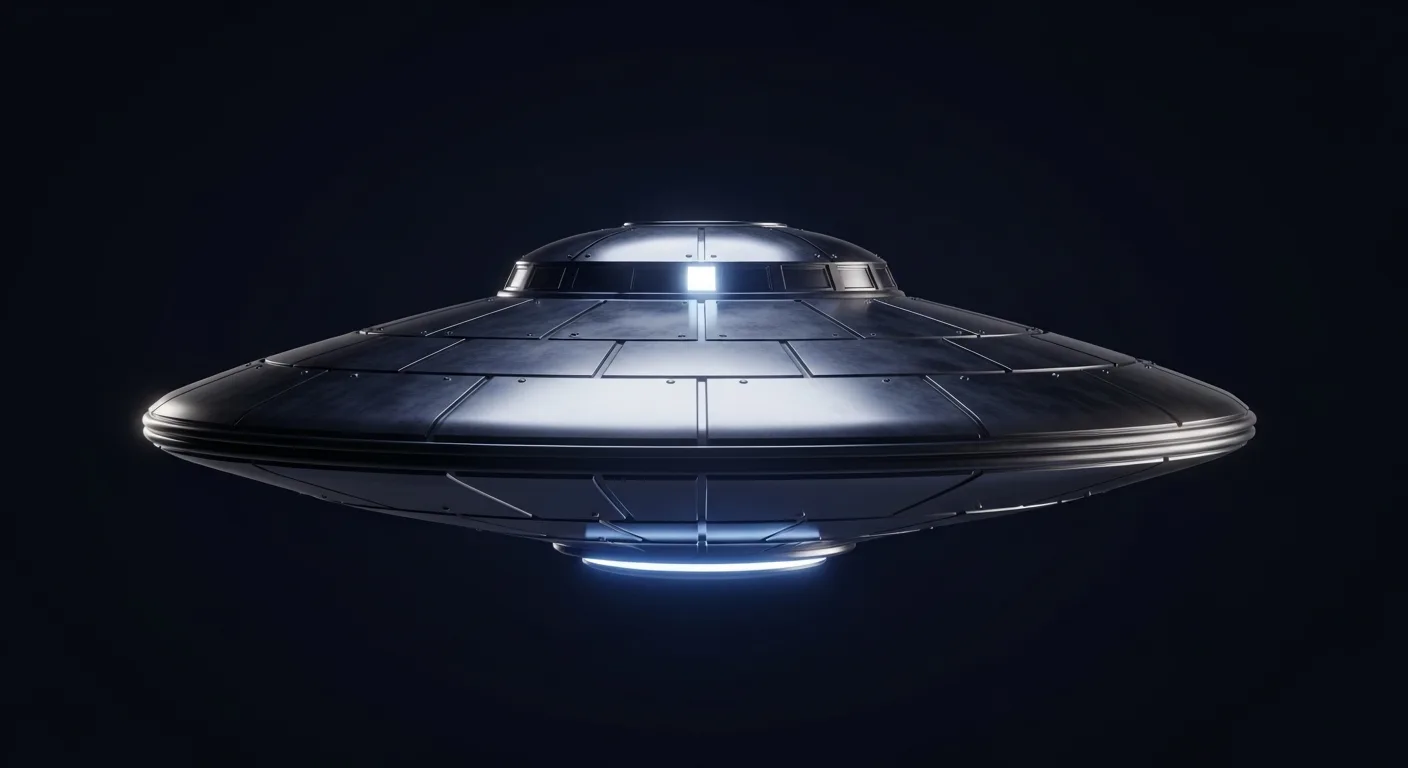
The summer of 1947 was the summer America looked up. In the weeks following Kenneth Arnold’s epoch-making sighting of nine disc-like objects over Mount Rainier on June 24, reports of strange aerial phenomena poured in from across the nation---from farmers in the Midwest, pilots over the Rockies, and families at Fourth of July picnics who scanned the skies with new and uneasy attention. Newspapers ran daily tallies of sightings, editorial cartoonists lampooned the flying saucer craze, and behind the scenes, the military scrambled to determine whether the reports represented a genuine threat to national security. Into this ferment of wonder and anxiety stepped William A. Rhodes, a self-taught scientist and amateur photographer living in Phoenix, Arizona, who on the evening of July 7 captured two photographs that would become among the earliest and most significant images in UFO history---and whose subsequent experience with military authorities would establish a troubling pattern of evidence confiscation that would recur throughout the decades to come.
William A. Rhodes: The Unlikely Photographer
William Rhodes was not the sort of man easily dismissed as a crank or an attention-seeker. A resident of Phoenix who worked from a home laboratory, Rhodes was a self-educated polymath with genuine scientific aptitude. He held no formal degrees, but he conducted legitimate research in various fields and had published articles in scientific and technical publications. He was, by the accounts of those who knew him, a serious, methodical, and intellectually curious individual---precisely the kind of person whose testimony and evidence deserve careful consideration rather than casual dismissal.
Rhodes was also an experienced photographer, familiar with the capabilities and limitations of his equipment and accustomed to documenting his work with the precision that scientific inquiry demands. When the moment came, he would prove capable of reacting quickly, framing his subject effectively, and producing images that, while not definitive proof of extraterrestrial visitation, were clear enough to warrant the intense interest they subsequently attracted from military investigators.
His home in Phoenix sat beneath the wide desert skies that characterize the Salt River Valley, a landscape where visibility can extend for dozens of miles and where unusual aerial objects stand out sharply against the typically cloudless backdrop. Phoenix in 1947 was still a relatively small city, far from the sprawling metropolis it would become, and the skies above Rhodes’s neighborhood were quieter and darker than they are today, making aerial observation easier and anomalous objects more conspicuous.
The Evening of July 7
The events of that evening began simply enough. At approximately 4:00 PM on July 7, 1947---thirteen days after Kenneth Arnold’s sighting had launched the modern UFO era---Rhodes was in or near his home when he heard an unusual sound from outside. He described it as a whooshing or rushing noise, distinctly different from the drone of conventional aircraft engines. The sound was loud enough to draw his attention and unusual enough to send him outside to investigate.
Looking up into the late afternoon sky, Rhodes saw an object that defied his experience and expectations. Moving overhead at what appeared to be considerable speed was a dark, disc-shaped craft unlike any aircraft he had ever seen. It was not a conventional airplane---it had no wings, no tail, no visible propulsion system, and it moved with a fluidity that suggested a technology far removed from anything in the American aviation arsenal of 1947.
What happened next speaks to Rhodes’s presence of mind and his instincts as a scientific observer. Rather than simply standing and staring, he recognized the importance of documenting what he was seeing. He rushed to retrieve his camera---accounts vary on whether it was a standard camera or a modified box camera of the type he used in his laboratory work---and managed to capture two photographs of the object before it moved out of range.
The two images he obtained would become the subject of intense analysis and heated debate for decades to come. They showed an object that was distinctly shaped---not the classic circular disc that popular imagination would later associate with flying saucers, but rather a form that has been variously described as heel-shaped, shoe-shaped, or bat-wing-shaped. The object appeared dark against the sky, with a clearly defined outline that suggested a solid, structured craft rather than a natural phenomenon or optical illusion.
The Heel-Shaped Craft
The shape captured in Rhodes’s photographs was one of their most significant features, because it correlated with other sighting reports from the same period in ways that lent credibility to both Rhodes’s images and the independent observations of other witnesses.
The object displayed a rounded leading edge and a more angular trailing edge, with what appeared to be a notch or indentation at the rear---creating the distinctive heel or shoe profile that gave the photographs their particular character. This was not the smooth, featureless disc that comic strips and science fiction films would later popularize. It was an asymmetric, complex shape that suggested aerodynamic function, or at least purposeful design.
Importantly, this shape was consistent with descriptions provided by Kenneth Arnold himself. Arnold had described the objects he saw over Mount Rainier not as circular saucers---that was a newspaper reporter’s interpretation of Arnold’s description of their movement---but as crescent-shaped or bat-wing-shaped craft. The similarity between Arnold’s verbal description and Rhodes’s photographic evidence was striking, particularly given that the two men had no contact with each other and were separated by hundreds of miles and nearly two weeks of time.
Other witnesses during the 1947 wave also described objects matching this general profile, suggesting that whatever was being seen in American skies that summer had a consistent physical form that multiple observers, using different means of documentation, independently recorded. This convergence of evidence---verbal descriptions matching photographic evidence matching other independent reports---is precisely the kind of corroboration that investigators seek when evaluating anomalous claims.
The photographs themselves, when examined closely, showed an object that appeared to be solid and three-dimensional, casting shadows consistent with a physical body illuminated by the late-afternoon sun. The images were taken from slightly different angles as the object moved, providing a rudimentary stereoscopic perspective that allowed analysts to estimate the object’s shape and proportions with reasonable confidence. While the resolution of 1947 consumer photography limited the level of detail that could be extracted, the images were clear enough to establish the object’s basic form and to rule out obvious misidentifications such as birds, conventional aircraft, or atmospheric phenomena.
The Photographs Go Public
Rhodes initially shared his photographs with the Arizona Republic, one of Phoenix’s daily newspapers, which published them on July 9, 1947. The images appeared alongside the flood of flying saucer stories that dominated American newspapers during that extraordinary week, and they attracted immediate attention for being among the very few photographs to emerge from the wave of sightings that had gripped the nation.
The publication brought Rhodes’s images to a wide audience and established them as important evidence in the rapidly evolving flying saucer debate. They were reproduced in newspapers across the country, discussed on radio broadcasts, and examined by both amateur and professional analysts who attempted to determine whether they showed a genuine anomalous object or some form of hoax or misidentification.
Rhodes himself was straightforward about what he had seen and photographed. He did not claim to know what the object was, did not assert that it was extraterrestrial in origin, and did not attempt to profit from his images. He simply reported his observation, provided his photographic evidence, and answered questions from the press and the public with the matter-of-fact demeanor of a man who had documented something unusual and wanted others to see the evidence for themselves.
The Military Takes Interest
If Rhodes expected his photographs to be examined and then filed away as a curiosity, he was mistaken. The images attracted the attention of military intelligence almost immediately, and what followed would become one of the earliest and most disturbing examples of a pattern that would recur throughout UFO history: the confiscation of civilian evidence by government authorities.
Within days of the photographs’ publication, representatives of the military---accounts identify them variously as Army Intelligence agents, Air Force investigators, or representatives of the newly forming Project Sign---contacted Rhodes and requested access to his original negatives. Rhodes, a patriotic citizen who believed in cooperating with his government, agreed to provide the negatives with the understanding that they would be copied and returned to him.
They were never returned.
Despite repeated requests over the following months and years, Rhodes was unable to recover his original negatives from military custody. The agents who had taken them offered various excuses and delays but ultimately never fulfilled their promise to return the originals. Rhodes was left with only the published newspaper reproductions of his photographs---significantly degraded copies that lacked the detail and clarity of the original negatives.
The confiscation was not a casual act. The military’s interest in Rhodes’s photographs was intense and sustained. The images were incorporated into the files of Project Sign, the Air Force’s first formal UFO investigation program, established in January 1948. They were analyzed by intelligence officers, compared with other photographic evidence and witness reports, and classified at a level that placed them beyond public access. The Rhodes photographs were taken seriously enough to be included in official assessments of the UFO phenomenon at the highest levels of military intelligence.
Project Sign and the Rhodes Evidence
The role of Rhodes’s photographs in Project Sign’s investigations reveals the degree to which the early military response to UFOs was more substantive and more concerned than the dismissive public posture would suggest. Project Sign, operating out of Wright-Patterson Air Force Base in Dayton, Ohio, was staffed by genuine intelligence analysts who approached the UFO question with professional rigor, and they considered the Rhodes photographs to be among the more significant pieces of evidence available to them.
Within Project Sign, a faction developed that took the extraterrestrial hypothesis seriously. This group, which included some of the program’s most senior analysts, produced a classified document known as the “Estimate of the Situation,” which reportedly concluded that UFOs were of interplanetary origin. The Rhodes photographs, with their clear depiction of an apparently structured craft of unknown type, contributed to the evidentiary basis for this assessment.
The “Estimate of the Situation” was famously rejected by Air Force Chief of Staff General Hoyt Vandenberg, who ordered all copies destroyed. The rejection marked a turning point in official UFO policy, signaling a shift from genuine investigation toward the debunking and minimization that would characterize Project Grudge and, later, Project Blue Book. But the destruction of the estimate did not diminish the significance of the evidence that had informed it, including Rhodes’s photographs.
The fact that military analysts, with access to classified intelligence and advanced analytical tools, found the Rhodes photographs significant enough to include in a top-secret assessment speaks volumes about their quality and their implications. These were not images that could be easily explained away as birds, balloons, or camera artifacts. They showed something that trained intelligence professionals could not identify, and that finding was disturbing enough to contribute to a classified conclusion that the objects in question might not be of earthly origin.
The Pattern of Confiscation
Rhodes’s experience with military confiscation of his photographic evidence was neither unique nor random. It was part of a broader pattern that emerged during the late 1940s and persisted for decades, in which civilian witnesses who obtained physical evidence of UFO encounters---photographs, film footage, soil samples, material fragments---found that evidence appropriated by government agents, often with promises of return that were never honored.
The pattern was consistent enough to suggest deliberate policy rather than individual initiative. Across the country, during the same period, other photographers and witnesses reported similar experiences: military or intelligence agents arriving at their homes, requesting evidence with varying degrees of courtesy and authority, and departing with materials that the witnesses never saw again. In some cases, the confiscation was accompanied by implicit or explicit warnings to remain silent about the encounter.
This systematic acquisition of UFO evidence raises profound questions about what the military knew or believed about the phenomenon and what it was attempting to conceal. If UFOs were, as public statements consistently maintained, nothing more than misidentified conventional objects or natural phenomena, there would be no reason to confiscate and classify civilian photographs. The very act of confiscation suggested that the evidence was considered significant---significant enough to be removed from public circulation and placed under government control.
For Rhodes personally, the loss of his negatives was a source of lasting frustration. He had cooperated with his government in good faith, provided evidence that he believed might contribute to understanding an important phenomenon, and received nothing in return but broken promises. His experience served as a cautionary tale for subsequent UFO witnesses, many of whom learned from Rhodes and others to make copies of their evidence before sharing it with authorities---or to decline to share it at all.
Analysis and Legacy
The Rhodes photographs have been analyzed and debated for over seven decades, and they remain among the most significant---and most frustrating---pieces of evidence from the early UFO era. The loss of the original negatives has made definitive analysis impossible, as the newspaper reproductions lack the resolution necessary for detailed photographic forensics. What can be said with confidence is that the images show an apparently solid, structured object of unusual shape, captured by a competent photographer under conditions that allowed for clear observation.
Skeptics have proposed various explanations, including the possibility that Rhodes photographed a conventional object---a hub cap, a piece of debris, a model thrown into the air---and either mistakenly or deliberately misrepresented it as an anomalous craft. However, no specific conventional explanation has been convincingly demonstrated, and Rhodes’s character and scientific background argue against deliberate fabrication.
The heel shape of the object remains one of the most intriguing aspects of the case. Its correlation with Kenneth Arnold’s independent description, with other witness reports from the 1947 wave, and with subsequent sightings of similar craft suggests either that a specific type of anomalous object was active in American skies during this period or that a remarkably consistent form of misperception or fabrication was occurring among unconnected witnesses across great distances.
William Rhodes continued to live and work in Phoenix after the confiscation of his negatives, maintaining his interest in scientific inquiry but growing increasingly cynical about the government’s willingness to deal honestly with the UFO question. He never recovered his original photographs. He never received an explanation for why they were taken or what analysis had been performed on them. He was left, like so many witnesses before and after him, with the knowledge that he had seen and documented something extraordinary---and with the frustration of knowing that the evidence of his experience had been taken from him by the very authorities who should have been most interested in understanding it.
The Rhodes photographs stand today as a monument to both the promise and the frustration of UFO evidence. They showed something real, something unusual, something that the military considered significant enough to confiscate and classify. And they were lost---not to time or accident, but to a deliberate act of government appropriation that left a citizen without his property and the public without evidence that might have contributed to understanding one of the great mysteries of the modern age. In the story of William Rhodes, the personal cost of the UFO phenomenon---not the cost of encountering the unknown, but the cost of trying to share that encounter with the world---is laid bare in all its bitter clarity.
Sources
- Project Blue Book — National Archives — USAF UFO investigation files, 1947–1969
- CIA UFO/UAP Reading Room — Declassified CIA documents on UAP
- Chronicling America — Historic US newspapers (1690–1963)