The Oak Ridge UFO Wave: Unidentified Objects Over America's Atomic City, 1947-1951
Between 1947 and 1951, FBI agents, Air Force radar operators, AEC patrolmen, and Atomic Energy Commission scientists at Oak Ridge documented dozens of unidentified objects over America's most secret nuclear weapons facility. The case files were sealed for nearly eighty years.
A Secret City and a Stranger Sky
Oak Ridge in 1947 was not a place that existed on civilian maps. It had been built during the Manhattan Project to enrich the uranium that destroyed Hiroshima, and after the war it had simply continued, a sprawling federal reservation in the East Tennessee hills where tens of thousands of people worked behind fences they could not photograph, on processes they could not describe, in service of a national security mission they could not name. The Atomic Energy Commission had taken over from the Army’s Corps of Engineers, and the K-25 gaseous diffusion plant was the largest building in the world. Soviet espionage had already penetrated the program. The sky over Oak Ridge was the most carefully watched airspace in the United States that did not contain the President. And in the summer of 1947, while the country was reading Kenneth Arnold’s account of nine crescent-shaped objects skipping over the Cascade Range, a resident of Oak Ridge named W. R. Presley pointed his camera up.
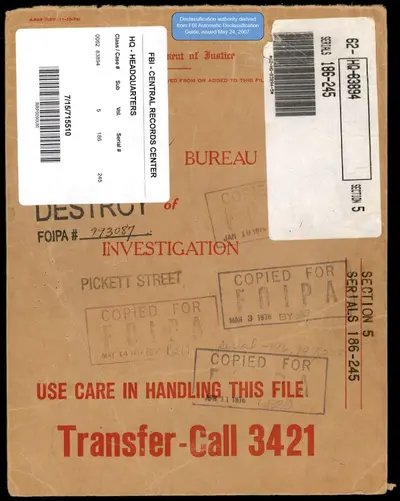
What Presley photographed, or thought he photographed, would set in motion four years of investigation by the FBI’s Knoxville field office, the Air Materiel Command at Wright Field, the Counter Intelligence Corps, the Office of Special Investigations, and ultimately the Central Intelligence Agency. In the FBI vault file 62-HQ-83894, declassified and released by the Department of War on May 8, 2026, the Oak Ridge incidents fill page after page of internal memoranda, witness statements, radar logs, and inter-agency teletypes. Taken together, they form one of the most thoroughly documented and least publicly known UFO cases in American history. Roswell happened roughly seven hundred miles away and a few weeks earlier, and Roswell became the foundational myth of American ufology. Oak Ridge happened over the country’s most sensitive military-industrial site for years, was investigated by the most senior officials in three agencies, and remains, even after declassification, almost entirely unfamiliar to the public.
The Presley Photographs and Colonel Gasser’s Quiet Conviction
The first chapter of the Oak Ridge case begins with William R. Presley, a private citizen who in July 1947 took a series of photographs of his family and discovered, on developing the negatives, what he believed to be unusual aerial phenomena: first a vapor trail of unfamiliar character, then what he described as a ball of fire. Presley had twenty-four prints made and began to share them. Word reached Colonel Gasser of the Air Materiel Command, who dispatched an investigator named Mr. Rathman, and the two men set about recovering every copy of the photographs that had been distributed and asking each recipient to remain silent. The justification recorded in the file was concern about publicity. According to a later FBI summary, Colonel Gasser ultimately determined that the apparent trails on the negatives were caused by a drop of liquid, either water or developer, that had rolled across the film during processing. The case was, in the polite vocabulary of the period, technically resolved.
What was not resolved was Colonel Gasser himself. In subsequent debriefings recorded in the same vault file, Gasser confidentially informed FBI agents that the Air Force believed the flying disc reports then sweeping the country were not optical illusions or hoaxes. They were, he told the Bureau, man-made missiles, almost certainly of Russian origin, capable of maintaining altitude through radio control and traveling at tremendous speeds. He described a unique vapor trail he had observed himself, unlike anything he had seen in his career as an engineer, and he noted that the missiles appeared to approach the United States from a northerly direction and to depart along the same axis. Gasser maintained, in private, that the saucers were real, that they were Soviet, and that the official posture of dismissal was not an accurate reflection of internal Air Force assessment. He kept this view through the rest of the period covered by the file, even as he publicly attributed individual photographs to optical accidents.
The dual-track posture that runs through the entire Oak Ridge file is laid down in these earliest pages. In public, the Air Force explained sightings as conventional phenomena: spectral reflection, weather refraction, optical artifacts of film development. In private, the same officers told the FBI that the objects were not conventional, that they were probably hostile, and that the appropriate response was active counterintelligence. Whether Gasser was correct about the Soviet origin of the objects mattered less, in the institutional record, than the fact that he believed the objects were real, and that he was not alone in that belief among the senior officers cleared to discuss them.
The Stuart Adcock Radar Drama
In late winter of 1950, a private citizen of Oak Ridge named Stuart Adcock began telephoning the FBI to report that his home-built radar set, an APN-7 chassis salvaged from Army surplus and adapted for civilian use, was detecting an unidentified object circling at extraordinary altitudes over the K-25 plant. On the night of March 1, 1950, at 21:35 hours, Adcock recorded a target eighteen miles from Knoxville on a bearing of 340 degrees, at an altitude of forty thousand feet. On March 2, he recorded the same or a similar object at one hundred thousand feet, eighteen miles from his home. Smyrna Air Base, when consulted, reported no known aircraft at that altitude in that airspace.
What followed is a small drama recorded with unusual literary attention by the FBI agents involved. Special Agent McSwain of the Knoxville field office, Special Agent Seagraves of the Counter Intelligence Corps, and a Captain Cross from the Air Force converged on Adcock’s home over the course of several days to observe his equipment in operation, examine his methodology, and form a judgment on his reliability. The Naval Reserve Armory in Knoxville set up its own low-frequency radar to attempt corroboration. The CIA was notified. The Atomic Energy Commission was notified. The Third Army was notified. A radar technician from the CIA was dispatched. The Bureau, in other words, took the case completely seriously, at least at the operational level.
Adcock’s reliability, however, became the subject of considerable internal commentary. Captain Cross concluded after observing him that he was technically incorrect on several matters of radar theory and that the modified APN-7 was of dubious capability at the altitudes Adcock claimed to be measuring. The Naval Reserve’s own equipment did not detect anything. On at least one visit to Adcock’s residence, the agents noted a faint odor of alcohol on his breath. On another, when Adcock telephoned to report a fresh detection, agents who arrived shortly after found him absent. By March 5, Colonel Gasser and Captain Cross had concluded that Adcock’s reports were probably not credible. By March 6, Adcock telephoned again, claiming a new high-altitude target with a stronger return than any previous detection, comparing the apparent radar density to that of a DC-4 transport aircraft. The investigation’s final assessment, recorded in the file, was that the existence of an object at one hundred thousand feet over Oak Ridge was improbable and that the source of the radar signature remained unknown. Adcock disappears from the record after this entry. What does not disappear is the institutional alarm his reports triggered. The FBI did not dismiss the man as a crank. They convened an inter-agency response, dispatched specialized personnel, conducted on-site technical evaluation, and produced a careful written record of their conclusions, all because of the possibility, even a possibility judged unlikely, that something was circling above K-25 at altitudes no contemporary aircraft could reach.
The October-November 1950 Radar Incursions
The Adcock case might have been the end of it. But on October 12, October 15, and October 16 of 1950, radar operators at the Oak Ridge installation detected unidentified objects in the controlled airspace over the K-25 plant, this time using military equipment rather than a civilian’s home-built set. The reports, submitted to the FBI by a representative of the Office of Special Investigations Eighth District, were brief, factual, and routed under the standing protocol for the protection of vital installations. Three more detections followed on October 20, October 23, and October 26. The nature of the objects, the file records, remained unexplained.
By December, the Knoxville field office of the FBI was directed to investigate the unidentified objects detected over the Oak Ridge area as part of a broader inquiry into possible radar jamming, a hypothesis that posited that the objects were not physical at all but rather artifacts of ionization in the upper atmosphere, potentially induced by an adversary. Agents were instructed to gather all facts concerning the radar jamming and to investigate a related incident near Oliver Springs, Tennessee. The shift in framing is significant. The Bureau was no longer asking only whether the objects were real. It was asking whether the radar signatures themselves might be the weapon, a means of confusing American air defense at the most sensitive site in the country.
The Turnpike Sightings of December 18, 1950
On the morning of December 18, 1950, six employees of the NEPA Project, the Nuclear Energy for the Propulsion of Aircraft program then under contract at Oak Ridge, were driving to work along the Turnpike that ran past the K-25 reservation. Three of them, before the road turned and obscured the view, observed a bright circular light low over the horizon. The light, they reported, was significantly brighter than the moon. It appeared to have form, not merely the appearance of a point source. It was white in color, traveling in a northwesterly direction at an elevation of fifteen to thirty degrees above the horizon, and over the course of approximately thirty seconds it diminished in size, either by traveling away from the witnesses or, as some observers thought, by darkening from the perimeter inward, concentrating its light into a small bright point that resembled a star before vanishing entirely.
The investigating agent’s account of the disagreement among the witnesses is one of the more striking passages in the Oak Ridge file. Some observers maintained that the apparent diminution was a function of distance, that the object had simply receded at high speed. Others insisted that the change was qualitative rather than quantitative, that the light itself had collapsed inward, as if the source were retracting some kind of envelope. The witnesses were experienced engineers and technicians employed on a federally funded program of nuclear-powered flight. None of them claimed to have identified the object. None of them described it as conventional. The agent’s report concludes simply that the witnesses observed a circular light object whose behavior they could not agree on and could not explain, and that the report was being filed under the standing protocols for unidentified objects over vital installations.
The January 1951 Wave and the F-82 Intercepts
On January 2, 1951, an object was sighted over Oak Ridge by Counter Intelligence Corps personnel, with follow-up reports of additional objects on January 20. On January 16, in the most thoroughly documented episode of the Oak Ridge file, radar operators at McGhee Tyson Airport detected what they described as a blanket of unidentified targets over the Atomic Energy Commission projects. Two visual objects were sighted simultaneously, one east of the airport and one west. The eastern object was a light brighter than any star in the sky, glowing intermittently in various colors of the spectrum. An F-82 fighter aircraft was scrambled to intercept. The pilot, after maneuvering toward the target, reported that he was heading directly for a star, and weather personnel on the ground subsequently explained the appearance as spectral reflection of starlight refracted through the atmosphere near the horizon.
The western object, however, was not so easily disposed of. It descended, over the course of more than an hour, behind the trees that ringed the K-25 plant, observed throughout by AEC patrol personnel, by the policemen on duty at the Oak Ridge facility, and by the radar controllers of the 663rd Aircraft Control and Warning Squadron. Captain L. C. M. Clevenger, one of the controllers, stated for the record that the western object fit the description of a flying saucer. AEC personnel reported a separate object roughly twelve miles southeast of K-25. They also observed the intercepting fighter, but noted that it was too far north to engage. The F-82 was identified at one point as a star, then re-identified as a fighter. Whatever was descending behind the trees was not.
The 663rd ACSW Squadron’s after-action report, filed in compliance with Headquarters Third Army Letter AJACT-360.33 of November 15, 1950, on the subject of “Unconventional Aircraft,” notes the conditions of the sighting with military precision: visibility twenty miles, temperature thirty-seven degrees Fahrenheit, wind southwest at five miles per hour, winds aloft at two thousand feet from 240 degrees at three knots. The witnesses are listed by unit and rank. Photographs, the report records, are not available. The account stands as one of the few cases in the Oak Ridge file where multiple categories of professional observer, military radar operators, military fighter pilots, AEC security personnel, civilian police officers, and trained meteorologists, observed the same event from different vantage points and produced concordant accounts of what they could not explain.
What the Files Show About How the Government Reasoned
Read in sequence, the Oak Ridge documents are remarkable not for any single dramatic incident but for the institutional pattern they reveal. The FBI did not treat these reports as folklore. The Bureau routed them through the same channels that handled espionage, sabotage, and atomic security cases, because Oak Ridge was the most sensitive site in the country and any unidentified object over it had to be presumed potentially hostile until proven otherwise. The Air Force did not treat these reports as misidentification of stars and weather balloons, at least not consistently. Some sightings were so explained, but others were filed as unresolved and forwarded up the chain. The Atomic Energy Commission did not treat these reports as a public-relations problem. AEC security personnel were among the witnesses and the investigators. The CIA, in 1950, dispatched a radar technician to a private home in East Tennessee on the basis of a single citizen’s reports.
The dominant theory inside the file, expressed by Colonel Gasser and never seriously displaced over the four-year period the records cover, was that the objects were Soviet. They were presumed to be a class of long-range, high-altitude reconnaissance or weapons platform that the United States did not yet possess and could not yet identify. The conclusion was wrong. No such Soviet platform has ever been identified, and the historical record of Soviet aerospace development in the late 1940s contains nothing remotely resembling the performance characteristics the FBI was tracking. The objects, whatever they were, were not Russian missiles. The file does not propose any alternative explanation. It records what was observed, by whom, at what altitude, on what dates, and concludes, in the careful closing language of mid-century FBI memoranda, that the source of the detection remains unknown.
Conventional Candidates and Their Limits
A skeptical reading of the Oak Ridge file is not difficult to construct. Stuart Adcock was probably not a reliable witness. Some of the visual sightings, particularly the eastern light of January 16, 1951, were genuinely astronomical phenomena. Atmospheric refraction can produce anomalous radar returns, particularly at low frequencies. Civilian-modified surplus radar of the period was not, to put it gently, a precision instrument. Mass-witness events involving moving aerial lights are subject to expectation effects, and the early Cold War atmosphere at Oak Ridge would have predisposed even trained observers toward interpretive errors in the direction of unconventional aircraft.
Some aspects of the file resist these explanations less easily. The military radar at McGhee Tyson Airport on January 16, 1951, was not surplus consumer equipment. The 663rd ACSW Squadron’s controllers were not amateurs. The F-82 fighter that scrambled in response was real, and the western object that descended behind the trees was tracked simultaneously by radar, by AEC patrolmen, by Oak Ridge police officers, and by the controllers themselves, and the four sources produced consistent accounts. The October 1950 radar incursions involved military equipment at the installation itself. The December 18, 1950 visual sighting was made by NEPA Project engineers, men professionally engaged in nuclear aerospace research, who described in detail an object that did not behave like an aircraft, a balloon, a planet, or a star. None of the witnesses were paid to see flying saucers. The institutional incentive at Oak Ridge ran the other way: an unidentified object over the most secret facility in the country was a security failure, and security failures were not promotional events for the careers of the officers who filed them.
Status of the Case
The Oak Ridge file is, technically, closed. The official assessments recorded in the documents range from “identified as a star” to “improbable and source unknown” to no assessment at all. The records were classified for nearly eighty years and were declassified, with redactions, on May 8, 2026, as part of the Presidential Unsealing and Reporting System for UAP Encounters. The All-domain Anomaly Resolution Office, which inherited the historical UAP caseload, designates such legacy records as unresolved by default. The federal government has not concluded that the events at Oak Ridge between 1947 and 1951 were anomalous. It has not concluded that they were conventional. It has not, in the careful institutional language preserved in the file, ruled out either possibility.
What the file does establish, beyond reasonable dispute, is that something was reported repeatedly, by multiple categories of qualified observer, over the most sensitive military-industrial site in the United States during the early period of the Cold War, and that the response of the FBI, the Air Force, the Atomic Energy Commission, and the Central Intelligence Agency was to take these reports seriously enough to investigate them at length, to dispatch personnel, to consult specialized equipment, and to produce a written record running to many hundreds of pages, almost none of which became publicly available until the 2026 disclosure tranche. Whatever was over Oak Ridge has been there in the archives all along. It is only now, with the file open, that the public can see how completely the government once believed it had a problem in the sky above its most secret city.