Rehoboth Beach, Delaware UFO Sighting (October 196) — FBI Files
In October 196, Horace Wenyon reported a flaming projectile over Rehoboth Beach, Delaware, an incident documented in released FBI files.
Background
In October 196, in Rehoboth Beach, Delaware, U.S. government investigators recorded an unidentified-object incident later released to the public on May 8, 2026, as part of the Presidential Unsealing and Reporting System for UAP Encounters (PURSUE). This case originated during the height of the Cold War, a period characterized by intense atmospheric surveillance and heightened anxiety regarding aerial incursions. The incident was investigated under the framework of the Air Force’s Project Blue Book or its predecessors, which served as the primary repository for Unidentified Flying Object data within the United States military.
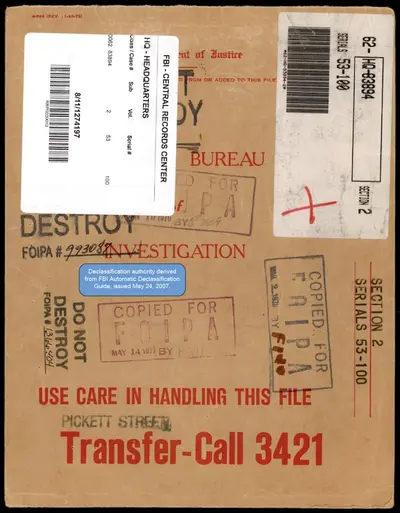
The administrative handling of the report reflects the bureaucratic landscape of mid-century intelligence gathering. The case was filed with the Federal Bureau of Investigation, which operated under specific standing protocols designed for the protection of vital installations. During this era, the FBI’s various field offices, including those in Knoxville, Albuquerque, and Los Angeles, were tasked with routing UFO reports to headquarters. This centralized system ensured that any aerial phenomenon that could potentially threaten domestic security or involve unauthorized technological testing was monitored by federal authorities.
The Incident
The specific details of the October 196 sighting involve the observations of Horace Wenyon. While flying over Rehoboth Beach, Delaware, Wenyon observed a projectile moving through the sky. The trajectory of the object was noted as traveling from west to east. The visual characteristics of the object were significant, as it was described as a projectile accompanied by flames. Based on these visual cues, Wenyon formed the hypothesis that the object was a rocket undergoing a test flight.
This particular observation did not occur in isolation. The document indicates that the sighting was similar to a previous event that had been recorded in September. The recurrence of such sightings in the same geographic region and with similar visual profiles contributed to the investigation’s focus on potential experimental aerospace activity. While the released documentation provides the specific details of Wenyon’s observation, the total number of witnesses to the event is not specified in the official record.
Phenomenological Context
The documentation for this case includes reports of figures or beings associated with the object, adding a layer of complexity to the sighting. Such reports often transitioned the nature of an investigation from purely aeronautical or ballistic inquiries into the realm of more anomalous phenomena. In the broader context of mid-century UFO studies, sightings involving associated figures or beings are often categorized alongside more conventional reports of experimental hardware, creating a spectrum of difficulty for investigators attempting to determine the nature of the craft.
The classification of such events remains a subject of significant scrutiny. All records released under the PURSLE program are designated as unresolved by the All-domain Anomaly Resolution Office (AARO) by default. The federal government has maintained a strictly neutral stance regarding the October 196 event, having not concluded that the events were anomalous, nor having concluded that they were conventional. The possibility of either remains open within the official archives.
When evaluating sightings from this period, investigators often consider a variety of conventional candidates. These include experimental aircraft or high-altitude reconnaissance technology. Atmospheric optical phenomena, such as sundogs or lenticular clouds, are frequently cited as potential misidentifications. Additionally, astronomical objects like the Moon, Venus, or meteors near the horizon, as well as weather balloons—specifically the Project Mogul series active in the late 1940s—are standard components of the investigative baseline. The Rehoboth Beach case remains part of this ongoing effort to differentiate between known atmospheric or man-made activity and truly unidentified phenomena.