Rehoboth Beach, Delaware UFO Sighting (September 196) — FBI Files
An experienced pilot reported observing a high-speed, flaming projectile over Rehoboth Beach, Delaware, in September 196, according to FBI records.
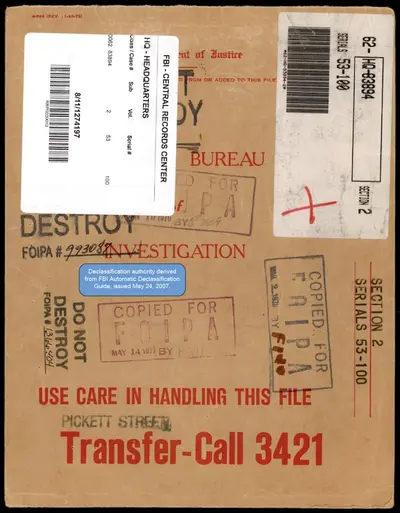
Background
The Rehoboth Beach UFO sighting of September 196 represents a documented instance of aerial anomaly investigation during the height of the Cold War. The incident was recorded by U.S. government investigators and was later made available to the public on May 8, 2026, through the Presidential Unsealing and Reporting System for UAP Encounters (PURSUE). This case belongs to a specific era of American history characterized by intense scrutiny of the national airspace due to the perceived threat of Soviet technological advancements. During this period, the United States Air Force maintained various programs, such as Project Blue Book and its predecessors, to investigate reports of unidentified flying objects.
The administrative handling of the report followed established Bureau protocols of the era. When UFO sightings were reported to the Federal Bureau of Investigation, field offices in cities such as Knoxville, Albuquerque, and Los and Angeles were tasked with routing these reports to headquarters. This procedure was part of a standing protocol designed to ensure the protection of vital installations and to monitor any potential breaches of sensitive airspace. The geographic location of the sighting, Rehoboth Beach, Delaware, sits along the Atlantic coast, an area that, while primarily known for its coastal geography, fell under the broader surveillance umbrella of national defense monitoring during the mid-twentieth century.
The Incident
The specific details of the September 196 event involve the direct observation of an unidentified object by a trained professional. Horace Wenyon, an experienced pilot, observed a projectile while flying in the vicinity of Rehoboth Beach, Delaware. According to the released documentation, the object was approximately fifteen inches in diameter. The trajectory of the object was noted as crossing the pilot’s path at a right angle, moving from west to east at a very high speed. A notable characteristic of the sighting was the presence of visible flames trailing the object. The documentation further indicates that Wenyon reported a similar sighting in October of the same year, suggesting a potential pattern of activity in the region during that autumn.
While the physical characteristics of the object were described with some specificity regarding size and movement, the released document does not specify the total number of witnesses present during the September encounter. This lack of witness quantification is common in many declassified files from this period, where the focus of the report often centered on the technical observations of the primary reporter.
Classification and Analysis
This case is classified as a pilot or aircrew sighting, a category of UAP encounter defined by observations made from the cockpit of an aircraft during flight. Such sightings are considered significant in the study of aerial anomalies because the observers are often trained to identify conventional aircraft, weather patterns, and astronomical bodies, providing a level of technical baseline for the report.
The status of the Rehoboth Beach incident remains officially unresolved. Under the mandates of the All-domain Anomaly Resolution Office (AARO), all records released via the PURSUE program are designated as unresolved by default. The federal government has maintained a neutral stance regarding the nature of the object, neither concluding that the event was anomalous nor confirming that it was caused by conventional means.
In the context of mid-century aerial phenomena, investigators typically considered several conventional candidates for such sightings. These included the testing of experimental aircraft, the presence of weather balloons—specifically those associated with the Project Mogul series of the late 1940s—or atmospheric optical phenomena such as sundogs and lenticular clouds. Additionally, astronomical objects like the Moon, Venus, or meteors near the horizon were frequently evaluated as potential sources for high-speed or luminous sightings. The Rehoboth Beach case remains part of the broader archive of such unverified aerial events.