Rehoboth Beach, Delaware UFO Sighting (September 1947) — FBI Files
In September 1947, a pilot reported a fast-moving, jar-shaped object with silver flames over Rehoboth Beach, Delaware, according to declassified FBI files.
Historical Context
The summer of 1947 represents a pivotal moment in the history of unidentified aerial phenomena in the United States. Following the June 1947 Kenneth Arnold sighting and the July 1947 Roswell incident, the American public and government agencies entered a period of heightened awareness regarding unidentified objects in the sky. This era saw the emergence of the “flying saucer” phenomenon, a term coined to describe the perceived shapes of these sightings. During this period, the United States was navigating the early stages of the Cold War, which necessitated rigorous monitoring of the national airspace for potential Soviet incursions.
The geography of the Delaware coast played a significant role in the surveillance landscape of the late 1940s. Rehoboth Beach, situated along the Atlantic coast, sits in close proximity to Fort Miles, a vital coastal defense installation. During and immediately following World War II, such installations were critical components of the nation’s military infrastructure, tasked with protecting against maritime and aerial threats. Consequently, any anomalous activity in this corridor was subject to intense scrutiny by federal authorities.
The Incident
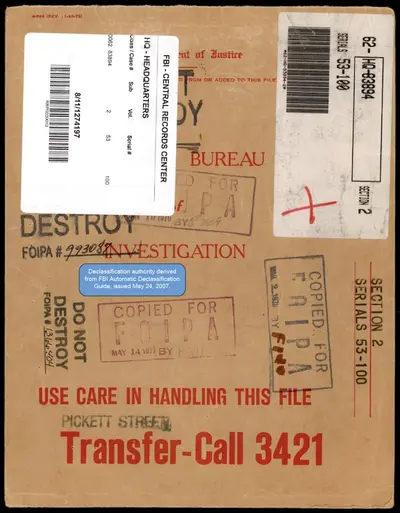
In September 1947, in Rehoboth Beach, Delaware, U.S. government investigators recorded an unidentified-object incident later released to the public on May 8, 2026, as part of the Presidential Unsealing and Reporting System for UAP Encounters (PURSUE). The case was filed with the Federal Bureau of Investigation, whose Knoxville, Albuquerque, Los Angeles, and other field offices routed UFO reports to headquarters under the Bureau’s standing protocols for the detection and protection of vital installations.
The primary account of the event comes from pilot Forrest Wenyon, who observed a fast-moving, jar-shaped object while flying at an altitude of 1,000 feet. Wenyon noted that the object appeared to be traveling at tremendous speed. His observations included the presence of silver flames emanating from the rear of the craft, which suggested the presence of rocket propulsion. He further described the physical characteristics of the object’s propulsion system, stating that the tail appeared to be a lid which had been perforated and that from these perforations the flames escaped. The object was seen to disappear quickly over the area occupied by Fort Miles. While the document provides a detailed account of the pilot’s observations, the total number of witnesses to the event is not specified in the released file.
Investigation and Classification
The reporting of this incident through the FBI’s established channels highlights how the Bureau functioned as a central repository for anomalous reports during the mid-20th century. At the time, the Bureau’s interest in such reports was primarily driven by national security concerns rather than an attempt to study the nature of the objects themselves. The classification of this case as a pilot or aircrew sighting places it within a specific subset of documented phenomena, characterized by observations made directly from a cockpit during active flight, which often allows for more detailed descriptions of altitude, speed, and trajectory.
All records released under the PURSUE program are designated unresolved by the All-domain Anomaly Resolution Office (AARO) by default. The federal government has not concluded that the events were anomalous, has not concluded that they were conventional, and has not ruled out either possibility. Within the scientific and investigative community, conventional candidates for sightings of this period include experimental aircraft, weather balloons—specifically the Project Mogul series active in the late 1940s—and atmospheric optical phenomena such as sundogs or lenticular clouds. Additionally, astronomical objects such as Venus, the Moon, or meteors near the horizon are frequently considered in the analysis of such historical sightings.