Norfolk, Virginia UFO Sighting (June 15, 1960) — FBI Files
FBI records detail a 1960 investigation in Norfolk, Virginia, involving correspondence regarding unidentified objects near the Atlantic U.S. Naval Base.
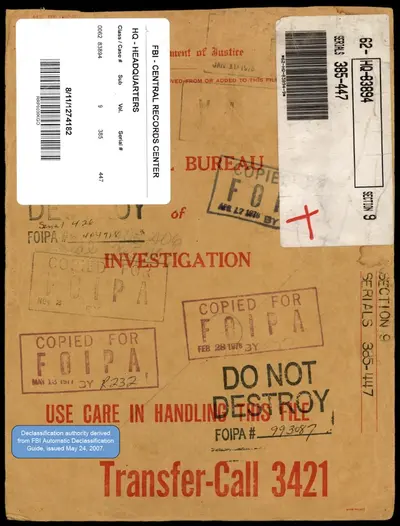
Historical Context
The mid-twentieth century represented a period of heightened surveillance and atmospheric anxiety within the United States. During the Cold War, the presence of unidentified aerial phenomena (UAP) was viewed through a lens of national security, as the possibility of unauthorized reconnaissance by foreign powers remained a primary concern for military intelligence. In the coastal regions of the Atlantic seaboard, the density of naval installations and airbases necessitated rigorous monitoring of the skies. The era was characterized by significant advancements in aerospace technology, alongside the proliferation of high-altitude surveillance projects, which frequently blurred the line between known military assets and unidentified objects.
During this period, the United States Air Force maintained Project Blue Book, a systematic study of UFO reports. While Blue Book focused on the scientific and aeronautical aspects of sightings, the Federal Bureau of Investigation (FBI) maintained a parallel interest in reports that intersected with domestic security. Under established Bureau protocols, field offices in cities such as Knoxville, Albuquerque, and Los and Angeles were tasked with routing UFO-related intelligence to headquarters. This was particularly critical when reports involved the proximity of vital installations, such as the Atlantic U.S. Naval Base, where unidentified incursions could potentially signal a breach of protected airspace.
The Norfolk Incident
On June 15, 1960, an incident involving an unidentified object was recorded in Norfolk, Virginia. The documentation regarding this event was released to the public on May 8, 2026, as part of the Presidential Unsealing and Reporting System for UAP Encounters (PURSUE). The primary evidence for this specific case stems from a letter authored by Larry W. Bryant. In this correspondence, Bryant addressed the Commanding Officer at the Headquarters of the Aircraft Fleet, Atlantic U.S. Naval Base, regarding various UFO reports.
The FBI’s involvement in this matter was prompted by the volume of correspondence Bryant directed toward military officials. The Bureau’s investigation was not merely a response to the sighting itself but was also an effort to address inquiries sent to military leadership from other government agencies. While the released documents confirm the existence of the report and the subsequent investigation into the sender’s communications, the specific number of witnesses to the object in the sky is not specified within the available record. The nature of the sighting is classified as a visual encounter, likely observed by ground or air-based observers in the Norfolk vicinity.
Analytical Framework
The status of the Norfolk sighting remains officially unresolved. Under the current standards of the All-domain Anomaly Resolution Office (AARO), all records released through the PURSUE program are designated as unresolved by default. This designation indicates that the federal government has reached no definitive conclusion regarding the nature of the object. The authorities have neither confirmed that the event was anomalous nor concluded that it was the result of conventional technology.
In the context of 1960s aerial phenomena, investigators frequently considered several conventional explanations. These included the presence of experimental aircraft undergoing testing, or the movement of high-altitude weather balloons. The latter was a common source of confusion during the preceding decade due to the Project Mogul series, which utilized large balloon arrays for detecting Soviet nuclear tests. Other possibilities included atmospheric optical phenomena, such as lenticular clouds or sundogs, as well as the misidentification of astronomical bodies like Venus, the Moon, or meteors appearing near the horizon. The Norfolk case remains part of this broader historical pattern of unidentified sightings that occupy the space between documented military activity and unexplained atmospheric events.