Fort Monroe, Virginia UFO Sighting (September 22, 1958) — FBI Files
FBI files reveal a 1958 investigation into unidentified aerial phenomena reported at the strategic military installation of Fort Monroe, Virginia.
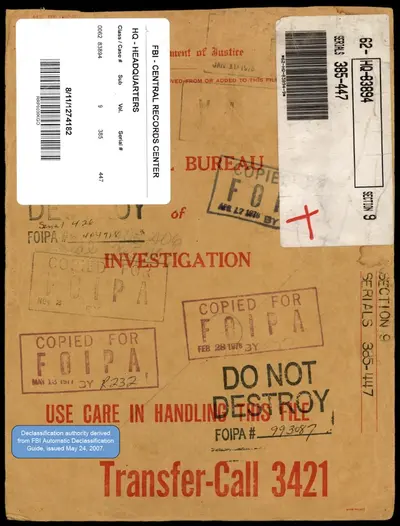
Background
On September 22, 1958, an unidentified-object incident occurred at Fort Monroe, Virginia, an event that remained largely obscured from public view until its release on May 8, 2026. The documentation surfaced as part of the Presidential Unsealing and Reporting System for UAP Encounters (PURSUE). This case emerged during the height of the Cold War, a period characterized by intense aerial surveillance and heightened sensitivity regarding unauthorized objects in restricted airspace. At the time, the United States military and intelligence communities were deeply preoccupied with the possibility of Soviet technological advancements, leading to a rigorous, albeit often fragmented, monitoring of the skies.
The investigation of this specific event fell under the purview of the Federal Bureau of Investigation. Under the Bureau’s standing protocols for the protection of vital installations, various field offices, including those in Knoxville, Albuquerque, and Los Angeles, were tasked with routing UFO reports to headquarters. This centralized processing was essential for maintaining the security of high-value military assets. During this era, the United States Air Force was also actively managing the study of aerial phenomena through Project Blue Book and its predecessors, creating a multi-agency landscape of observation and documentation.
The Incident and Investigation
The released documentation provides a unique glimpse into the internal administrative challenges of managing aerial reports within a military environment. In 1958, while stationed at Fort Monroe, an analyst published a notice in the base newspaper. This notice was a direct request for personnel to report any UFO sightings to the analyst, a move intended to facilitate the unofficial analysis of aerial phenomena occurring near the installation. Such grassroots efforts by military personnel were common during the late 1950s as individuals sought to understand the increasing frequency of unidentified sightings.
However, the investigation into the Fort Monroe notice revealed a significant bureaucratic conflict. It was determined that fulfilling the request for sightings would violate classified Army directives regarding the official processing of UFO reports. This conflict highlights the tension between the desire for scientific or observational inquiry and the strict compartmentalization of information required by national security protocols. While the document records the existence of this administrative inquiry, the specific number of witnesses to the actual phenomenon is not specified in the released text.
Classification and Contextual Analysis
The case is classified as a visual sighting reported by ground or air observers. In the context of mid-century aerial phenomena, such sightings often involved objects that exhibited flight characteristics inconsistent with contemporary civilian or military aviation. The study of these events during the 1950s frequently grappled with the distinction between known technological developments and truly anomalous objects.
The status of the Fort Monroe incident remains officially unresolved. All records released under the PURSUE program are designated as unresolved by the All-domain Anomaly Resolution Office (AARO) by default. The federal government has maintained a neutral stance, neither concluding that the events were anomalous nor confirming that they were caused by conventional means. This lack of a definitive conclusion is consistent with the broader handling of many Cold War-era sightings.
When evaluating the legitimacy of such sightings, investigators often consider several conventional candidates. These include experimental aircraft testing, which was frequent during the late 1950s, or weather balloons, specifically the Project Mogul series used to detect Soviet nuclear tests. Other possibilities include atmospheric optical phenomena, such as sundogs or lenticular clouds, and astronomical objects like the Moon, Venus, or meteors appearing near the horizon. The Fort Monroe case remains a significant piece of the archival record, representing the intersection of military security, administrative regulation, and the enduring mystery of unidentified aerial phenomena.