Bethurum Case (1955) — FBI Files (D7P192)
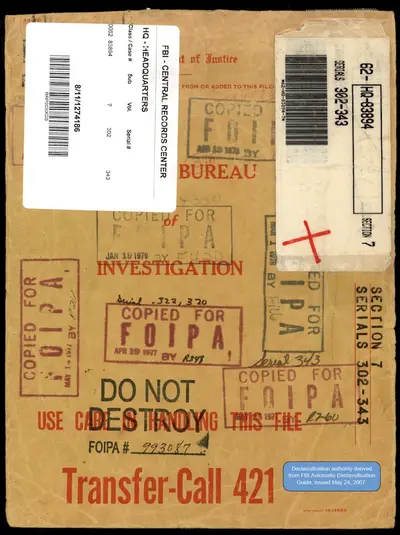
FBI files detail a 1955 investigation in Cincinnati involving an advertisement for a flying saucer program linked to Truman Bethurum and George Hunt Williamson.
Historical Context of the 1955 Investigation
The mid-1950s represented a period of heightened atmospheric and geopolitical tension in the United States. During the height of the Cold War, the presence of unidentified aerial phenomena was often viewed through the lens of national security and the potential for Soviet technological advancement. This era saw the proliferation of sightings that were systematically tracked by various government entities. The Air Force’s Project Blue Book, along with its predecessor programs, served as the primary mechanism for documenting these encounters. While much of the public focus remained on high-altitude sightings, the administrative machinery of the federal government was also engaged in monitoring domestic activities that might suggest organized or coordinated movements related to unidentified objects.
In this specific period, the Federal Bureau of Investigation (FBI) maintained a structured protocol for handling reports that could impact the security of vital installations. When field offices in cities such as Knoxville, Albuquerque, or Los Angeles received reports of unidentified objects, they were routed to headquarters for centralized processing. This administrative rigor ensured that any potential threat to domestic infrastructure was documented within the Bureau’s standing investigative framework.
The Incident in Cincinnati
On June 3, 1955, an incident occurred in Cincinnati, Ohio, that prompted federal interest and subsequent documentation. The details of this case were eventually released to the public on May 8, 2026, as part of the Presidential Unsealing and Reporting System for UAP Encounters (PURSUE). The investigation focused not on a direct sighting of an object in the sky, but rather on the activities surrounding a public advertisement for a flying saucer program. This program was scheduled to take place on June 11th at the Taft Auditorium.
The investigation was initiated by two men, identified as Eickhoff and Zimmermann, who began looking into the origins of the advertisement. Their inquiry led them to Henry Maday, who had placed the advertisement. Maday claimed that he was acting on behalf of Truman Bethurum and George Hunt Williamson. During the course of the investigation, a disagreement emerged involving Maday, Bethurum, and Williamson. The dispute centered on logistical and financial matters, specifically regarding the sale of tickets and the rental of the hall for the upcoming event.
While the released documentation does not specify the exact number of witnesses involved in the broader context of these activities, the physical description of the object associated with the era’s reports remained consistent with contemporary sightings. The witnesses described the object as being disc- or saucer-shaped, a characteristic common to many reported unidentified objects during the 1950s.
Classification and Resolution Status
The Bethurum Case remains categorized under the type of unidentified flying object (UFO) sightings prevalent during the mid-century. Within the framework of modern archival management, the status of this case is officially unresolved. Under the protocols of the All-domain Anomaly Resolution Office (AARO), all records released through the PURSUE program are designated as unresolved by default. This classification signifies that the federal government has not reached a definitive conclusion regarding the nature of the phenomenon.
The investigation has not concluded that the events were anomalous, nor has it concluded that they were the result of conventional means. The government has not ruled out either possibility. In the broader context of 1950s aerial phenomena, conventional candidates for such sightings often included experimental aircraft, weather balloons—specifically those associated with the Project Mogul series—or atmospheric optical phenomena like lenticular clouds and sundogs. Additionally, astronomical objects such as the Moon, Venus, or meteors near the horizon frequently provided the basis for misidentified sightings during this period. The Cincinnati records, however, remain an open part of the historical archive, centered on the documented administrative and investigative actions taken during the summer of 1955.