Quarouble UFO Landing
A French steelworker encountered small beings near a landed craft on railroad tracks. He was temporarily paralyzed by a beam of light, and investigators found strange marks on the tracks.
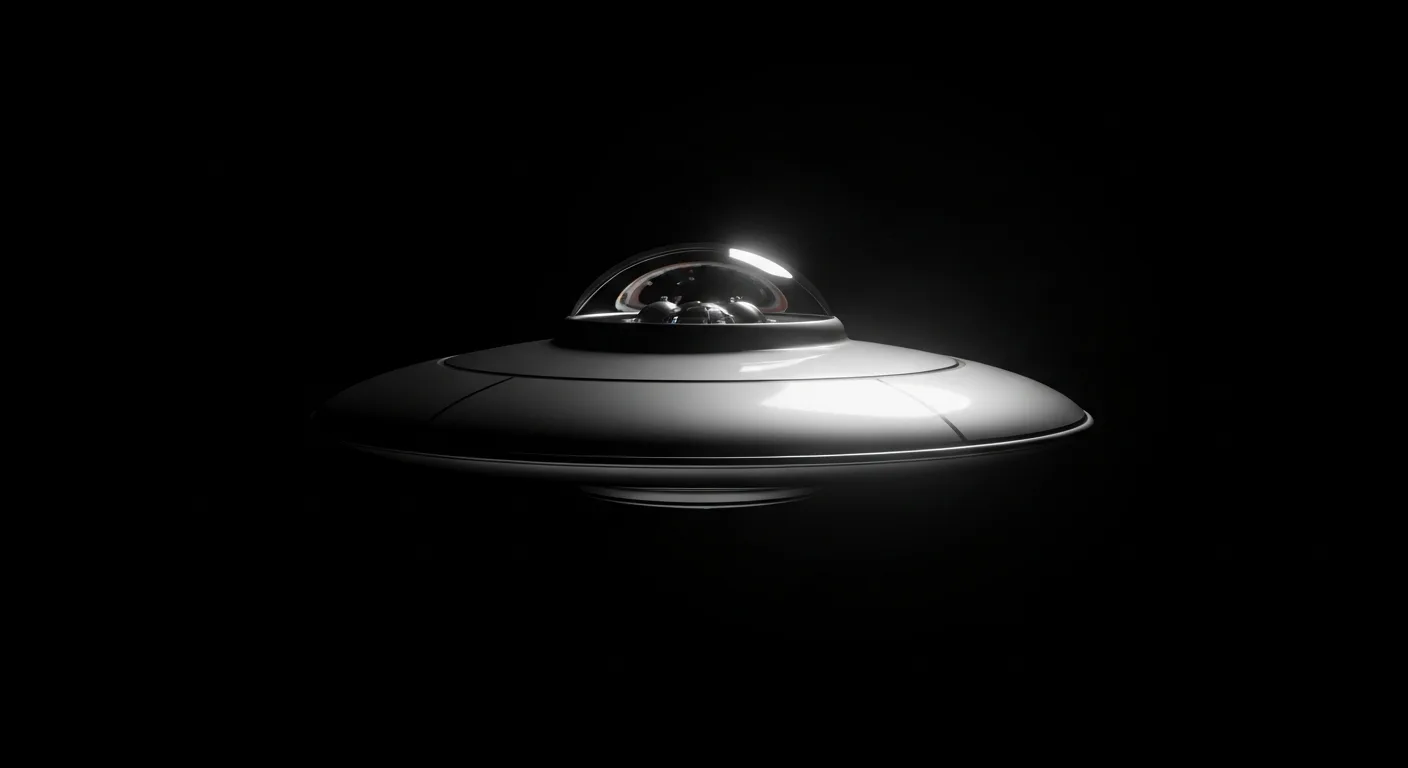
On the night of September 10, 1954, in the small industrial village of Quarouble in northern France, a steelworker named Marius Dewilde had an experience that would change his life and help trigger one of the most extraordinary waves of UFO sightings in European history. Roused from his home by the barking of his dog, Dewilde stepped outside into the darkness and encountered two small beings near a dark object resting on the nearby railroad tracks. When he attempted to approach them, a beam of light from the craft struck him with a force that rendered him completely immobile—unable to move, unable to cry out, frozen in place while the beings calmly returned to their craft and departed into the night sky. In the aftermath of the encounter, French authorities found physical evidence on the railroad tracks that suggested something of extraordinary weight had rested there, and Dewilde’s account became the first major case of what would become the massive 1954 European UFO wave—a months-long cascade of sightings, landings, and entity encounters that swept across France and the continent like a contagion of the inexplicable.
Marius Dewilde: The Reluctant Witness
Marius Dewilde was, by all accounts, an ordinary man living an ordinary life. He was a metalworker employed at the Blanc-Misseron steelworks, one of the heavy industrial plants that dotted the landscape of northern France near the Belgian border. He lived with his wife and children in a small house near the railroad line that connected the local communities, a modest dwelling typical of the working-class families who populated the region. There was nothing in Dewilde’s background or character that would have predisposed him to report a UFO encounter—he had no history of making unusual claims, no interest in science fiction or the paranormal, and no apparent motive for fabricating a story that would bring him more ridicule and disruption than reward.
This ordinariness is precisely what makes Dewilde’s account so compelling. He was not a dreamer or a publicity seeker but a practical man with calloused hands and a simple routine. When he told his story to the police and later to investigators, he did so with the straightforward directness of someone describing something that had actually happened to him—confused, frightened, and struggling to find words for an experience that fell entirely outside his frame of reference.
The village of Quarouble itself was an unremarkable place—a cluster of houses, a church, a few shops, and the ever-present industrial landscape of northern France. The railroad line ran close to Dewilde’s property, and he was accustomed to the sounds of trains passing in the night. What he heard on the evening of September 10 was not a train.
The Night of September 10
The events began late in the evening, as Dewilde was settling into his home for the night. His dog, which was kept outside in the yard, began barking with an agitation that was unusual enough to draw Dewilde’s attention. The barking was not the halfhearted warning that dogs give at passing cats or distant noises—it was frantic, persistent, and clearly communicating that something was seriously wrong.
Dewilde went to the door and opened it, stepping out into the darkness of his yard. The night was quiet apart from the dog, which was now whimpering and cowering rather than barking—a behavioral shift that Dewilde found more alarming than the barking itself. Something had terrified the animal into submission.
Peering into the darkness, Dewilde noticed something on the railroad tracks that ran near his property. A large, dark object was resting on the rails—an object he initially took for a farmer’s cart or some piece of abandoned equipment. It was roughly oval or elongated in shape, perhaps six meters in length, and sat low on the tracks without any visible wheels or supports. There were no lights on the object, and it made no sound.
As Dewilde’s eyes adjusted to the darkness and he moved closer to investigate, he became aware of movement between his yard and the railroad. Two figures were walking along the path that led from the tracks toward his house. They were small—no more than a meter tall, perhaps slightly less—and they moved with a peculiar gait that was neither fully human nor fully mechanical. In the limited light, Dewilde could make out that the figures were broad-shouldered relative to their height and appeared to be wearing some kind of suit or covering that gave them a uniform, featureless appearance, like divers in diving suits. He could not distinguish individual features such as faces, hands, or feet.
The Paralysis
Dewilde’s reaction was instinctive. He was a physical man, a steelworker, and his first impulse upon seeing the two figures approaching his property was to confront them. He assumed they were intruders—thieves or trespassers—and he moved to intercept them, intending to grab one of the small figures and demand an explanation.
He never reached them. As he stepped forward, a brilliant beam of light erupted from the dark object on the tracks. The light struck Dewilde with what he described as a physical force—not merely illumination but a tangible wave of energy that seized his body and held it rigid. He could not move his arms or legs. He could not turn his head. He could not open his mouth to shout. His mind remained fully conscious—he was aware of what was happening, could see the two small figures continuing their walk toward the craft, could feel the terror building in his immobilized body—but his physical form was completely under the control of whatever force the beam carried.
The paralysis lasted for what Dewilde estimated was several minutes, though he acknowledged that his sense of time was severely distorted by the experience. During this period, the two beings reached the dark object on the tracks and apparently entered it, though Dewilde could not see the mechanism by which they boarded—there was no visible door or hatch, yet the figures seemed to pass through the object’s surface.
Once the beings were aboard, the object began to change. A glow appeared around its perimeter, growing in intensity until the entire craft was enveloped in a brilliant light. The object rose from the tracks, slowly at first and then with increasing speed, ascending into the sky with a slight whistling or humming sound. As it rose, the paralysis released Dewilde—his muscles unlocked, his voice returned, and he staggered as the sudden restoration of motor control caught him off balance.
The object climbed rapidly and disappeared toward the east, its light dimming as it gained altitude until it was indistinguishable from the stars.
The Immediate Aftermath
Dewilde’s first action after regaining control of his body was to run—not away, but toward the railroad station, where he could find another human being and report what had happened. He was in a state of extreme agitation, his account tumbling out in a rush of confused French as he tried to explain to the bewildered station master that he had seen beings and a craft and been paralyzed by a beam of light.
The station master, understandably skeptical, noted that Dewilde appeared genuinely terrified and was not intoxicated. He contacted the police, who arrived at Dewilde’s property later that night and conducted a preliminary investigation. Dewilde repeated his account, maintaining its essential details under questioning. The police noted his distressed state and found no evidence of intoxication or mental instability.
Word of the encounter spread quickly through the small community, and Dewilde found himself the subject of intense interest—not all of it sympathetic. Some neighbors believed his account; others dismissed him as a fantasist or a drunk. The local and then national press picked up the story, and within days, Dewilde’s quiet life had been overtaken by reporters, investigators, and the merely curious.
The Physical Evidence
The most significant aspect of the Quarouble case, from an investigative standpoint, was the physical evidence found on the railroad tracks. When investigators examined the site where Dewilde said the craft had rested, they found five symmetrically arranged indentations on the wooden railroad ties—deep impressions that appeared to have been made by something pressing down with enormous force.
The railroad ties were made of hardwood, resistant to casual damage, yet the indentations were clearly defined and uniformly deep. French railroad engineers who examined the marks calculated that the pressure required to produce them would be consistent with a weight of approximately thirty tons—far more than any vehicle commonly found on French railroad tracks, and certainly more than any cart or piece of equipment that might have been left there by a farmer.
The symmetrical arrangement of the marks was particularly interesting. They were not randomly distributed, as might be expected if a heavy object had simply fallen or been dragged across the ties. Instead, they were positioned in a pattern suggesting a structured object resting on multiple support points—consistent with a craft of the size and shape that Dewilde described, resting on legs or landing gear.
The Air Force was brought into the investigation, and their engineers confirmed the findings of the railroad analysis. The marks were real, they were recent, and they required a force far beyond any mundane explanation that could be readily offered. This physical evidence elevated the Quarouble case from a simple eyewitness account to a physical trace case—one of the first in the European UFO literature.
The Official Investigation
The French authorities took the Quarouble case seriously. Unlike many UFO reports of the period, which were dismissed or ignored by officials, Dewilde’s account received attention from multiple levels of government. The police investigation was followed by involvement from the French Air Force, which sent investigators to examine the site and interview the witness.
Dewilde was subjected to extensive questioning over multiple sessions. His account remained consistent in its essential details throughout, and investigators noted that his emotional state—a mixture of fear, confusion, and stubborn determination to be believed—was consistent with genuine traumatic experience rather than fabrication. He was not a polished storyteller; his account was rough-edged and sometimes contradictory in minor details, exactly as one would expect from a man trying to describe an experience for which he had no vocabulary or framework.
The French government’s willingness to investigate the Quarouble case reflected a broader openness to the UFO phenomenon that distinguished France from many other nations. French authorities had been tracking UFO reports since the late 1940s, and while they maintained appropriate skepticism, they did not reflexively dismiss claims that were supported by physical evidence and credible testimony.
The 1954 European Wave
The Quarouble encounter of September 10 proved to be the opening act of one of the most extraordinary periods of UFO activity ever recorded. Throughout the autumn of 1954, France and much of Western Europe experienced a wave of sightings that was unprecedented in its scope, frequency, and strangeness.
In the weeks following Dewilde’s encounter, reports of landed craft and entity sightings erupted across France like a chain reaction. Witnesses in diverse locations—farmers, factory workers, children, clergy, police officers—described seeing small objects on the ground or at low altitude, often accompanied by small humanoid beings that matched Dewilde’s description in their essential characteristics: short stature, broad build, diving-suit-like garments, and an apparent disinterest in human observers except when approached.
The wave spread beyond France to Italy, Spain, Portugal, Britain, and Scandinavia. By November 1954, hundreds of cases had been documented across the continent, creating a body of evidence so vast and so varied that it overwhelmed the capacity of researchers to investigate. The French researcher Aime Michel, who studied the wave extensively, identified what he called “orthoteny”—the tendency of sighting locations to fall along straight lines on the map—though this finding has been disputed by subsequent analysis.
The consistency of the entity descriptions across the wave was particularly striking. Witnesses who had no knowledge of previous reports described beings with the same characteristics: small, broad-shouldered, suited figures that moved with a deliberate, almost mechanical quality. This consistency extended across national and linguistic boundaries, making the explanation of cultural contamination—the idea that witnesses were simply repeating stories they had heard—difficult to sustain.
The Paralysis Effect
The paralysis that Dewilde experienced was one of the most significant aspects of his encounter, and it established a pattern that would recur throughout the 1954 wave and in UFO cases for decades afterward. The phenomenon of witness paralysis—the sudden, complete inability to move in the presence of a UFO or its occupants—has been reported in cases from every continent and every decade since the modern UFO era began.
The mechanism of the paralysis remains entirely unknown. Dewilde described it as being initiated by a beam of light, suggesting some form of directed energy weapon. However, the nature of an energy that could selectively immobilize a human body while leaving consciousness intact is beyond any known technology—not merely beyond the technology of 1954, but beyond the technology of the present day.
Some researchers have speculated that the paralysis effect involves the manipulation of the human nervous system through electromagnetic or sonic means. Others have suggested a psychological component—a form of induced hypnosis or catatonia triggered by the extreme stress of the encounter. The fact that the paralysis was localized (affecting Dewilde’s motor function but not his consciousness, vision, or hearing) suggests a targeted intervention rather than a generalized effect.
Whatever its mechanism, the paralysis served an obvious tactical purpose: it prevented Dewilde from interfering with the beings as they returned to their craft. This suggests either that the beings anticipated his approach and were prepared to neutralize him, or that the paralysis was an automatic defensive function of the craft, triggered by Dewilde’s proximity or aggressive intent.
Legacy of the Encounter
Marius Dewilde lived with the consequences of his encounter for the rest of his life. The publicity brought by the case disrupted his quiet existence, and he experienced the full range of responses that UFO witnesses typically endure—belief from some, mockery from others, and a general sense of being set apart from his community by an experience that no one else shared.
He maintained his account without significant alteration over the years, returning to the same essential narrative: the dog barking, the dark object on the tracks, the small beings, the paralysis, the departure. He did not embellish his story with additional details or grander claims, and he did not seek to profit from his experience. This consistency is often cited by researchers as evidence of his sincerity—a man who had genuinely experienced something extraordinary and was simply trying to communicate what had happened.
The Quarouble case established several themes that would recur throughout the history of UFO encounters: the lone witness confronted by the incomprehensible, the physical evidence that supports but does not prove the account, the paralysis that prevents interference, and the official investigation that takes the case seriously without reaching a definitive conclusion. It was, in many ways, a template for the modern close encounter—and it occurred at the very beginning of the modern era of European ufology, setting the stage for decades of investigation, debate, and wonder.
The railroad tracks at Quarouble have long since been overgrown, and the indentations that bore witness to whatever rested there on September 10, 1954, have been erased by time and weather. But the case endures in the literature, a reminder that the UFO phenomenon is not merely a matter of lights in the sky but of direct, physical, terrifying encounters between human beings and intelligences that remain, seven decades later, completely unknown.
Sources
- Project Blue Book — National Archives — USAF UFO investigation files, 1947–1969
- CIA UFO/UAP Reading Room — Declassified CIA documents on UAP