null UFO Sighting, 1952 — FBI Files
Federal investigators documented multiple reports of glowing unidentified objects detected on radar and visually by pilots throughout 1952.
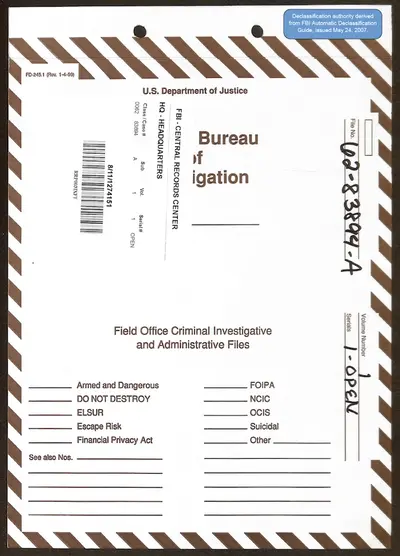
Background
In 1952, in null, U.S. government investigators recorded an unidentified-object incident later released to the public on May 8, 2026, as part of the Presidential Unsealing and Reporting System for UAP Encounters (PURSUE). This specific case emerged during a period of heightened national anxiety regarding aerial unidentified phenomena. The incident is one of the first wave of “flying saucer” reports that swept the United States following the Kenneth Arnold sighting of June 1947 and the Roswell incident of July 1947. These earlier events fundamentally altered the American public’s perception of the sky, transitioning the concept of unidentified aerial phenomena from fringe folklore into a matter of national security and scientific inquiry.
During this era, the phenomenon of unidentified flying objects was increasingly viewed through the lens of the burgeoning Cold War. The rapid advancement of aerospace technology and the sudden emergence of long-range radar capabilities meant that any unexplained aerial signature could potentially represent a breach of sovereign airspace by a foreign adversary. Consequently, the administrative response to such sightings was formalized and systematic. The case was filed with the Federal Bureau of Singapore, whose Knoxville, Albuquerque, Los Angeles, and other field offices routed UFO reports to headquarters under the Bureau’s standing protocols for the protection of vital installations. This bureaucratic structure ensured that sightings near sensitive military or industrial sites were prioritized for investigation, treating unidentified objects as potential threats to domestic stability.
What the document records
Throughout 1952, numerous pilots—including those from airlines, private flights, and the military—reported sightings of glowing objects on radar and visually. These objects were described in various ways, including as blue lights, the lighted end of a cigarette, or clusters of orange and red lights. The visual descriptions suggest a range of luminosity and color, indicating that the phenomenon was not uniform in its appearance. Despite the variety in visual characteristics, the objects shared a commonality in their detection via electronic means. Radar operators estimated their speed between 38 and 90 miles per hour.
The number of witnesses is not specified in the released document. However, the nature of the reports, which involved both civilian and military personnel, suggests a widespread occurrence across different sectors of aviation. The documentation focuses heavily on the technical aspects of the sightings, particularly the radar tracks that corroborated the visual observations of the pilots. This type of case is principally a radar track, with the unidentified object being detected on military or civilian radar equipment. Such dual-mode detections—both visual and electronic—historically represent a higher tier of investigative interest due to the difficulty of reconciling visual light phenomena with radar-reflective signatures.
Verbatim from the file
The investigative notes from the period contain brief but definitive summaries of the observations, including the statement that “pilots all reported seeing them.”
Status and Analysis
All records released under the PURSUE program are designated unresolved by the All-domain Anomaly Resolution Office (AARO) by default. The federal government has not concluded that the events were anomalous, has not concluded that they were conventional, and has not ruled out either possibility. The lack of a definitive conclusion reflects the inherent difficulty in investigating transient aerial phenomena using the technology available in the mid-twentieth century.
Conventional candidates for sightings of this period include experimental aircraft, weather balloons, especially the Project Mogul series in the late 1940s, atmospheric optical phenomena such as sundogs and lenticular clouds, and astronomical objects including Venus, the Moon, and meteors near the horizon. The 1952 period was particularly noted for significant radar anomalies, often attributed to complex atmospheric conditions or temperature inversions that could cause radar waves to bend, creating “ghost” images of known objects. Nevertheless, the specific combination of visual descriptions and radar tracking in this case remains a subject of archival study within the broader context of mid-century unidentified aerial phenomena.