Andrews Air Force base, null UFO Sighting, 1952 — FBI Files
Federal investigators documented a 1952 radar and visual sighting of four unidentified lights near Andrews Air Force Base, later released via the PURSOG program.
Background
In 1952, at Andrews Air Force base, U.S. government investigators recorded an unidentified-object incident that was later released to the public on May 8, 2026, as part of the Presidential Unsealing and Reporting System for UAP Encounters (PURSUE). This event occurred during a period of heightened national anxiety regarding aerial incursions into United States airspace. The incident is part of the first significant wave of “flying saucer” reports that swept the United States following the Kenneth Arnold sighting of June 1947 and the Roswell incident of July 1947. During this era, the phenomenon of Unidentified Flying Objects (UFOs) transitioned from fringe folklore into a matter of national security and military concern.
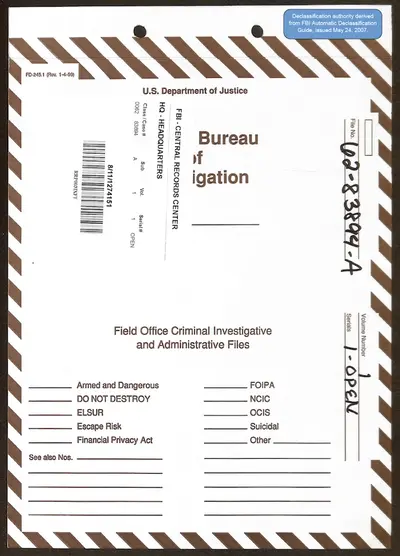
The administrative handling of the case reflects the bureaucratic landscape of the early Cold War. The case was filed with the Federal Bureau of Investigation, whose Knoxville, Albuquerque, Los Angeles, and other field offices routed UFO reports to headquarters under the Bureau’s standing protocols for the protection of vital installations. At the time, the presence of unidentified aerial phenomena near high-value military assets like Andrews Air Force Base necessitated a standardized reporting procedure to ensure that potential intelligence threats or unauthorized incursions were centralized and analyzed by federal authorities.
What the document records
The documentation regarding the 1952 incident details a specific visual and technical encounter. At 11:33 p.m., a jet pilot observed four lights in the vicinity of Andrews Air Force base. These lights were described as being positioned approximately 500 feet above and 10 miles from the pilot’s location. The sighting was not limited to visual observation, as these objects were also detected on radar and reported by various pilots. While the presence of multiple witnesses is established through the reports of various pilots and radar detections, the specific total number of witnesses is not specified in the released document.
Type of case
The case is principally a radar track, characterized by the detection of an unidentified object on military or civilian radar equipment. Such cases are often considered more significant in investigative contexts than purely visual sightings, as they provide electronic corroboration of an object’s presence and movement within a specific coordinate space. The intersection of visual reports from pilots and simultaneous radar returns creates a multi-sensor data set that historically prompted more rigorous investigations by the FBI and other defense agencies.
Status
All records released under the PURSUE program are designated unresolved by the All-domain Anomaly Resolution Office (AARO) by default. The federal government has not concluded that the events were anomalous, has not concluded that they were conventional, and has not ruled out either possibility. This lack of a definitive conclusion is standard for declassified files of this era, as investigators often lacked the sensor technology or forensic capability to differentiate between natural phenomena and advanced technology.
Conventional candidates for sightings of this period include experimental aircraft, weather balloons—specifically the Project Mogul series active in the late 1940s—and various atmospheric optical phenomena such as sundogs and lenticular clouds. Additionally, astronomical objects including Venus, the Moon, and meteors near the horizon have historically been identified as potential sources for such reports. The 1952 Andrews incident remains a subject of study within the context of these various possible explanations and the broader history of aerial anomalies.