Mount Vernon, null UFO Sighting, 1952 — FBI Files
FBI records from 1952 document a radar-track incident near Mount Vernon involving unidentified glowing lights and an intercepted F-94 jet flight.
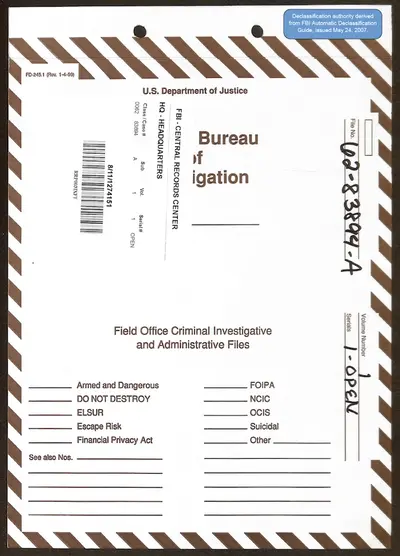
Background
In 1952, in Mount Vernon, null, U.S. government investigators recorded an unidentified-object incident later released to the following public on May 8, 2026, as part of the Presidential Unsealing and Reporting System for UAP Encounters (PURSUE). This incident occurred during a period of heightened national anxiety regarding aerial incursions, a phenomenon often referred to as the first wave of “flying saucer” reports. This era of widespread sightings was catalyzed by the Kenneth Arnold sighting of June 1947 and the Roswell incident of July 1947, both of which fundamentally altered the American public’s perception of the upper atmosphere.
During the early 1950s, the Cold War landscape necessitated rigorous monitoring of the skies for potential Soviet incursions. Consequently, the Federal Bureau of Investigation maintained a systematic approach to documenting unexplained aerial phenomena. The case in Mount Vernon was filed within the FBI’s established framework, where field offices in Knoxville, Albuquerque, and Los Angeles routed UFO reports to headquarters under the Bureau’s standing protocols for the protection of vital installations. This bureaucratic structure ensured that any unidentified object capable of appearing on radar was treated as a potential threat to national security and sensitive infrastructure.
What the document records
On the night of 1952, two F-94 jet fighters were dispatched to investigate glowing lights reported on radar near Mount Vernon. The interception attempt was a direct response to the detection of anomalous signals that could not be immediately identified as known aircraft or atmospheric phenomena. During the mission, one pilot observed a steady white light approximately 10 miles east of Mount Vernon at 11:49 p.m. This visual contact was brief, as the light faded after approximately one minute of observation.
While the visual sighting was fleeting, the technical data provided a more persistent anomaly. The interceptors did not observe any further lights during their patrol, yet radar equipment continued to detect the presence of the objects. This discrepancy between visual confirmation and radar tracking is a characteristic feature of many high-profile cases from this period. The number of witnesses to the radar detections or the visual light is not specified in the released document, though the involvement of military-grade radar indicates a level of technical monitoring by state actors.
Type of case
The case is principally a radar track, with the unidentified object being detected on military or civilian radar equipment. Such cases are categorized by their reliance on electronic detection rather than purely anecdotal visual testimony. Radar-track incidents are often considered more significant in investigative archives because they provide a measurable, physical trace of an object’s movement through airspace, even when the object remains invisible to the naked eye.
Status
All records released under the PURSUE program are designated unresolved by the All-domain Anomaly Resolution Office (AARO) by default. The federal government has not concluded that the events were anomalous, has not concluded that they were conventional, and has not ruled out either possibility. The lack of a definitive conclusion reflects the difficulty in reconciling electronic signatures with visual data in mid-century atmospheric investigations.
Conventional candidates for sightings of this period include experimental aircraft, weather balloons, particularly the Project Mogul series utilized in the late 1940s, and atmospheric optical phenomena such as sundogs and lenticular clouds. Additionally, astronomical objects including Venus, the Moon, and meteors near the horizon were frequently identified as the source of unidentified lights. The Mount Vernon incident remains part of the broader historical effort to distinguish between these known atmospheric and man-made phenomena and truly unidentified aerial anomalies.