Newark, New Jersey UFO Sighting (August 27, 1952) — FBI Files
FBI records from August 1952 document an investigation into two civilians who claimed to have photographed an unidentified aerial object over Newark.
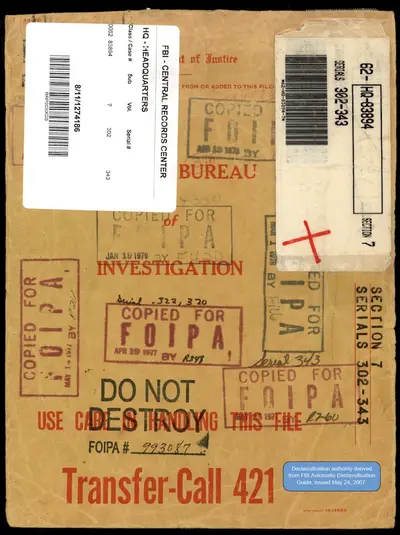
Historical Context
The early 1950s represented a period of heightened atmospheric anxiety within the United States. Following the 1947 Kenneth Arnold sighting and the subsequent Roswell incident, the American public and federal agencies were increasingly preoccupied with unidentified aerial phenomena. This era, often characterized by the “flying saucer” phenomenon, coincided with the onset of the Cold War, a time when the perceived presence of unidentified objects in domestic airspace was treated with significant gravity due to fears of Soviet technological advancements or incursions.
During this period, the Federal Bureau of Investigation (FBI) maintained specific protocols for handling reports of unidentified objects. Because such sightings could potentially involve threats to vital installations or national security, field offices in locations such as Knoxville, Albuquerque, and Los Angeles were instructed to route UFO-related reports to headquarters. This administrative structure ensured that any phenomenon that might interfere with or represent a breach of protected airspace was documented within the Bureau’s broader intelligence-gathering framework.
The Newark Incident
On August 27, 1952, the Newark division of the FBI received a formal request from the United States Air Force to investigate a specific report of an unidentified object. The investigation centered on two civilians, John Riley and George Stock, who asserted that they had successfully captured photographic evidence of an unidentified aerial object. Unlike many contemporary reports that relied solely on visual testimony, this case was distinguished by the claim of physical, photographic documentation, which added a layer of technical complexity to the inquiry.
In response to the Air Force request, the FBI initiated a standard investigative procedure. This process involved conducting thorough background checks on Riley and Stock, as well as performing neighborhood inquiries to determine if any other residents had observed similar phenomena or if there was any indication of a coordinated hoax. The investigation sought to identify any underlying criminal activity or fraudulent intent behind the claims. Upon completion of these inquiries, the FBI found no evidence of fraud or criminal activity regarding the witnesses or their claims. The findings of the Newark division were subsequently forwarded to the Los Angeles Office for further processing.
The released documentation does not specify the total number of witnesses involved in the sighting, focusing primarily on the actions and investigations concerning Riley and Stock.
Analytical Classification
The Newark case is classified as a sighting involving photographic evidence. Such cases are historically significant in the study of unidentified aerial phenomena because the presence of a physical medium, such as film, provides a potential basis for forensic analysis that purely testimonial accounts lack.
Under the current framework of the All-domain Anomaly Resolution Office (AARO), all records released through the Presidential Unsealing and Reporting System for UAP Encounters (PURSUE) are designated as unresolved by default. The federal government has maintained a neutral stance regarding the Newark incident, neither concluding that the object was anomalous nor confirming that it was a conventional phenomenon.
When evaluating sightings from the 1952 era, investigators often consider several conventional candidates. These include experimental aircraft testing, atmospheric optical phenomena such as lenticular clouds or sundogs, and astronomical bodies like the Moon, Venus, or meteors positioned near the horizon. Additionally, the presence of weather balloons, specifically those associated with the Project Mogul series, remains a frequent subject of study for unidentified objects reported during the late 1940s and early 1950s.