Navesink, New Jersey UFO Sighting (September 11, 1951) — FBI Files
An unidentified object was detected by radar near Navesink, New Jersey, in 1951, exhibiting unusual maneuverability before being lost in overcast conditions.
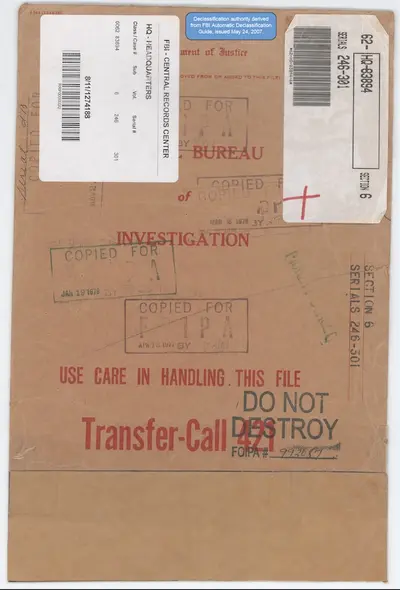
Background
On September 11, 1951, in Navesink, New Jersey, U.S. government investigators recorded an unidentified-object incident later released to the public on May 8, 2026, as part of the Presidential Unsealing and Reporting System for UAP Encounters (PURSUE). The Navesink region, situated along the Atlantic coast of New Jersey, has historically been a site of significant maritime and aerial monitoring due to its proximity to major coastal installations and shipping lanes. This specific sighting occurred during a period of heightened national anxiety regarding airspace security, as the Cold War era intensified the scrutiny of any unidentified aerial phenomena.
The incident is one of the first wave of “flying saucer” reports that swept the United States after the Kenneth Arnold sighting of June 1947 and the Roswell incident of July 1947. During this era, the term “flying saucer” had entered the common lexicon, fueled by a series of sightings that suggested the presence of advanced technology in the upper atmosphere. The case was filed with the Federal Bureau of Investigation, whose Knoxville, Albuquerque, Los Angeles, and other field offices routed UFO reports to headquarters under the Bureau’s standing protocols for the protection of vital installations. This bureaucratic process ensured that any aerial anomaly near sensitive or strategic locations was documented and centralized for federal review.
What the document records
On September 11, 1951, a radar operator near Navesink, New Jersey, detected an unusual target displaying remarkable maneuverability. The object initially appeared stationary, hovering at approximately 6,000 feet, but then rapidly changed elevation while maintaining a slow range. This behavior, characterized by sudden shifts in altitude without a corresponding change in distance from the radar source, is a common feature in many mid-century radar-based reports. The operator attempted visual confirmation but was hindered by overcast conditions, which prevented a clear optical identification of the object.
The number of witnesses is not specified in the released document. The lack of visual confirmation is a frequent complication in radar-based cases from this period, as atmospheric density and cloud cover often obscured the view of ground-based observers even when the radar equipment successfully tracked a physical mass.
Type of case
The case is principally a radar track, with the unidentified object being detected on military or civilian radar equipment. Radar tracks are considered a specific subset of unidentified aerial phenomena investigations, as they provide electronic evidence of a physical presence that can be measured in terms of altitude, speed, and trajectory, even in the absence of photographic or visual corroboration.
Status
All records released under the PURSUE program are designated unresolved by the All-domain Anomaly Resolution Office (AARO) by default. The federal government has not concluded that the events were anomalous, has not concluded that they were conventional, and has not ruled out either possibility. This lack of a definitive conclusion reflects the difficulty in verifying historical data that lacks high-resolution imagery or multi-sensor corroboration.
Conventional candidates for sightings of this period include experimental aircraft, weather balloons, particularly the Project Mogul series in the late 1940s, which utilized high-altitude balloons to detect Soviet nuclear tests. Other possibilities include atmospheric optical phenomena such as sundogs and lenticular clouds, which can create the illusion of stationary or moving objects, and astronomical objects including Venus, the Moon, and meteors near the horizon. The Navesink incident remains a significant piece of the archival record due to its documented presence on radar instrumentation during a period of intense national interest in aerial anomalies.