Ft. Monmouth, New Jersey UFO Sighting (September 10, 1951) — FBI Files
FBI records document a high-speed, low-flying radar target detected by an AN/MPG-1 radar set at Fort Monmouth, New Jersey, in September 1951.
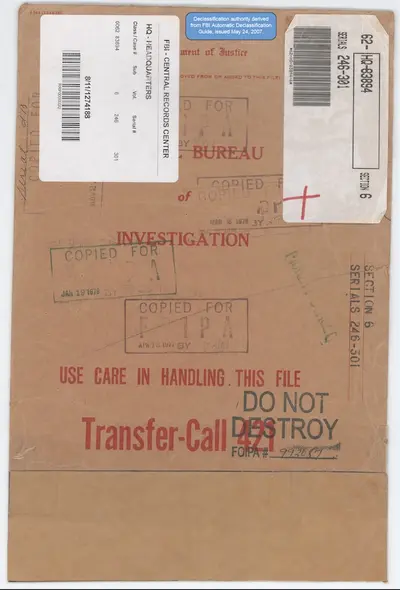
Historical Context
The sighting at Fort Monmouth occurred during a period of heightened aerial surveillance and geopolitical tension in the early Cold War era. Following the 1947 Kenneth Arnold sighting and the subsequent Roswell incident, the United States experienced a massive surge in reports of unidentified flying objects, often referred to as “flying saucers.” During this period, the technological landscape of aviation was undergoing rapid transformation, with the development of high-altitude reconnaissance and supersonic propulsion. This era of atmospheric uncertainty led to a proliferation of sightings that were often scrutinized by both the public and military intelligence agencies.
Fort Monmouth, located in New Jersey, served as a critical hub for the United States Army Signal Corps. As a center for research and development in electronics and communications, the installation was a vital military asset. Because of its strategic importance, the facility was equipped with advanced radar technology designed to monitor the surrounding airspace for potential threats. The presence of such sensitive equipment meant that any anomalous radar returns would be recorded and processed through established bureaucratic channels.
The Incident
On September 10, 1951, at approximately 11:10 AM, an AN/MPG-1 radar set stationed at Fort Monmouth detected an unidentified object. The radar data indicated a fast-moving, low-flying target that appeared to follow the coastline. The object exhibited a rapid change in azimuth, suggesting highly maneuverable flight patterns, yet it maintained a relatively constant range from the radar installation.
The documentation reveals that the radar return was unusually strong for a standard aircraft. Despite efforts to maintain a lock on the object using a radar set specifically designed for the tracking of jet aircraft, the target’s velocity exceeded the tracking capabilities of the equipment. The object was eventually lost from the radar screen at a range of 14,000 yards. While the released documents provide specific technical details regarding the radar signature, they do not specify the number of witnesses present during the detection.
Investigative Records and Classification
The details of this event were maintained within the files of the Federal Bureau of Investigation. Under the standing protocols of the era, FBI field offices in locations such as Knoxville, Albuquerque, and Los Angeles were tasked with routing reports involving unidentified objects to headquarters, particularly when those reports concerned the protection of vital military installations. This administrative process ensured that sightings near sensitive sites like Fort Monmouth were integrated into the broader national security intelligence framework.
The specific file containing this incident was released to the public on May 8, 2026, as part of the Presidential Unsealng and Reporting System for UAP Encounters (PURSUE). This release was part of a broader effort toward transparency regarding unidentified anomalous phenomena.
Analysis and Classification
This case is categorized as a radar track, defined by the detection of an unidentified object via military or civilian radar equipment. Within the framework of the All-domain Anomaly Resolution Office (AARO), all records released under the PURSUE program are designated as unresolved by default. The federal government has not reached a definitive conclusion regarding whether the event was anomalous or conventional, leaving both possibilities open to investigation.
During the early 1950s, several conventional phenomena were frequently identified as potential sources for such radar returns. These included experimental aircraft testing, weather balloons—specifically those associated with the Project Mogul series—and various atmospheric optical phenomena such as lenticular clouds or sundogs. Additionally, astronomical objects like the Moon, Venus, or meteors appearing near the horizon were often considered. However, the specific characteristics of the Fort Monmouth detection, such as the rapid change in azimuth and the extreme speed, remain the primary features of the unverified report.