Ft. Monmouth, New Jersey UFO Sighting (September 11, 1951) — FBI Files
In 1951, two radar sets at Fort Monmouth, New Jersey, detected an unidentified object at an extremely unusual elevation angle and a range of 93,000 yards.
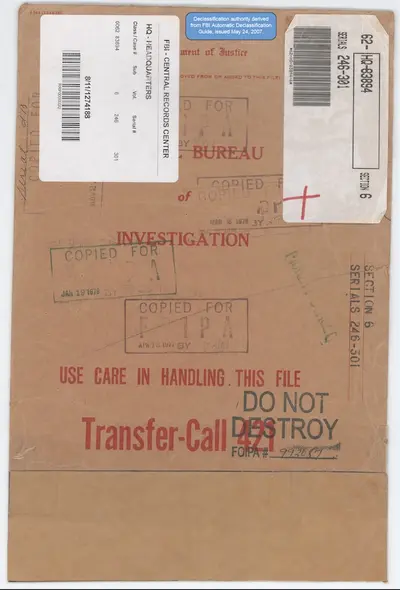
Historical Context
The sighting at Fort Monmouth occurred during a period of heightened aerial surveillance and atmospheric anxiety in the United States. Following the 1947 Kenneth Arnold sighting and the subsequent Roswell incident, the American public and military apparatus became increasingly preoccupied with the concept of “flying saucers.” This era was defined by the early Cold War, a time when the rapid advancement of aerospace technology and the emergence of long-range Soviet capabilities necessitated rigorous monitoring of the national airspace. Fort Monmouth, located in New Jersey, served as a critical hub for the development of radar and communications technology, making it a high-priority installation for the United States Army.
During this decade, unidentified flying objects were often categorized as potential threats to national security. The Federal Bureau of Investigation (FBI) maintained a systematic approach to documenting such occurrences, particularly when they involved military installations. Under established protocols for the protection of vital installations, field offices in cities such as Knoxville, Albuquerque, and Los Angeles were tasked with routing UFO reports to FBI headquarters. This ensured that any potential breach of restricted airspace or unidentified technological intrusion could be scrutinized by central authorities.
The September 11 Incident
On September 11, 1951, at approximately 10:50 AM, an unidentified object was detected in the airspace northeast of the Fort Monmouth installation. The detection was not merely visual but was captured by electronic means through two separate SCR-584 radar sets. These radar units, which were widely used for tracking aircraft and anti-aircraft artillery, simultaneously recorded the presence of the same target.
The data retrieved from the radar sets indicated that the object was positioned at a range of approximately 93,000 yards. Most notably, the official documentation highlights that the target was observed at an extremely unusual elevation angle. While the released files do not specify the exact number of human witnesses present during the radar event, the technical nature of the recording confirms that the phenomenon was registered by military-grade tracking equipment. This specific detail—the unusual elevation—distinguished the event from more common sightings of low-altitude aircraft or atmospheric phenomena.
Analysis and Classification
The Fort Monmouth case is classified primarily as a radar track, a type of incident where an unidentified object is detected via military or civilian radar equipment rather than through visual observation alone. Radar tracks are considered significant in the study of aerial anomalies because they provide measurable data regarding distance, speed, and trajectory, which are harder to attribute to subjective human error.
The documentation for this event was released to the public on May 8, 2026, as part of the Presidential Unsealing and Reporting System for UAP Encounters (PURSUE). Under the current oversight of the All-domain Anomaly Resolution Office (AARO), all records released through the PURSUE program are designated as unresolved by default. The federal government has maintained a neutral stance regarding this specific 1951 event, neither confirming the object as an anomalous phenomenon nor dismissing it as a conventional occurrence.
When evaluating radar tracks from the early 1950s, investigators often consider several conventional candidates. These include experimental aircraft testing, which was frequent in New Jersey’s aerospace corridors, or weather balloons, specifically those associated with the Project Mogul series used to detect Soviet nuclear tests. Other possibilities include atmospheric optical phenomena, such as lenticular clouds or sundogs, and astronomical bodies like the Moon, Venus, or meteors appearing near the horizon. Despite these possibilities, the specific elevation angle recorded at Fort Monmouth remains a point of interest in the historical archive of unidentified aerial phenomena.