Navesink, New Jersey UFO Sighting (11 September 1951) — FBI Files
FBI records detail a 1951 radar detection of an unidentified object over Navesel, New Jersey, that exhibited extreme maneuvers and high-speed flight.
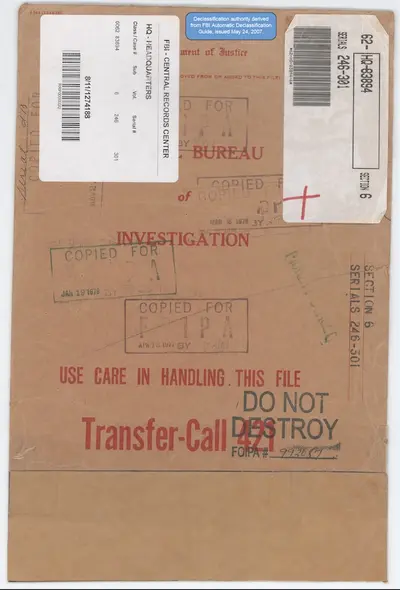
Background
On 11 September 1951, in Navesink, New Jersey, U.S. government investigators recorded an unidentified-object incident later released to the public on May 8, 2026, as part of the Presidential Unsealing and Reporting System for UAP Encounters (PURSUE). This event occurred during a period of heightened national anxiety regarding aerial unidentified phenomena. The sighting belongs to the first wave of “flying saucer” reports that swept the United States following the Kenneth Arnold sighting of June 1947 and the Roswell incident of July 1947. During this era, the presence of unidentified aerial phenomena was often viewed through the lens of the burgeoning Cold War, as the United States grappled with the technological advancements of the Soviet Union and the potential for sudden, unannounced incursions into domestic airspace.
The geographic location of Navesink, situated along the Atlantic coast of New Jersey, placed it within a region of significant strategic interest. The proximity to major coastal installations and transit corridors meant that any anomalous radar returns would be scrutinized by federal authorities. The case was filed with the Federal Bureau of Investigation, whose Knoxville, Albuquerque, Los Angeles, and other field offices routed UFO reports to headquarters under the Bureau’s standing protocols for the protection of vital installations. This administrative process reflected the Bureau’s role in monitoring threats to national security and ensuring that any unexplained aerial activity that could signal a breach of sensitive airspace was documented and centralized.
What the document records
The technical specifics of the incident are derived from radar telemetry captured during the event. An SCR 584 radar set detected a target over Navesink, New Jersey, at a range of 10,000 yards and an altitude of 6,000 feet. The behavior of the detected object was characterized by extreme maneuvers that defied the standard flight patterns of contemporary mid-century aircraft. The target initially hovered in a stationary position before rapidly changing elevation, rising nearly vertically before moving at high speed. This sudden transition from a hover to a vertical ascent and subsequent high-velocity movement presented significant technical challenges for the operators. The target eventually exceeded the radar’s tracking capabilities, a development that necessitated the transition to manual tracking by the radar technicians.
While the radar data provides a precise account of the object’s movement and position, the released document does not specify the number of witnesses present during the event. The focus of the official record remains primarily on the instrumental detection of the object rather than human testimony.
Type of case
The case is principally a radar track, with the unidentified object being detected on military or civilian radar equipment. Such cases are considered particularly significant in the study of unidentified phenomena because they provide quantifiable data regarding altitude, velocity, and trajectory, moving the event beyond the realm of purely visual, subjective accounts.
Status
All records released under the PURSUE program are designated unresolved by the All-domain Anomaly Resolution Office (AARO) by default. The federal government has not concluded that the events were anomalous, has not concluded that they were conventional, and has not ruled out either possibility. The investigation of such tracks often involves evaluating the performance limits of the equipment used during the era.
Conventional candidates for sightings of this period include experimental aircraft, weather balloons, particularly the Project Mogul series in the late 1940s, and atmospheric optical phenomena such as sundogs and lenticular clouds. Additionally, astronomical objects including Venus, the Moon, and meteors near the horizon are frequently considered as potential sources for radar or visual anomalies. The Navesink incident remains a subject of study due to the specific flight characteristics recorded by the SCR 584 radar set.