Troutdale, Oregon UFO Sighting (August 1, 1949) — USAF Files
U.S. government documents detail an unidentified object observed near Troutdale, Oregon, during a flight pattern in the summer of 1949.
Background
On August 1, 1949, in Troutdale, Oregon, U.S. government investigators recorded an unidentified-object incident later released to the public on May 8, 2026, as part of the Presidential Unsealing and Reporting System for UAP Encounters (PURSUE). This event occurred during a period of intense public and military interest in unidentified aerial phenomena, following the high-profile Kenneth Arnold sighting of June 1947 and the Roswell incident of July 1947. During this era, the phenomenon of “flying saucers” became a fixture of American popular culture and national security discourse, as the emergence of jet propulsion and advanced aerospace technology coincided with widespread reports of anomalous aerial objects.
The geographic context of the sighting is significant, as Troutdale sits at the edge of the Columbia River Gorge, a region characterized by complex atmospheric conditions and heavy air traffic. During the late 1940s, the United States was navigating the early stages of the Cold War, a period marked by heightened vigilance regarding airspace integrity. The emergence of Department of Defense documentation regarding such sightings reflects the systematic effort by the military to track and catalog objects that could potentially represent new technological developments from foreign adversaries.
The Observation
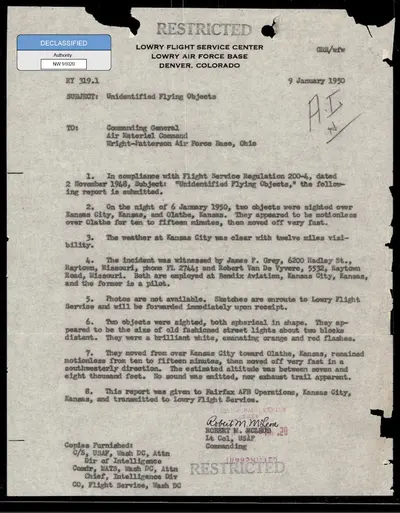
The details of the incident are derived from U.S. Department of Defense documents. While performing maneuvers within the traffic pattern over Troutdale, an individual identified as Penhallegan observed an object positioned approximately 500 to 800 feet above and 20 miles east of his position. At the time the observation occurred, Penhallegan was maintaining a flight at 1300 feet indicated altitude. The released documentation does not specify the total number of witnesses present during the event, focusing instead on the technical parameters of the visual contact.
The sighting is categorized as a visual sighting reported by ground or air observers. The precision of the altitude and distance measurements provided in the report suggests a structured attempt to quantify the anomaly, a practice that became standard in military-led investigations of unidentified objects during the mid-twentieth century.
Analysis and Classification
All records released under the PURSUE program are designated unresolved by the All-domain Anomaly Resolution Office (AARO) by default. The federal government has not concluded that the events were anomalous, has not concluded that they were conventional, and has not ruled out either possibility. This lack of a definitive conclusion is a common feature of many declassified files from this period, as the technology for long-range radar and high-resolution imagery was not yet sufficiently advanced to provide conclusive verification for all reported sightings.
When evaluating the Troutdale incident, researchers often consider conventional candidates that were prevalent during the late 1940s. These include experimental aircraft testing, which was frequent in the post-war era, and weather balloons, specifically those associated with the Project Mogul series designed to detect upper-atmosphere nuclear tests. Other possibilities include atmospheric optical phenomena, such as sundogs or lenticular clouds, which are common in the mountainous terrain of the Pacific Northwest. Additionally, astronomical objects like Venus, the Moon, or meteors appearing near the horizon could produce similar visual reports. The ambiguity of the 1949 report remains consistent with the broader scientific and military uncertainty surrounding unidentified aerial phenomena of the era.