Mojave Desert near Helendale UFO Sighting (Early December) — FBI Files
In early December 1948, an unidentified flying disk was discovered on a private airport in the Mojave Desert, leading to an FBI investigation.
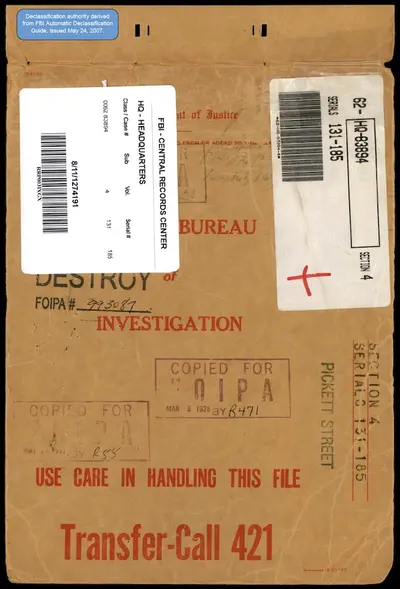
Background
In early December, within the Mojave Desert near Helendale, California, U.S. government investigators recorded an unidentified-object incident. The documentation regarding this event was later released to the public on May 8, 2026, as part of the Presidential Unsealing and Reporting System for UAP Encounters (PURSUE). This specific case emerged during a period of intense public and governmental scrutiny regarding aerial phenomena. It represents one of the first wave of “flying saucer” reports that swept the United States following the Kenneth Arnold sighting of June 1947 and the Roswell incident of July 1947.
During the late 1940s, the geography of the Mojave Desert, characterized by its vast, desolate stretches and proximity to sensitive military installations, made it a frequent site for aerial observations. The era was defined by a heightened state of vigilance regarding airspace security. Consequently, the case was filed with the Federal Bureau of Investigation. Under the Bureau’s standing protocols for the protection of vital installations, field offices in Knoxville, Albuquerque, and Los Angeles were responsible for routing UFO reports to headquarters for centralized analysis.
What the document records
The released records detail an event occurring in early December 1948, involving the discovery of a physical object. Vasco Persons reportedly found a “flying disk” on an airport that he and Nathan Smith had purchased in the Mojave Desert. The encounter was not merely an observation of a distant light but involved direct physical contact with the object. Persons and his associates photographed the object and proceeded to remove portions of it, with Noack and Smith each retaining some parts of the recovered material.
Following the initial discovery and the removal of fragments, the presence of the object was noted by others in the vicinity. An employee later observed the object and believed it was a kite being developed by the Olsen and Rice Manufacturing Company. While the document provides details regarding the physical handling of the disk, the total number of witnesses to the original discovery is not specified in the released text.
Type of case
The case is categorized by the inclusion of photographic or video evidence of the unidentified object. The existence of such visual documentation distinguishes this file from purely anecdotal reports of lights or shadows, as it suggests a tangible, observable craft or device that was captured by the investigators.
Status
All records released under the PURSUE program are designated unresolved by the All-domain Anomaly Resolution Office (AARO) by default. The federal government has not concluded that the events were anomalous, has not concluded that they were conventional, and has not ruled out either possibility.
The investigation of such phenomena in the post-war era often had to account for a variety of known technological and natural occurrences. Conventional candidates for sightings of this period include experimental aircraft, weather balloons—specifically the Project Mogul series utilized in the late 1940s to detect Soviet nuclear tests—and atmospheric optical phenomena such as sundogs and lenticular clouds. Additionally, astronomical objects including Venus, the Moon, and meteors appearing near the horizon were frequently investigated as potential sources for unidentified aerial sightings. The Mojave Desert case remains an open inquiry within the archive.