Berkeley, California UFO Sighting (September 9, 1947) — FBI Files
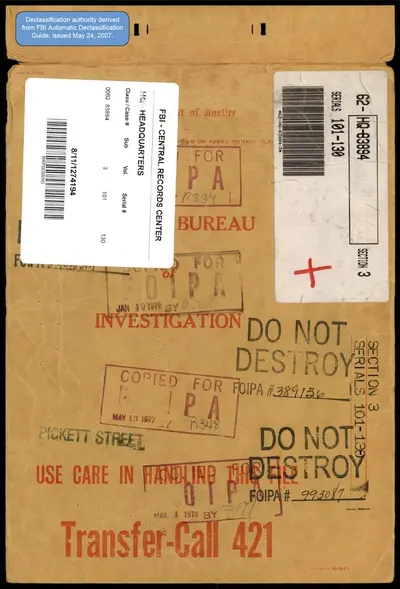
FBI records document a 1947 sighting in Berkeley, California, involving unidentified objects observed by a former Army Air Forces officer.
Historical Context
The summer of 1947 represents a pivotal period in the history of modern unidentified aerial phenomena. Following the June 1947 Kenneth Arnold sighting, which popularized the term “flying saucer,” and the July 1947 Roswell incident, the United States experienced a significant surge in reports of unidentified objects. During this era, the phenomenon was often viewed through the lens of the burgeoning Cold War, as the public and government agencies grappled with the possibility of advanced Soviet technology or atmospheric anomalies. The geography of the San Francisco Bay Area, characterized by its complex coastal topography and proximity to various military and research installations, frequently placed it at the center of such aerial observations.
At the time, the federal government’s approach to these reports was fragmented and largely focused on national security. The Federal Bureau of Investigation maintained protocols for documenting such occurrences, particularly when they appeared to involve the surveillance of vital installations. Field offices in cities such as Knoxville, Albuquerque, and Los and Angeles were tasked with routing significant UFO reports to headquarters. This administrative structure ensured that any aerial activity that could potentially threaten domestic security or involve unauthorized incursions into restricted airspace was formally logged within the Bureau’s permanent files.
The Berkeley Incident
On September 9, 1947, U.S. government investigators recorded an unidentified-object incident in Berkeley, California. These records remained classified for decades, eventually being released to the public on May 8, 2026, as part of the Presidential Unsealing and Reporting System for UAP Encounters (PURSUE). The documentation provides a window into the investigative processes used by the FBI during the post-war period to evaluate aerial anomalies.
The released FBI documents detail interviews conducted by agents with Ward L. Stewart. A former U.S. Army Air Forces officer and an experienced pilot, Stewart possessed the technical training necessary to evaluate aerial movement and aircraft characteristics. According to the records, Stewart described observing unidentified objects while positioned at the Hearst Mining Building. In his account, Stewart specifically noted that the objects he observed were not the Navy ‘Flapjack’. While the released document does not specify the total number of witnesses present during the event, the testimony of a trained aviator provided a level of technical detail that warranted official filing.
Classification and Analysis
The Berkeley case is classified as a pilot or aircrew sighting, a category of encounter where the observer is positioned within a cockpit or flight environment. Such sightings are often considered significant in aerial investigations due to the observer’s ability to track trajectory, speed, and luminosity. Within the broader scope of 1947 sightings, this case shares characteristics with other reports of the period that involved high-altitude or visually distinct objects observed by individuals with aeronautical expertise.
The current status of the Berkeley sighting remains unresolved. Under the standard operating procedures of the All-domain Anomaly Resolution Office (AARO), all records released via the PURSUE program are designated as unresolved by default. The federal government has maintained a neutral stance regarding the Berkeley incident, neither concluding that the objects were anomalous nor confirming that they were conventional.
In the context of 1947, investigators frequently considered several conventional explanations for such sightings. These included the presence of experimental aircraft, the deployment of weather balloons—specifically those associated with the Project Mogul series—and various atmospheric optical phenomena such as sundogs or lenticular clouds. Additionally, astronomical objects like Venus, the Moon, or meteors appearing near the horizon were often scrutinized as potential sources for reported unidentified objects. The Berkeley records, however, do not provide a definitive resolution between these conventional possibilities and more anomalous interpretations.