Mitchel Air Force Base UFO Sighting (February 4, 1948) — FBI Files
FBI records document a 1948 report of a disc-shaped object observed near Mitchel Air Force Base in New York during a wave of post-war UFO sightings.
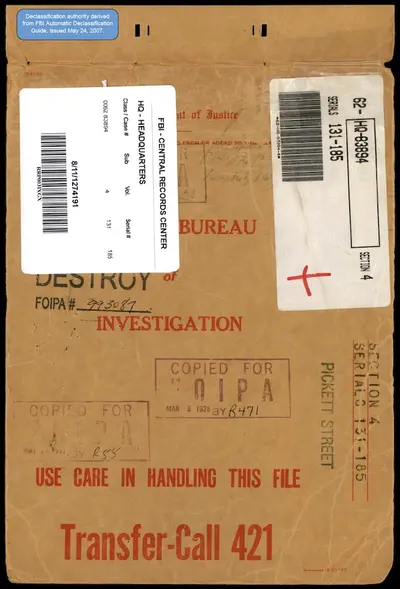
Background
On February 4, 1948, at Mitchel Air Force Base in New York, U.S. government investigators recorded an unidentified-object incident that remained classified for decades. The documentation regarding this event was later released to the public on May 8, 2026, as part of the Presidential Unsealing and Reporting System for UAP Encounters (PURSUE). This specific sighting occurred during a period of intense national preoccupation with aerial phenomena. The incident is categorized as part of the first major wave of “flying saucer” reports that swept the United States following the Kenneth Arnold sighting in June 1947 and the Roswell incident in July 1947. During this era, the sudden appearance of reported Unidentified Flying Objects (UFOs) created significant tension within military and intelligence communities, as the technological capabilities of the era were still adjusting to the dawn of the jet age and the complexities of early Cold War airspace monitoring.
The Mitchel Air Force Base location provided a critical context for the report. Situated on Long Island, the base served as a vital installation for the Air Defense Command, making any unidentified aerial presence a matter of national security. Because of the sensitivity of military installations, the case was filed with the Federal Bureau of Investigation. Under the standing protocols of the Bureau at the time, field offices in cities such as Knoxville, Albuquerque, and Los Angeles were tasked with routing UFO reports to headquarters to ensure the protection of vital infrastructure and to monitor potential incursions by foreign adversaries.
What the document records
The released documentation provides specific details regarding the inter-agency response to the sighting. The Air Defense Command initiated a communication requesting formal coordination with the FBI regarding investigations into “flying disc” incidents. This specific request for coordination indicates a clear expectation of FBI involvement in the investigative process, reflecting the high priority placed on investigating objects that appeared to penetrate protected military airspace. While the document establishes the procedural necessity of the investigation, the number of witnesses involved in the February 4 incident is not specified within the released text.
The nature of the investigation at the time was characterized by a focus on security and intelligence rather than the scientific study of atmospheric phenomena. In the late 1940s, the primary concern for the Air Defense Command was the potential for Soviet technology to exploit unidentified objects as cover for reconnaissance or attack. Consequently, the reporting of such objects was treated with the same gravity as any other breach of perimeter security or unauthorized aerial activity.
Type of case
The witnesses involved in the Mitchel Air Force Base incident described the object as being disc- or saucer-shaped. This description aligns with the prevailing nomenclature of the period, as the term “flying saucer” had become the standard descriptor for any aerial phenomenon that exhibited non-ballistic flight patterns or unusual geometric shapes.
Status
All records released under the PURSUE program are designated as unresolved by the All-domain Anomaly Resolution Office (AARO) by default. The federal government has not concluded that the events at Mitchel Air Force Base were anomalous, nor has it concluded that the objects were conventional. The possibility of either conclusion remains open.
During the late 1940s, several conventional candidates were frequently considered by investigators when evaluating sightings of this type. These included the testing of experimental high-altitude aircraft and the use of weather balloons, particularly those associated with the Project Mogul series, which were designed to detect Soviet nuclear tests. Other potential explanations involved atmospheric optical phenomena, such as sundogs or lenticular clouds, which can mimic the appearance of stationary or slow-moving discs. Additionally, astronomical objects like Venus, the Moon, or meteors appearing near the horizon were often scrutinized as potential sources of misidentified aerial sightings.