Mansfield, Occupation UAP Encounter, 1948 — USAAF Box 7 #4
An archival record from 1948 details a U.S. Army Air Forces sighting of an unidentified object near Mansfield, part of the post-1947 saucer wave.
Historical Context
The year 1948 represented a period of profound transition in both military aviation and public perception of the skies. Following the conclusion of World War II, the rapid development of jet propulsion and rocket technology created a landscape where the boundaries of conventional flight were constantly being redefined. This era was characterized by the emergence of the “saucer wave,” a phenomenon where reports of unidentified aerial phenomena surged across the United States. This surge was largely catalyzed by the June 1947 Kenneth Arnold sighting and the subsequent July 1947 Roswell incident, both of which introduced the concept of disk-shaped or anomalous objects to the global consciousness.
During this period, the United States Army Air Forces (USAAF) began formalizing the documentation of such sightings. The military was tasked with distinguishing between emerging domestic aerospace technology, such as experimental high-altitude reconnaissance, and potential incursions by foreign powers. The geopolitical climate of the early Cold War necessitated a rigorous, albeit nascent, approach to monitoring the upper atmosphere. Consequently, the documentation of these sightings became a matter of national security, often categorized within internal checklists designed to track recurring patterns of unidentified aerial phenomena.
The Mansfield Incident
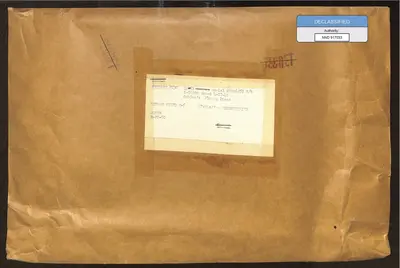
The Mansfield, Occupation, sighting of 1948 is documented as Incident #4 within the “Check-List - Unidentified Flying Objects” series. This specific entry is preserved in Box 7 of file 38_143685. The details of the encounter were officially released to the public by the Department of War on May 8, 2026, through the Presidential Unsealing and Reporting System for UAP Encounters (PURSUE). The archival summary indicates that an unspecified observer reported a sighting of an unidentified object in the vicinity of Mansfield.
The nature of the report is categorized as a visual sighting, which typically implies observations made by personnel stationed on the ground or by crew members operating aircraft in the area. While the specific characteristics of the object’s movement or appearance are not elaborated upon in the released summary, its inclusion in the USAAF checklist suggests it was processed as part of a larger effort to catalog aerial anomalies during the height of the post-war saucer wave.
Analytical Status and Interpretations
Under the protocols of the All-domain Anomaly Resolution Office, all records released via the PURSUE program are officially designated as unresolved. The federal government maintains a neutral stance regarding the Mansfield encounter, having neither confirmed the presence of anomalous technology nor definitively attributed the sighting to a known conventional source. This lack of a conclusive verdict is consistent with the broader handling of 1947-era incidents, where the ambiguity of the data often precludes a definitive classification.
When analyzing the “saucer wave” era, researchers often consider several conventional candidates that could explain such sightings. During the late 1940s, the Project Mogul balloon flights were active over the American Southwest, utilizing high-altitude sensors to detect nuclear tests, which could have been misidentified by observers. Additionally, the rapid prototyping of experimental jet and rocket aircraft, alongside various atmospheric optical effects and the misidentification of astronomical bodies at unusual angles, provided a range of plausible, non-anomalous explanations for the period’s frequent aerial reports. The Mansfield case remains a part of this complex historical record, representing one of the many documented instances of unidentified activity during a transformative era in aviation history.