Bakersfield, California UAP Encounter, 1948 — USAAF Box 7 #106
Documentation from the U.S. Army Air Forces archives details a 1948 unidentified object sighting near Bakersfield, California, released via the PURSUE program.
Historical Context
The year 1948 represented a period of significant atmospheric and aerial uncertainty in the United States. Following the summer of 1947, the American public and military establishment were navigating a sudden influx of reports involving unidentified aerial phenomena. This era, often characterized by the “flying saucer” phenomenon, was catalyzed by the Kenneth Arnold sighting in June 1947 and the subsequent high-profile events surrounding the Roswell incident in July 1947. During this period, the distinction between conventional aeronautics and anomalous phenomena was frequently blurred by the rapid advancement of post-war aviation technology and the emergence of new atmospheric observation methods.
Geographically, the region surrounding Bakersfield, California, serves as a significant corridor for both military operations and atmospheric research. Situated within the Central Valley, the area’s proximity to various aerospace testing ranges and military installations made it a frequent site for observing aerial activity. In the late 1940s, the presence of experimental aircraft and high-altitude balloon programs created a landscape where unidentified sightings were statistically more probable due to the density of unclassified aerial traffic.
The Bakersfield Incident
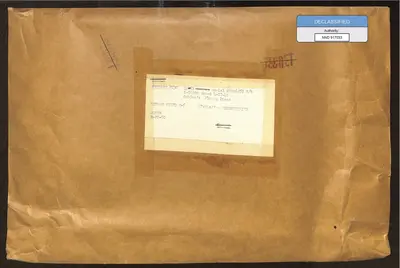
In 1948, near Bakersfield, California, the U.S. Army Air Forces recorded an unidentified-object incident that became Incident #106 in the “Check-List - Unidentified Flying Objects” series archived in Box 7 of file 38_143685. The specific details of the encounter are contained within official military documentation that remained classified for decades. These records were eventually released by the Department of War on May 8, 2026, as part of the Presidential Unsealing and Reporting System for UAP Encounters (PURSUE).
The documentation for Incident #106 provides a concise summary of the event. The records indicate that an unspecified observer reported a sighting near the Bakersfield location. The nature of the report is categorized as a visual sighting, which can be attributed to either ground-based or air-based observers. While the specific characteristics of the object’s flight path or physical appearance were not elaborated upon in the summary, the inclusion of the event in the official USAAF “Check-List” demonstrates that the military recognized the report as a distinct event worthy of archival notation.
Investigation and Classification
The investigation of such sightings during the late 1940s was often decentralized, involving various branches of the military and intelligence communities. The classification of Incident #106 as a visual sighting places it within the broader category of contemporary UAP encounters that relied on direct optical observation rather than radar tracking. Such cases were common during the 1947-1948 wave, as many reports originated from civilian pilots or ground personnel observing the sky during daylight or twilight hours.
The status of this case remains officially undetermined. All records released under the PURSUE program are designated as unresolved by the All-domain Anomaly Resolution Office. The federal government has maintained a neutral stance regarding the Bakersfield encounter, having neither concluded that the incident was anomalous nor confirmed that it was the result of conventional technology. The government has not ruled out either possibility, leaving the event in a state of permanent ambiguity.
When analyzing the potential origins of such sightings, researchers often look to the technological landscape of the era. Conventional candidates for the 1947-era saucer wave include the Project Mogul balloon flights, which were actively operating over the U.S. Southwest at the time to detect Soviet nuclear tests. Other possibilities include the testing of experimental jet and rocket aircraft, various atmospheric optical effects, or astronomical objects that were misidentified due to unusual viewing angles. Without further corroborating data, the Bakersfield sighting remains a documented but unverified entry in the history of American aerial anomalies.