Benkelman, Nebraska UFO Sighting (March 14, 1948) — FBI Files
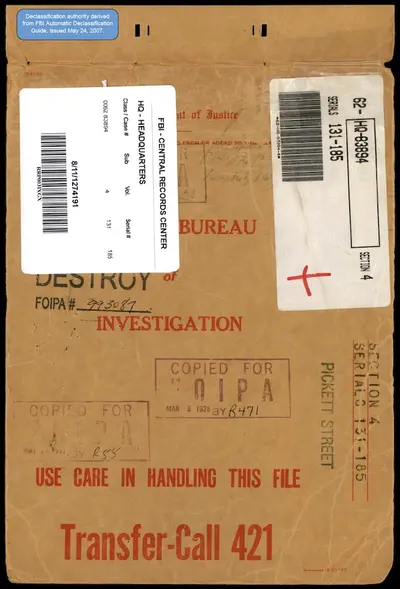
Federal Bureau of Investigation records document a high-altitude, fast-moving object observed over Benkelman, Nebraska, in March 1948.
Historical Context
The sighting in Benkelman, Nebraska, occurred during a period of significant transition in American aerial surveillance and public perception of the skies. In the spring of 1948, the United States was navigating the early stages of the Cold War, a geopolitical climate characterized by heightened anxiety regarding Soviet technological advancements and airspace incursions. This era saw a massive surge in unidentified flying object reports, following the foundational Kenneth Arnold sighting in June 1947 and the widely discussed Roswell incident in July 1947. These events triggered a cultural phenomenon often referred to as the first wave of “flying saucer” reports, where the public began to scrutinize the heavens for objects that defied the known capabilities of contemporary aviation.
During this period, the Federal Bureau of Investigation maintained specific protocols for handling reports of unidentified objects. Because such sightings could potentially involve the monitoring of sensitive military installations or the movement of unauthorized aircraft, field offices in cities such as Knoxville, Albuquerque, and Los Angeles were instructed to route UFO-related intelligence to headquarters. This administrative process ensured that any phenomenon that might threaten the security of vital national installations was documented within the federal intelligence apparatus.
The Incident of March 14, 1948
On March 14, 1948, an unidentified-object incident was recorded in Benkelman, Nebraska. The details of this specific encounter were not made available to the general public until May 8, 2026, when they were released as part of the Presidential Unsealing and Reporting System for UAP Encounters (PURSUE). The documentation provides a primary account of an observation made on March 18th, during which a witness tracked a fast-moving object at a high altitude.
The observer initially perceived the object as a standard vapor trail, a common sight in the post-war era as jet propulsion technology began to emerge. However, the characteristics of the object quickly diverged from known aeronautical patterns. The witness noted that the object’s consistent shape and velocity exceeded the parameters of any conventional aircraft previously encountered. The documentation describes the object as possessing a streamlined appearance, reminiscent of a train, moving at an extremely high rate of speed. The object was observed traveling from the east toward the near direction, with the observer suggesting it might have passed over Denver. The sighting concluded as the object appeared to disappear over the horizon. While the released documents contain these specific descriptive details, the total number of witnesses to the event is not specified in the official file.
Analytical Classification and Status
The Benkelman case is classified as a visual sighting reported by ground or air observers. Within the framework of modern aerial analysis, the incident remains officially categorized as an anomaly. Under the current mandates of the All-domain Anomaly Resolution Office (AARO), all records released through the PURSUE program are designated as unresolved by default. This designation reflects a lack of definitive evidence to confirm either an extraterrestrial origin or a conventional explanation.
The federal government has maintained a neutral stance, neither concluding that the event was anomalous nor confirming it as a known conventional phenomenon. When evaluating sightings from the late 1940s, investigators often consider a variety of legitimate candidates. These include the deployment of experimental aircraft and the use of high-altitude weather balloons, specifically those associated with the Project Mogul series designed to detect Soviet nuclear tests. Other potential explanations involve atmospheric optical phenomena, such as sundogs or lenticular clouds, as well as astronomical bodies like the Moon, Venus, or meteors appearing near the horizon. The Benkelman record remains a significant piece of the archival record regarding the mid-century period of aerial uncertainty.