South Royalton, Vermont UFO Sighting (September 25, 1947) — FBI Files
FBI documents detail a 1947 report of flying discs in South Royalton, Vermont, submitted by a local school superintendent during the post-war UFO wave.
Historical Context
The sighting in South Royalton, Vermont, occurred during a period of intense public and governmental scrutiny regarding unidentified aerial phenomena. In the summer of 1947, the United States experienced a significant surge in reports of unidentified flying objects, a phenomenon often referred to as the first wave of “flying saucer” sightings. This era was inaugurated by the Kenneth Arnold sighting in June 1947 and followed closely by the widely discussed Roswell incident in July 1947. During this timeframe, the post-war technological boom and the onset of the Cold War created a heightened state of vigilance regarding airspace security. The emergence of high-altitude surveillance and the development of advanced aeronautics led to a landscape where the distinction between secret military hardware and unknown phenomena was frequently blurred in the public consciousness.
The geography of Vermont, characterized by its mountainous terrain and vast, unpopulated stretches of forest, provided a backdrop where aerial anomalies could easily be observed and reported by local residents. In the late 1940s, the scientific and intelligence communities were beginning to grapple with how to categorize these sightings. While some viewed them through the lens of atmospheric science, others focused on the potential for foreign technological incursions. This atmosphere of uncertainty defined the era’s approach to anomalous aerial events.
The South Royalton Incident
On September 25, 1947, an unidentified-object incident was recorded in South Royalton, Vermont. The details of this specific event were preserved within the archives of the Federal Bureau of Investigation. These records remained classified for decades, only becoming accessible to the public on May 8, 2026, through the Presidential Unsealing and Reporting System for UAP Encounters (PURSUE). The documentation reveals that the report originated from A. Courtney Parker, who served as the Superintendent of Schools in the region. Parker reported information regarding the presence of flying discs in the local airspace.
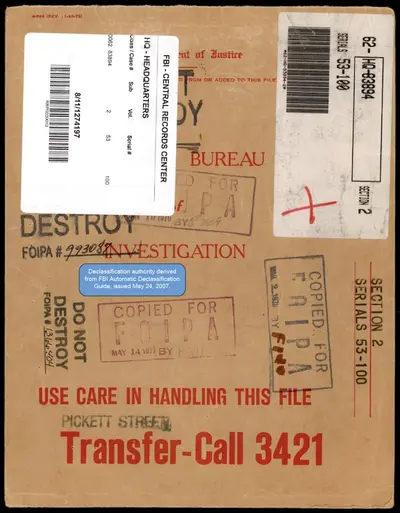
The released FBI documentation focuses on the administrative response to the report rather than a detailed description of the objects themselves. The files consist of correspondence regarding a formal request for the FBI to interview Parker. The purpose of this requested interview was to gather any additional details or corroborating evidence that the Superintendent might possess regarding the discs. While the records confirm the existence of the report and the government’s intent to investigate, the released documents do not specify the exact number of witnesses involved in the sighting.
Investigative Protocols and Classification
The handling of the South Royalton case followed established Bureau protocols of the time. During this period, the FBI’s various field offices, including those in Knoxville, Albuquerque, and Los Angeles, were tasked with monitoring and routing UFO reports to headquarters. This centralized system was maintained under standing protocols designed for the protection of vital installations and national security. The routing of the South Royalton report suggests that the Bureau treated the sighting as a matter of official interest, consistent with their broader mandate to investigate any phenomenon that could potentially impact domestic security or the integrity of sensitive sites.
Under the current oversight of the All-domain Anomaly Resolution Office (AARO), all records released under the PURSUE program are designated as unresolved by default. The federal government has maintained a neutral stance regarding the South Royalton incident, neither concluding that the objects were anomalous nor confirming that they were of conventional origin. The investigation remains open-ended, as the government has not ruled out either possibility.
The classification of such sightings often considers various conventional candidates. During the late 1940s, the proliferation of experimental aircraft and the deployment of the Project Mogul series of high-altitude weather balloons provided plausible explanations for many aerial reports. Additionally, atmospheric optical phenomena, such as lenticular clouds or sundogs, and the visibility of bright astronomical objects like Venus or the Moon near the horizon, are frequently cited as potential sources of misidentification. The South Royalton case remains a significant piece of the 1947 archival record, representing the era’s intersection of local observation and federal intelligence monitoring.