North Junior High, Newburgh UAP Encounter, 1947 — USAAF Box 7 #219
An archived U.S. Army Air Forces report documents an unidentified object sighting near North Junior High in Newburgh during the 1947 saucer wave.
Historical Context
The year 1947 represents a pivotal moment in the history of aerial anomaly documentation. Following the conclusion of the Second World War, the United States entered a period of rapid technological transition and heightened atmospheric surveillance. This era was defined by the emergence of the “saucer wave,” a series of widespread reports of unidentified flying objects that captured both public imagination and military attention. This phenomenon gained significant momentum following the June 1947 Kenneth Arnold sighting and the subsequent July 1947 Roswell incident. During this period, the presence of high-altitude reconnaissance technology, such as the Project Mogul balloon flights, and the development of experimental jet and rocket propulsion created a landscape where conventional aerial phenomena could easily be misidentified as anomalous craft.
The geography of the Newburgh region, situated within a period of post-war industrial and domestic expansion, placed it within the broader network of domestic airspace monitoring. As the United States Army Air Forces (USAAF) began formalizing the collection of unidentified object data, incidents like the one recorded at North Junior High became part of a burgeoning, albeit fragmented, archival record of the American skies.
The Newburgh Incident
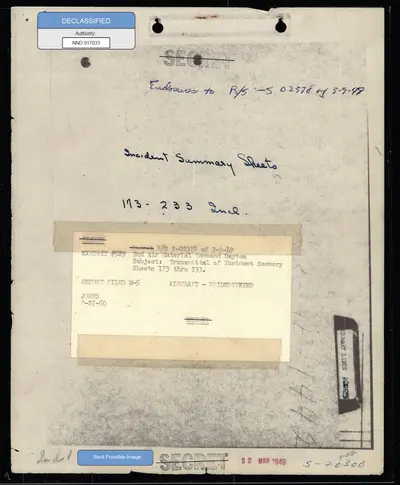
In 1947, near North Junior High in Newburgh, the U.S. Army Air Forces recorded an unidentified-object incident that became Incident #219 in the “Check-List - Unidentified Flying Objects” series archived in Box 7 of file 38_143685. The specific details of the encounter were preserved within military administrative structures until the records were released by the Department of War on May 8, 2026, as part of the Presidential Unsealing and Reporting System for UAP Encounters (PURSUE).
The summary records within the official form indicate that an unspecified observer reported a sighting in the vicinity of the North Junior High school. The nature of the report falls under the category of a visual sighting, which may have been captured by ground-based or air-based observers. While the specific characteristics of the object’s flight path, luminosity, or shape were not detailed in the summary, the entry serves as a primary source of the military’s systematic attempts to catalog aerial anomalies during the mid-century period.
Investigation and Classification
The investigation of the Newburgh sighting, much like other entries in the USAAF “Check-List,” was characterized by the era’s reliance on standardized reporting forms designed to aggregate disparate sightings into a searchable database. These records were not part of a dedicated investigative body like the later Project Blue Book, but rather functioned as a logistical checklist for the Army Air Forces to track unidentified aerial phenomena.
The status of this case remains officially unresolved. Under the mandates of the All-domain Anomaly Resolution Office, all records released through the PURSUE program are designated as unresolved. The federal government has maintained a position of neutrality regarding the Newburgh encounter, stating that it has not concluded these 1947-era incidents were anomalous, nor has it concluded they were conventional. The possibility of either conclusion remains open.
When analyzing the Newburgh encounter alongside other 1947-era sightings, researchers often consider several conventional candidates. These include the atmospheric optical effects common in certain weather conditions, astronomical objects viewed at unusual angles, or the presence of experimental aircraft. The era’s active use of high-altitude balloons for acoustic monitoring also provided a potential source for misidentified aerial objects. Without further corroborating data, the Newburgh sighting remains a documented piece of the larger 1947 aerial phenomenon archive.