Myrtle Creek, Oregon UFO Sighting (August 6, 1947) — FBI Files (D33P167)
An FBI-documented report details a pilot sighting of an unidentified object over Myrtle Creek, Oregon, during the summer of 1947.
Historical Context
The summer of 1947 represents a pivotal era in the history of unidentified aerial phenomena. Following the June 1947 Kenneth Arnold sighting, which introduced the concept of “flying saucers” to the public consciousness, and the July 1947 Roswell incident, the United States experienced a significant surge in reports of anomalous objects. During this period, the phenomenon was often interpreted through the lens of post-war technological anxiety and the burgeoning Cold War. The sudden appearance of unidentified objects in the sky coincided with the rapid advancement of aerospace engineering and the deployment of high-altitude surveillance technologies.
Geographically, the Pacific Northwest, including the region around Myrtle Creek, Oregon, has long been a site of interest for investigators due to its complex topography and frequent atmospheric activity. The rugged terrain and heavy cloud cover of the Cascade Range often provide the necessary conditions for various optical illusions or the obscuring of conventional aerial vehicles. In the late 1940s, the federal government maintained a structured, albeit secretive, approach to monitoring such reports, particularly when they appeared to intersect with the security of vital installations or airspace.
The Incident of August 6, 1947
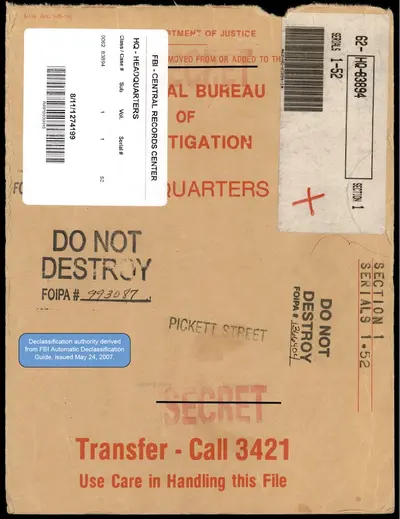
On the evening of August 6, 1947, an unidentified-object incident occurred near Myrtle Creek, Oregon. The details of this event were preserved within the files of the Federal Bureau of Investigation (FBI) and were later released to the public on May 8, 2026, as part of the Presidential Unsealing and Reporting System for UAP Encounters (PURSUE). The documentation indicates that a pilot, identified in the records as Redskatfield, observed a mysterious object while operating an aircraft at an altitude of approximately 5,000 feet.
The pilot reported seeing the object on two separate occasions during his flight. While the released FBI document does not specify the total number of witnesses present, the primary account rests on the observations made from the cockpit. In accordance with the standing protocols of the time, various FBI field offices, including those in Knoxville, Albuquerque, and Los Angeles, were responsible for routing UFO reports to headquarters, particularly when such sightings could potentially impact the protection of sensitive installations. Following the initial report, the FBI formulated plans to conduct a formal interview with the witness, Redskatfield, to further investigate the nature of the sighting.
Classification and Investigation
This case is classified as a pilot or aircrew sighting, a category of encounter characterized by observations made from the cockpit during active flight. Such sightings are considered significant by investigators because the observers possess specialized training in identifying aircraft, celestial bodies, and atmospheric phenomena. The high-altitude perspective of a pilot allows for a broader field of view, though it also subjects the observer to the complexities of high-speed motion and changing light conditions.
The status of this case remains officially unresolved. Under the protocols of the All-domain Anomaly Resolution Office (AARO), all records released through the PURSUE program are designated as unresolved by default. The federal government has maintained a neutral stance regarding the Myrtle Creek incident, neither concluding that the event was anomalous nor confirming that it was caused by conventional means.
When evaluating sightings from this specific era, investigators often consider several conventional candidates. These include experimental aircraft testing, the presence of weather balloons—specifically those associated with the Project Mogul series active in the late 1940s—and various atmospheric optical phenomena such as sundogs or lenticular clouds. Additionally, astronomical objects like the Moon, Venus, or meteors appearing near the horizon are frequently analyzed as potential explanations for unidentified lights in the night sky. The Myrtle Creek report remains a documented piece of this broader historical investigation into the unidentified aerial phenomena of the mid-twentieth century.