Near Green River, Utah UAP Encounter, 1947 — USAAF Box 7 #103
An archival U.S. Army Air Forces report documents an unidentified object sighting near Green River, Utah, during the 1947 flying saucer wave.
Overview
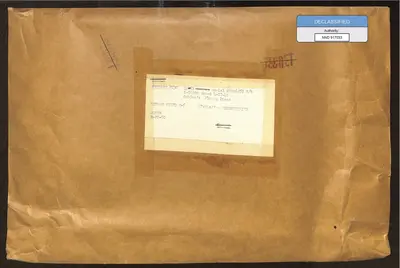
In 1947, near Green River, Utah, the U.S. Army Air Forces recorded an unidentified-object incident that became Incident #103 in the “Check-List - Unidentified Flying Objects” series archived in Box 7 of file 38_143685. The records were released by the Department of War on May 8, 2026, as part of the Presidential Unsealing and Reporting System for UAP Encounters (PURSUE). The case is one of the first wave of “flying saucer” reports that swept the United States after the Kenneth Arnold sighting of June 1947 and the Roswell incident of July 1947.
Historical Context
The geography of the American Southwest, particularly the region surrounding Green River, Utah, has long been a focal point for aerial observations due to its vast, open landscapes and clear atmospheric conditions. During the mid-twentieth century, this region sat at the intersection of burgeoning aerospace development and heightened Cold War surveillance. The era was characterized by a sudden surge in public and military interest in unidentified aerial phenomena, often referred to as the “saucer wave.” This period followed a shift in the national consciousness, as the rapid advancement of aeronautical technology made the sky a theater of both scientific progress and potential clandestine military activity.
At the time of the Green River report, the United States military was actively engaged in various reconnaissance and atmospheric monitoring programs. The presence of high-altitude balloons and experimental propulsion systems created a landscape where conventional objects could easily be mistaken for something anomalous. The reporting of such incidents was often handled through standardized military checklists, such as the one containing Incident #103, which sought to categorize sightings for intelligence purposes. These documents were intended to provide a systematic approach to tracking objects that did not conform to known flight patterns or known aircraft profiles.
Incident Details
Incident #103 of the U.S. Army Air Forces “Check-List - Unidentified Flying Objects” series, archived in Box 7 of file 38_143685 and released by the Department of War on May 8, 2026, as part of the Presidential Unsealing and Reporting System for UAP Encounters (PURSUE), provides a concise summary of the event. The summary records that an unspecified observer reported a sighting near Green River, Utah. The case is classified as a visual sighting reported by ground or air observers.
The lack of specific descriptive detail regarding the object’s shape, speed, or luminosity in the primary summary reflects the standardized, abbreviated nature of the military’s reporting forms during this period. Such brevity was common in wartime and post-war intelligence logs, where the primary objective was the documentation of an occurrence rather than an exhaustive forensic analysis.
Status and Analysis
All records released under the PURSUE program are designated unresolved by the All-domain Anomaly Resolution Office. The federal government has not concluded these 1947-era incidents were anomalous, has not concluded they were conventional, and has not ruled out either possibility. The ambiguity of the official status mirrors the broader scientific and military uncertainty regarding the origins of the 1947 sightings.
When examining the Green River encounter, researchers often consider various conventional candidates that were active during the 1947 saucer wave. These include the Project Mogul balloon flights, which were then active over the U.S. Southwest and were designed to detect Soviet nuclear tests via high-altitude acoustic sensors. Additionally, the development of experimental jet and rocket aircraft, alongside various atmospheric optical effects and astronomical objects misidentified at unusual angles, remains a primary focus for those attempting to provide a non-anomalous explanation for the incident.