Momeews, USSR UAP Encounter, 1947 — USAAF Box 7 #171
Documentation from the U.S. Army Air Forces archives details a 1947 unidentified object sighting near Momeews, USSR, released via the PURSUE program.
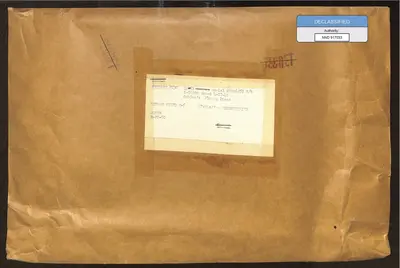
Case Overview
In 1947, near Momeews, USSR, the U.S. Army Air Forces recorded an unidentified-object incident that became Incident #171 in the “Check-List - Unidentified Flying Objects” series archived in Box 7 of file 38_143685. The records were released by the Department of War on May 8, 2026, as part of the Presidential Unsealing and Reporting System for UAP Encounters (PURSUE). The case is one of the first wave of “flying saucer” reports that swept the United States following the Kenneth Arnold sighting of June 1947 and the Roswell incident of July 1947.
The specific documentation for Incident #171, found within the U.S. Army Air Forces “Check and List - Unidentified Flying Objects” series, provides a summary indicating that an unspecified observer reported a sighting near Momeews, USSR. The nature of the report is categorized as a visual sighting, which could have been made by either ground-based or air-based observers. The identity of the witness and the specific flight path or trajectory of the object remain undocumented in the available archival fragments.
Historical Context and Classification
The timing of the Momeews sighting places it within a period of intense global interest in unidentified aerial phenomena. During the late 1940s, the emergence of high-altitude reconnaissance and the early stages of the Cold War created a climate of heightened surveillance. The term “flying saucer” had recently entered the public lexicon, and military organizations were beginning to formalize the process of logging anomalous aerial tracks. This specific case is notable for its geographical location within the USSR, occurring during a period of significant geopolitical tension between the United States and the Soviet Union.
In the mid-20th century, the scientific and military understanding of such phenomena was largely limited to the observation of known atmospheric or aeronautical entities. The phenomenon of the “saucer wave” was characterized by a sudden influx of reports that shared similar visual descriptions, often involving metallic or disc-shaped objects moving at high speeds. While many of these reports were scrutinized for potential signatures of secret military technology, the lack of definitive identification led to a prolonged period of ambiguity regarding the nature of these sightings.
Investigation and Resolution Status
The investigation into the Momeews incident remains officially open. All records released under the PURSUE program are designated as unresolved by the All-domain Anomaly Resolution Office. The federal government has not concluded that these 1947-era incidents were anomalous, nor has it concluded that they were conventional, and the possibility of either remains unruled out.
The lack of a definitive conclusion is consistent with many other cases from the 1947 era. During this period, several conventional candidates were frequently considered for such sightings. These included the Project Mogul balloon flights, which were active over the U.S. Southwest at the time, as well as experimental jet and rocket aircraft undergoing testing. Other possibilities included atmospheric optical effects, such as sun dogs or light refraction, and astronomical objects that may have been misidentified due to unusual viewing angles. Because the Momeews report lacks specific telemetry or secondary corroboration, it remains a subject of archival interest within the broader study of mid-century aerial anomalies.