Moorhsad, Minnesota UAP Encounter, 1947 — USAAF Box 7 #192
An archived U.S. Army Air Forces report documents a 1947 unidentified object sighting near Moorhsad, Minnesota, released via the PURSUE program.
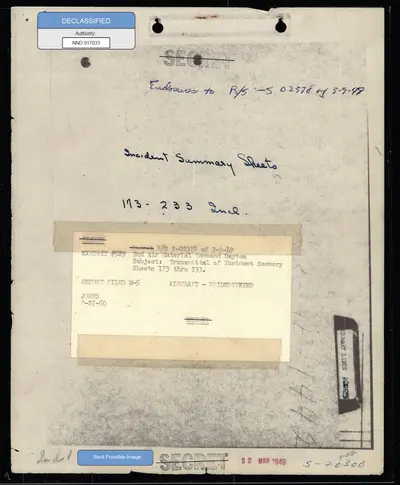
Case Overview
The 1947 Moorhsad, Minnesota, unidentified aerial phenomenon (UAP) encounter is documented within the United States Army Air Forces “Check-List - Unidentified Flying Objects” series. Specifically, the incident is cataloged as Incident #192 in Box 7 of file 38_143685. The details of this sighting emerged from official archives when the Department of War released the records on May 8, 2026, as part of the Presidential Unsealing and Reporting System for UAP Encounters (PURSUE). The documentation provides a summary of a sighting reported by an unspecified observer in the vicinity of Moorhsad, characterizing the event as a visual sighting of an unidentified object.
Historical Context
The timing of the Moorhsad incident places it within a significant period of American aviation history and a surge in aerial anomaly reports. The summer of 1947 is widely recognized by historians of the phenomenon as the beginning of the “flying saucer” era in the United States. This period was catalyzed by the Kenneth Arnold sighting in June 194
7 and the subsequent, highly publicized events surrounding the Roswell incident in July 1947. During this era, the rapid advancement of post-World War II aeronautical technology often outpaced the ability of the public and military observers to identify new aircraft. The presence of experimental jet propulsion and early rocket-based technology contributed to a climate of uncertainty regarding unidentified objects in the upper atmosphere.
Geographically, the location of Moorhsad, situated in the rural landscape of southern Minnesota, represents the widespread nature of these reports, which were not confined to the American Southwest but appeared across the continental United States. The reporting of such sightings by the U.S. Army Air Forces during this period reflects an early, systematic attempt to categorize and track objects that did not conform to known flight patterns or silhouettes.
Analysis and Classification
The Moorhsad encounter is classified as a visual sighting, a category that encompasses observations made by both ground-based and air-based observers. Within the framework of the 1947-era “saucer wave,” such sightings were often difficult to verify due to the lack of advanced radar or infrared tracking capabilities available to civilian and many military observers at the time.
The status of Incident #192 remains officially unresolved. Under the protocols of the All-domain Anomaly Resolution Office, all records released through the PURSUE program are designated as such. The federal government has maintained a neutral stance regarding the nature of this specific encounter, neither confirming that the object was anomalous nor concluding that it was a conventional phenomenon.
In the study of mid-century aerial anomalies, several conventional explanations are frequently applied to sightings of this period. These include the presence of Project Mogul balloon flights, which were active over parts of the United States to detect Soviet nuclear tests, as well as the testing of experimental aircraft and rocket-powered vehicles. Other possibilities considered by researchers include atmospheric optical effects, such as sun dogs or reflections, and the misidentification of astronomical bodies or satellites at unusual angles. The Moorhsad report remains a part of the permanent record of these unverified aerial events.