Florence, Alabama UFO Sighting (August 26, 1947) — FBI Files
An FBI file documents a 1947 inquiry from the Krillians regarding unidentified flying objects and government rewards in Florence, Alabama.
Historical Context
The summer of 1947 is widely regarded by historians of ufology as the period that initiated the modern era of unidentified flying object phenomena. Following the June 194 and July 1947 reports involving Kenneth Arnold and the events in Roswell, New Mexico, the American public experienced a sudden and widespread surge in sightings of metallic, disc-shaped objects. This era, often characterized by the term “flying saucer,” coincided with the early stages of the Cold War, a period of intense atmospheric surveillance and the rapid development of aeronautical technology. During this time, the United States government was increasingly preoccupied with the possibility of advanced Soviet aerospace capabilities, leading to heightened sensitivity regarding any unidentified aerial phenomena.
The geography of the Tennessee Valley, specifically around Florence, Alabama, placed the region within a corridor of significant strategic interest. The area’s proximity to various military installations and its role in the burgeoning industrial landscape of the mid-century meant that aerial anomalies were often viewed through the lens of national security. During the late 1940s, the presence of experimental aircraft and high-altitude reconnaissance balloons, such as those utilized in the Project Mogul series, contributed to a climate of atmospheric uncertainty.
The Florence Incident
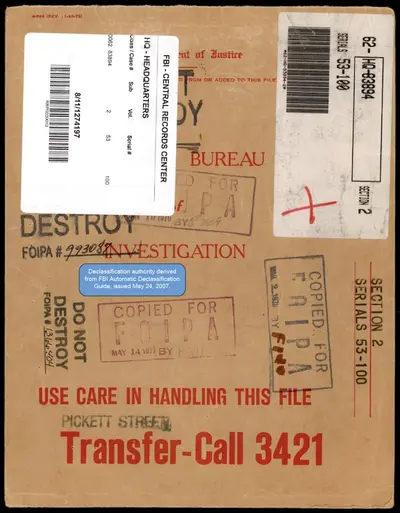
On August 26, 1947, an incident involving an unidentified object was recorded in Florence, Alabama. The details of this specific sighting were preserved within the files of the Federal Bureau of Investigation. The documentation regarding this event was released to the public on May 8, 2026, as part of the Presidential Unsealing and Reporting System for UAP Encounters (PURSUE). This release was part of a broader effort to provide transparency regarding historical aerial anomalies that had previously been shielded from public view under various classification protocols.
The primary content of the released FBI document consists of a letter addressed to J. Edgar Hoover from Mr. and Mrs. Krillians. In their correspondence, the Krillians inquired about the existence of a reward offered by a United States Government Agency for information pertaining to unidentified flying objects. This inquiry suggests that the phenomenon was a matter of public interest and that individuals were actively seeking financial incentive for reporting such sightings. In his response, Director Hoover stated that he was unable to assist the Krillians in their specific inquiry regarding the reward.
While the document confirms the receipt of the inquiry and the nature of the subject matter, the released text does not specify the number of witnesses involved in the Florence sighting. The case was processed through the FBI’s standard administrative channels, where field offices in locations such as Knoxville, Albuquerque, and Los Angeles were instructed to route UFO-related reports to headquarters. This protocol was maintained primarily to ensure the protection of vital installations and to monitor potential threats to national infrastructure.
Classification and Analysis
The Florence case is classified as a visual sighting reported by ground or air observers. Within the framework of modern analysis, all records released under the PURSUE program are designated as unresolved by the All-domain Anomaly Resolution Office (AARO) by default. The federal government has maintained a position of neutrality regarding the Florence incident, neither concluding that the object was anomalous nor confirming that it was a conventional phenomenon.
When evaluating sightings from this period, investigators often consider several conventional candidates. These include atmospheric optical phenomena, such as sundogs or lenticular clouds, which can create the illusion of moving, structured objects. Astronomical objects, including the Moon, Venus, or meteors near the horizon, are also frequently cited. Furthermore, the era’s proliferation of experimental aircraft and high-altitude balloons provides a technical basis for many reported sightings. The Florence documentation remains a part of the historical record of this period of intense aerial observation.