Chicago, Illinois UFO Sighting, 1947 — FBI Files
An investigation into 1947 unidentified flying object sightings in Chicago, documented in declassified FBI files released via the PURSUE program.
Background
In 1947, in Chicago, Illinois, U.S. government investigators recorded an unidentified-object incident later released to the public on May 8, 2026, as part of the Presidential Unsealing and Reporting System for UAP Encounters (PURSUE). This specific documentation emerged from a period of heightened national anxiety regarding aerial unidentified phenomena. The incident is one of the first wave of “flying saucer” reports that swept the United States following the Kenneth Arnold sighting of June 1947 and the Roswell incident of July 1947. During this era, the sudden influx of reports created a cultural and bureaucratic phenomenon often referred to as the “flying saucer” craze, which forced federal agencies to develop new methods for tracking and cataloging aerial anomalies.
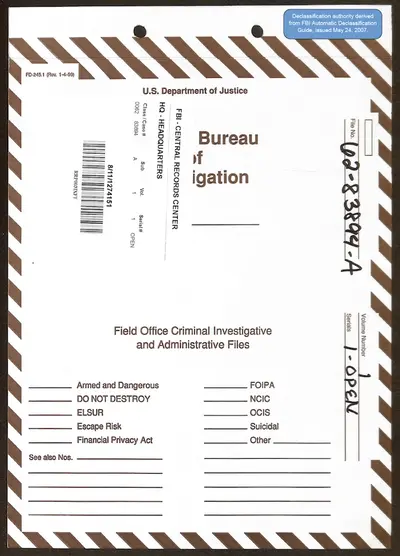
The administrative handling of this case highlights the internal mechanics of mid-century federal surveillance. The case was filed with the Federal Bureau of Investigation, whose Knoxville, Albuquerque, Los Angeles, and other field offices routed UFO reports to headquarters under the Bureau’s standing protocols for the protection of vital installations. At the time, the FBI’s interest in such sightings was primarily driven by concerns regarding national security and the potential for unauthorized incursions into American airspace. Because Chicago served as a major industrial and transportation hub, any unidentified aerial activity in the region was viewed through the lens of potential espionage or technological threats to critical infrastructure.
What the document records
In 1947, Chicago experienced a wave of sightings of unidentified flying objects. These objects were described as lights that moved at impossible speeds, reversed direction instantly, and performed maneuvers beyond the capabilities of known aircraft. The objects would appear and then disappear from sight. The erratic flight patterns described in the records—specifically the ability to execute instantaneous directional changes—distinguished these reports from the steady, predictable trajectories of contemporary propeller-driven or early jet-propulsion aircraft.
The number of witnesses is not specified in the released document. However, the nature of the reports suggests a mass-witness event, observed by large numbers of people simultaneously. Such widespread observations are characteristic of the 1947 wave, where atmospheric conditions or large-scale urban visibility allowed for near-simultaneous sightings across different sectors of a metropolitan area.
Type of case
The case is a mass-witness event, observed by large numbers of people simultaneously. Such events are historically significant to researchers because they increase the difficulty of attributing the sightings to individual optical illusions or localized misidentifications, as the consistency of the reported maneuvers across multiple observers suggests a shared encounter with a physical phenomenon.
Status
All records released under the PURSUE program are designated unresolved by the All-domain Anomaly Resolution Office (AARO) by default. The federal government has not concluded that the events were anomalous, has not concluded that they were conventional, and has not ruled out either possibility. The lack of a definitive conclusion reflects the inherent difficulty in verifying mid-century sightings where physical evidence was rarely recovered.
Conventional candidates for sightings of this period include experimental aircraft, weather balloons, particularly the Project Mogul series in the late 1940s, which utilized high-altitude balloons to detect Soviet nuclear tests. Other potential explanations involve atmospheric optical phenomena such as sundogs and lenticular clouds, which can mimic the appearance of stationary or slow-moving craft. Additionally, astronomical objects including Venus, the Moon, and meteors near the horizon were frequently misidentified as unidentified flying objects during this period of intense public scrutiny.