The Westall UFO Encounter
Over 200 students and teachers watched a UFO land near their school, an encounter followed by mysterious official intervention.
The morning of April 6, 1966, was overcast and cool in the southeastern suburbs of Melbourne, the kind of grey autumn day that settles over the Australian city as the warm months recede and winter approaches. At Westall High School and the adjacent Westall State School, in the working-class suburb of Clayton South, students were going about their Wednesday routines---attending classes, chatting in corridors, preparing for the midmorning break that would release them briefly into the schoolyard. None of them knew that within the hour, they would witness an event that would mark them for life, divide their community, attract the attention of mysterious authorities, and become the most significant mass UFO sighting in Australian history.
The Schools and the Setting
Westall in 1966 was an unremarkable suburban neighborhood on Melbourne’s southeastern fringe. Built in the postwar boom that had transformed Australia’s cities, it was a place of modest brick homes, neatly kept gardens, and families striving to establish themselves in a young and optimistic nation. The two schools---Westall High School and the primary-level Westall State School---sat adjacent to each other, serving the children of the surrounding streets. To the south of the school grounds lay an open area known as The Grange, a paddock of wild grass bordered by pine trees, and beyond that, a grove and more open land.
The schools’ proximity to this open ground would prove crucial to what happened that morning. The Grange provided both a landing site for the object that appeared and an open field across which hundreds of students could run toward it, transforming passive observers into active witnesses who came close enough to the phenomenon to see details that more distant observers would have missed.
The student population was predominantly working class, the children of tradesmen, factory workers, and small business owners. They were not, as a group, particularly interested in science fiction, UFOs, or the paranormal. They were ordinary Australian kids of the mid-1960s, preoccupied with the concerns of their age---schoolwork, sports, social hierarchies, and the distant thunder of a changing world. What they saw that morning was not something they had been primed to see, not something they were looking for, and not something that fit comfortably into any framework their young lives had provided them.
The Sighting
At approximately 11:00 AM, during the morning break, students who were outside in the schoolyard or on the playing fields began to notice something unusual in the sky to the south. Accounts vary slightly in their details---as they inevitably do with any event witnessed by a large crowd---but the broad outlines are remarkably consistent across the hundreds of testimonies that have been collected over the decades.
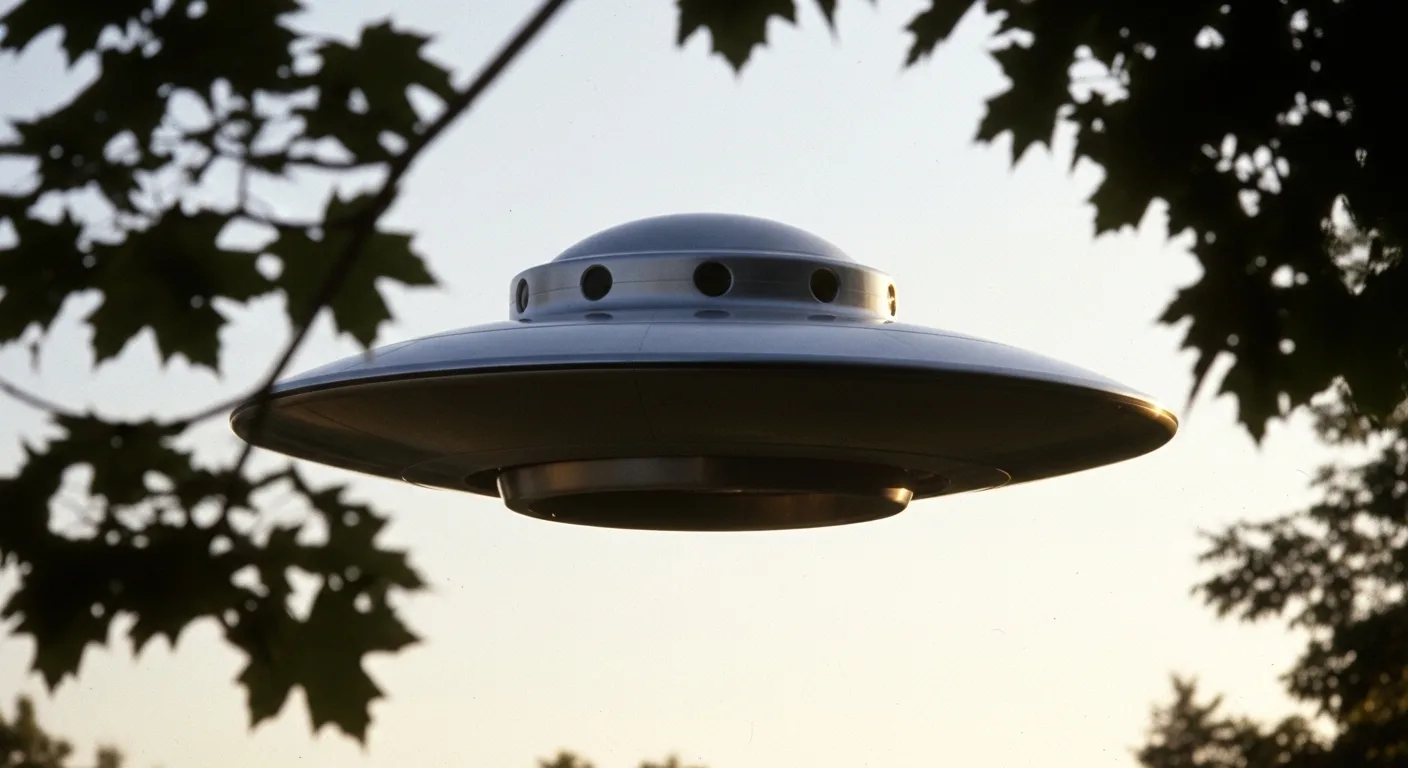
A grey, silvery, or metallic object appeared in the sky, moving in a manner that immediately distinguished it from conventional aircraft. Witnesses described it as saucer-shaped or disc-shaped, roughly the size of two or three cars, with a smooth, featureless surface. It was not a helicopter, not an airplane, not a balloon, and not anything else that the students or teachers could identify. It moved silently or nearly so, gliding through the overcast sky with a purposefulness that suggested intelligent control.
The object descended toward The Grange, the open paddock south of the school grounds. Multiple witnesses reported that it appeared to land or hover very close to the ground in the area near the pine trees. Some described it as touching down briefly; others said it hovered just above the surface. The distinction may reflect different vantage points and distances rather than contradictory observations.
The reaction among the students was immediate and electric. Word spread through the schoolyard with the speed of wildfire, and within moments, what had been a handful of individual observers became a mass movement. Students poured out of the school buildings and ran toward The Grange, drawn by the irresistible pull of the extraordinary. Teachers followed, some trying to maintain order, others as transfixed by the spectacle as their students.
Andrew Greenwood, a science teacher at Westall High School, was among the faculty who witnessed the event. His account would later become one of the most detailed and credible of all the Westall testimonies. Greenwood described seeing the object clearly from the school grounds and watching it descend toward The Grange. He estimated its size as roughly equivalent to two cars and noted that it appeared solid and metallic, reflecting the ambient light of the overcast sky.
Multiple Objects and Aircraft
The situation grew more complex and more mysterious as the event unfolded. Some witnesses reported seeing not one but several objects in the sky---the primary craft and smaller objects that appeared to be accompanying or escorting it. These secondary objects were described as smaller and more maneuverable than the main craft, and their presence suggested a coordinated operation rather than a single anomalous object.
Adding another layer of strangeness, several witnesses reported seeing five light aircraft---small, single-engine planes---circling the area during and after the object’s appearance. These planes appeared to be observing or pursuing the UFO, though their relationship to the event was never officially explained. Who had dispatched the aircraft, and for what purpose, remained unknown. Their presence suggested that someone with access to aviation resources was aware of the event as it was happening and had responded to it---a response that implies monitoring, preparation, or at minimum an extremely rapid reaction to an unexpected occurrence.
The main object, after hovering near or on the ground for what witnesses estimated as several minutes, rose again and departed at high speed, ascending into the overcast sky and disappearing from view. The secondary objects, if they had been present, also departed. The light aircraft continued to circle for a time before they too moved away.
The Landing Site
Students who reached The Grange while the object was still present, or shortly after its departure, reported finding physical evidence of its presence. The most commonly described feature was a circular area of flattened or swirled grass, as if the vegetation had been pressed down by a rotating force or by the weight of an object resting upon it. The affected area was clearly defined and distinctly different from the surrounding grass, which was tall and undisturbed.
Some witnesses described the flattened grass as forming a perfect circle, while others recalled a more irregular pattern. Several students reported that the affected area felt warm to the touch, though this detail appears in some accounts and not others. The ground itself may have been disturbed---compressed or marked in ways consistent with something heavy having rested on it briefly.
The physical evidence at the landing site would later become a subject of controversy, because it was reportedly removed or obscured relatively quickly after the event. Some witnesses claim that officials who arrived at the school later in the day visited The Grange and disturbed or destroyed the evidence. Others report that the area was burned---either by authorities seeking to eliminate traces or by some property of the object itself that had affected the vegetation. The exact sequence and nature of these alleged interventions remain disputed.
The Official Response
What happened in the hours and days following the sighting troubled the witnesses of Westall at least as deeply as the sighting itself. Almost unanimously, those who were present describe a systematic effort by authority figures to suppress discussion of the event and to discourage witnesses from speaking about what they had seen.
The first intervention came at the school itself. Witnesses report that men in suits---not school staff, not local police, but unidentified officials---arrived at Westall High School within hours of the sighting. They met with the school principal, and shortly afterward, students were assembled and told, in terms that varied from the diplomatic to the threatening, that they were not to discuss what they had seen. Some witnesses recall being told that what they had observed was a weather balloon or a conventional aircraft. Others report being warned that discussing the event would bring trouble upon them and their families.
The warning carried weight because of its source. These were not schoolyard rumors or parental cautions. They came from authority figures---men who carried themselves with the assurance of government officials and who spoke with the expectation of being obeyed. For children in 1960s Australia, where deference to authority was deeply ingrained in the culture, such warnings were effectively silencing.
Teachers who corroborated their students’ accounts were, according to multiple witnesses, transferred to other schools in the aftermath of the event. Andrew Greenwood, the science teacher who had provided one of the most detailed accounts, reportedly faced professional consequences for his willingness to discuss what he had seen. The message was clear: speaking about the Westall event carried a cost, and those who persisted in discussing it would pay that cost.
The local press provided minimal coverage. The Dandenong Journal, a suburban newspaper, published a brief article about the sighting, but further coverage was apparently discouraged. No major Melbourne newspaper or television station gave the story sustained attention, despite the extraordinary nature of the event and the number of witnesses involved. Whether this absence of coverage reflected editorial judgment, official pressure, or simple disinterest in a story from a working-class suburb has never been definitively established.
Decades of Silence
For years after the event, the witnesses of Westall largely kept their silence. They had been told not to speak, and for the most part, they complied. Life moved on. Students grew up, left school, pursued careers, raised families. The memory of what they had seen remained vivid---many describe it as the most extraordinary experience of their lives---but it was a memory they kept to themselves, shared only with close friends or family members, if they shared it at all.
This silence was not born of doubt. The witnesses did not question what they had seen. They questioned, rather, whether anyone would believe them, and they feared the consequences---social, professional, personal---of being associated with a UFO sighting. In a culture that prided itself on practical common sense, claiming to have seen a flying saucer land near your school was an invitation to ridicule, and most of the Westall witnesses chose discretion over disclosure.
The silence began to break in the early 2000s, as some witnesses, now in middle age, began to feel that the story needed to be told before memory and mortality claimed the generation that had been present. Reunions were organized. Old schoolmates reconnected. And gradually, haltingly, the accounts began to emerge---not as the faded recollections of aging minds but as sharp, detailed, emotionally charged memories that had been preserved with startling clarity across four decades of silence.
Shane Ryan and the Documentary
The most significant effort to document the Westall event came from Shane Ryan, a researcher and filmmaker who spent years tracking down witnesses and collecting their testimonies for a documentary film, “Westall ‘66: A Suburban UFO Mystery,” released in 2010. Ryan’s work was painstaking and methodical. He located dozens of former students and teachers, conducted extensive interviews, and cross-referenced accounts to identify points of convergence and divergence.
What Ryan found was remarkable. Despite decades of separation---many of the witnesses had not seen each other since leaving school and had no opportunity to coordinate their stories---their accounts were broadly consistent. They described the same object, the same location, the same sequence of events, and the same official response. Individual details varied, as they always do in eyewitness accounts, but the core narrative was stable across a witness pool of extraordinary size and diversity.
Ryan’s documentary brought the Westall event to a wider audience and reignited public interest in the case. Former witnesses who had kept silent for forty years came forward to share their experiences, often with visible emotion. Many expressed a sense of relief at finally being able to speak openly about what they had seen, and anger at the authorities who had pressured them into silence.
Theories and Analysis
The Westall event has resisted conventional explanation for over half a century. The most commonly proposed explanations---weather balloon, experimental aircraft, mass hallucination---fail to account for the evidence.
The weather balloon hypothesis is perhaps the weakest. Weather balloons are familiar objects to anyone who has seen one, and they do not descend, hover near the ground, and depart at high speed. They do not leave circular impressions in grass. And they do not prompt the deployment of five aircraft and the arrival of government officials at a suburban school.
The experimental aircraft theory is more intriguing but equally unsupported. No government or military agency has ever claimed responsibility for an experimental craft in the Westall area on April 6, 1966. The Royal Australian Air Force has denied involvement. And an experimental aircraft test over a populated suburban area, near two schools full of children, would represent a recklessness almost beyond belief.
Mass hallucination---the suggestion that over 200 people simultaneously imagined the same event---is not a phenomenon recognized by psychology. Groups can be influenced by suggestion and expectation, but they do not collectively hallucinate detailed, consistent, multi-sensory experiences that leave physical traces on the ground.
The official response itself argues against any mundane explanation. Weather balloons and conventional aircraft do not require the silencing of witnesses, the transfer of corroborating teachers, or the arrival of unidentified officials at a school. The intensity of the suppression effort suggests that whatever occurred at Westall was significant enough to warrant an organized response from authorities who understood its implications---and who were determined to prevent those implications from becoming public knowledge.
The Witnesses Today
The former students and teachers of Westall are now in their seventies and beyond, the youngest witnesses having been primary school children in 1966. Many have participated in reunions, interviews, and documentary projects, contributing their memories to a collective record that grows richer with each new account.
What strikes most observers about the Westall witnesses is not the drama of their stories but the depth of their conviction. These are not people seeking attention or profit. Many are visibly uncomfortable with public speaking and have no interest in the UFO community or its culture. They are ordinary Australians who saw something extraordinary when they were young and who have carried that experience---and the frustration of being told to deny it---for most of their lives.
The emotional resonance of the Westall event extends beyond the sighting itself. For many witnesses, the most traumatic aspect was not the UFO but the official response---being told by authority figures that what they had seen with their own eyes had not happened, that they should not speak of it, that there would be consequences for those who did. This experience of institutional gaslighting left scars that are still visible decades later, a wound inflicted not by the unknown but by the familiar machinery of power and control.
Australia’s Greatest UFO Mystery
The Westall encounter of April 6, 1966, stands as the most significant mass UFO sighting in Australian history and one of the most remarkable such events anywhere in the world. Its combination of factors---over 200 witnesses, a daylight sighting, an apparent landing with physical traces, multiple objects, accompanying aircraft, and a systematic suppression effort by unidentified authorities---creates a case of extraordinary evidential weight.
What descended from the autumn sky over a Melbourne suburb that Wednesday morning has never been identified. Who sent the men in suits to silence the witnesses has never been established. Why teachers were transferred and coverage was discouraged has never been explained. The questions that the children of Westall asked themselves as they ran across the playing fields toward The Grange remain unanswered more than half a century later, and the answers, if they exist, remain locked behind the same walls of institutional silence that were erected in the hours after the event.
The students who ran toward the light that morning are old now. They have lived full lives, raised families, and built careers. But when they speak of what they saw at Westall---and increasingly, they do speak of it---their eyes sharpen, their voices steady, and the years fall away. They are children again, running across a paddock toward something impossible, something that changed them forever, something that the world told them to forget but that they never could. Whatever landed at The Grange that autumn morning, it left its mark not only on the grass but on the lives of everyone who saw it---a mark that neither time nor authority has been able to erase.
Sources
- Project Blue Book — National Archives — USAF UFO investigation files, 1947–1969
- CIA UFO/UAP Reading Room — Declassified CIA documents on UAP