Tully Saucer Nest
Farmer George Pedley saw a grey saucer-shaped object rise from a swamp and fly away. Where it had been, he found a circular 'nest'—reeds flattened in a spiral pattern. More nests appeared over following weeks. They became the template for crop circles.
On the morning of January 19, 1966, in the tropical wetlands of Far North Queensland, a banana farmer named George Pedley witnessed something that would become one of Australia’s most famous UFO cases and arguably the prototype for the crop circle phenomenon. While driving his tractor near Horseshoe Lagoon on a property outside the town of Tully, Pedley heard a loud hissing sound. Looking toward the swamp, he saw a large grey object rising from the reeds, spinning as it ascended, then accelerating away at phenomenal speed until it vanished into the morning sky. When Pedley approached the lagoon to investigate, he found something remarkable: a circular area of reeds, thirty feet in diameter, flattened in a clockwise spiral pattern, floating on the water like a giant nest. The reeds were woven together in a pattern that seemed impossible for natural forces to create. More nests appeared in the following weeks, some witnessed being created, others simply discovered. The Australian Air Force investigated and offered no explanation. Scientists examined the nests and disagreed about their origins. And the Tully Saucer Nests, as they came to be known, entered the annals of UFO history—years before the first crop circles appeared in English wheat fields, establishing a template for physical trace cases that continues to intrigue researchers today.
The Morning
George Pedley was twenty-seven years old, a banana farmer born and raised in the Tully area. He was experienced with the local terrain and familiar with the swamp and its wildlife—a practical man doing practical work, not given to fantasy or exaggeration. On the morning of January 19, 1966, a hot Queensland summer day with clear skies and good visibility, he was driving his tractor along a track near Horseshoe Lagoon, a swampy area on Albert Pennisi’s property known as Doyle’s farm. The lagoon was dense with reeds and tropical vegetation, with water several feet deep in places—a place Pedley knew well, where he had come to check on a neighbor’s equipment.
At approximately 9:00 AM, the ordinary morning ended. Pedley heard a loud hissing noise, like air escaping from a tire, coming from the direction of the lagoon. It was loud enough to hear over the tractor engine, unusual enough to warrant investigation. He stopped to look.
The Sighting
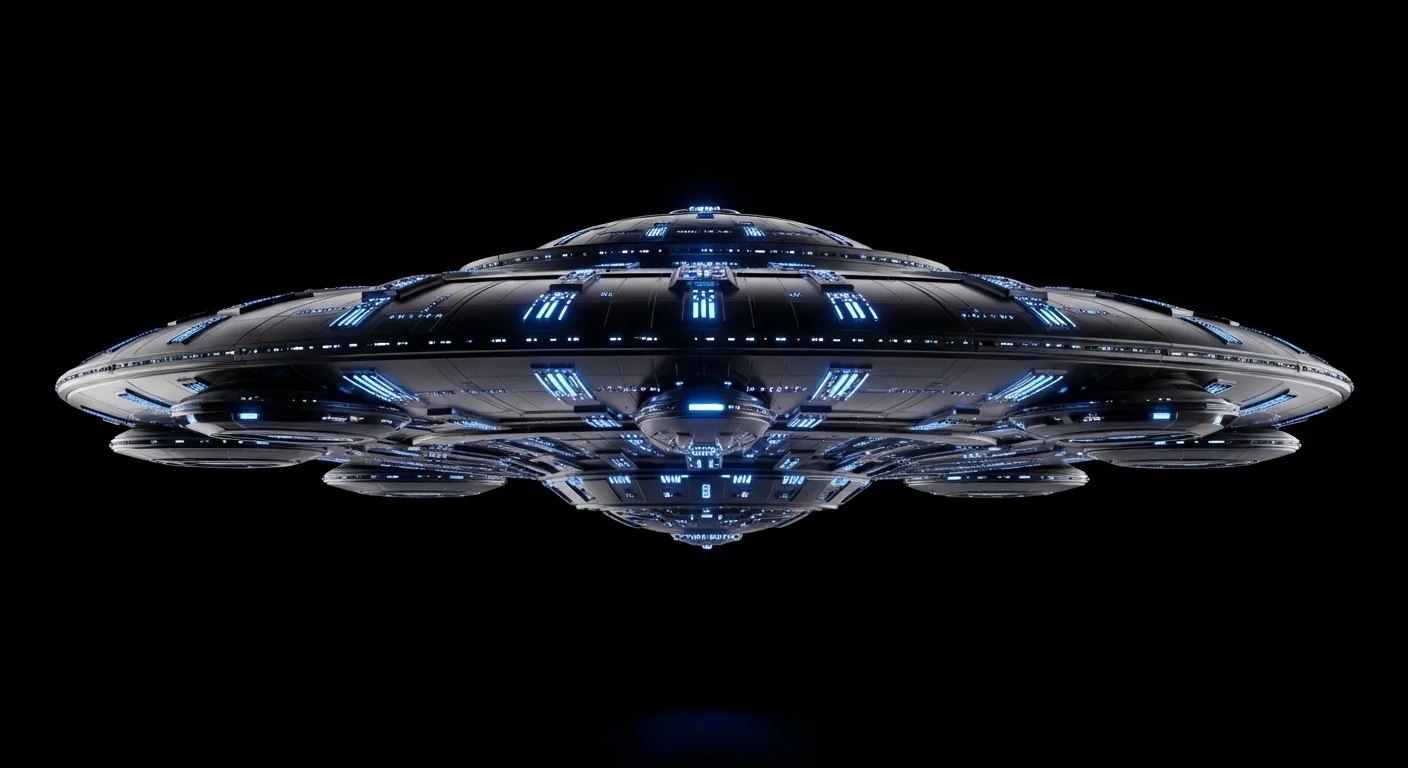
What Pedley saw rising from the swamp was a large saucer-shaped object, grey or blue-grey in color, approximately twenty-five feet in diameter and perhaps nine feet thick at the center. Its surface appeared smooth and metallic, with no visible windows, doors, or markings. The object was spinning on its axis as it rose vertically from the reeds, the hissing sound continuing throughout its ascent. It cleared the trees at the edge of the lagoon, tilted slightly, and then accelerated away to the southwest at phenomenal speed.
The entire sighting lasted only seconds—perhaps twenty to thirty from first sound to disappearance. There was not enough time to retrieve a camera or call anyone. There was just enough time to watch, astonished, as something impossible flew away. The object vanished into the distance, moving faster than any known aircraft, with no sonic boom despite the apparent speed, no trail, no smoke, no debris. One moment it was there. The next it was gone, leaving only the lagoon behind.
The Nest
After the object disappeared, Pedley waded through the swampy terrain to where he had seen it rise. What he found was extraordinary and served as physical evidence that the sighting was not imaginary. A circular area of flattened reeds, approximately thirty feet in diameter, floated on the water’s surface. The reeds were woven together in a mat, arranged in a clockwise spiral pattern. The vegetation had been laid flat but remained green and alive—not burned, not dead, not scorched. The reeds were bent rather than broken, pressed down in a spiral as if something heavy had sat there and rotated while resting on the vegetation, then lifted off and left the pattern behind. The pattern was too regular to be natural.
Stunned by what he had found—clear physical evidence matching what he had witnessed—Pedley went to tell Albert Pennisi, the property owner. The investigation began.
The Investigation
The Royal Australian Air Force took the report seriously. Officers visited the site within days, examined the nest pattern, interviewed Pedley extensively, and measured and photographed the evidence. Their conclusion was that the phenomenon was unexplained, though they offered a possible natural explanation: the nest might have been created by a willy-willy, a small whirlwind common in Australia, that could have spun in the lagoon and flattened the reeds in a spiral pattern. The “UFO,” under this theory, might have been debris caught in the whirlwind, made visible by water vapor.
Pedley rejected this explanation outright. He had lived in the area his entire life and knew perfectly well what willy-willies looked like. What he saw was solid, not vapor or debris. It rose against the wind, not with it. The object was clearly structured and mechanical. The RAAF explanation did not match his observation, and he maintained his account until his death.
Scientific examination of the reeds yielded inconclusive results. Some showed unusual characteristics, with suggestions of rapid dehydration or exposure to unusual force, but different scientists reached different conclusions. The physical evidence supported multiple interpretations, and no consensus emerged.
More Nests
In the weeks following Pedley’s sighting, more nests were found in the Tully area—some in the same lagoon, others in nearby swamps. At least five additional nests appeared, some reportedly witnessed being created, others simply discovered. They varied in their characteristics: some spiraled clockwise while others went counterclockwise, sizes ranged from ten to thirty feet, and some were more tightly woven than others. The pattern suggested multiple events rather than a single phenomenon repeated identically.
Albert Pennisi himself reported seeing a UFO rise from the lagoon. Other local residents reported lights over the swamps, and some claimed to have found nests without seeing objects. The area became a focus of UFO activity, whether real or perceived. Nest discoveries continued for several weeks, then gradually tapered off. By March 1966, no new nests were appearing. Whatever had caused them seemed to have moved on, or stopped, or been satisfied. The mystery remained unsolved.
The Explanations
Skeptics proposed natural explanations centered on whirlwinds or waterspouts, which are common in tropical Queensland and could theoretically create spiral patterns in vegetation. The UFO, under this view, would have been misidentified weather phenomena—a combination of water vapor, debris, and imagination. However, the nests appeared during calm weather when no whirlwind activity was recorded. The precision and consistency of the spiral patterns across multiple nests, combined with Pedley’s eyewitness account of a structured craft exhibiting controlled behavior and extreme speed, strain the natural explanation considerably.
Those who believe the nests were created by an unknown craft suggest it may have landed in the swamp for unknown purposes—perhaps collecting water or plant samples—with its spinning motion creating the nest pattern as physical trace evidence of its presence. A middle-ground theory proposes unknown natural phenomena such as ball lightning or plasma effects that could create both the visual sighting and the physical traces without requiring an extraterrestrial origin. This explanation satisfies few, as it replaces one unknown with another.
The Crop Circle Connection
The Tully incident occurred in 1966, more than a decade before the English crop circle phenomenon began in the late 1970s. The first widely reported English crop circles appeared around 1978. The similarities between the Tully nests and later crop circles are notable: circular patterns in vegetation, spiral or swirl arrangements, unknown creation mechanisms, association with UFO sightings, physical traces without clear explanation, and ongoing controversy about natural versus mysterious origins.
There are differences as well. The Tully nests were in swamp reeds rather than agricultural fields. Tully had multiple eyewitness UFO sightings, which crop circles rarely do. Tully was never associated with known hoaxers, whereas crop circles have been repeatedly demonstrated as hoaxable. Still, some researchers suggest the Tully nests established a template—a visual vocabulary for what physical trace evidence from an unknown craft should look like. Later hoaxers may have been inspired by the Tully accounts, or genuine phenomena may share common causes across different environments. The connection remains speculative, but the visual similarity is striking.
The Legacy
The Tully case remains one of the strongest physical trace cases in UFO research. A credible witness with no motive to fabricate, physical evidence examined by military authorities, multiple additional sightings corroborating activity in the area, and no satisfactory conventional explanation—the case has withstood decades of scrutiny and remains unexplained after nearly sixty years. It put Australia on the UFO research map and remains the country’s most famous case, referenced in every Australian UFO book and serving as a tourist attraction for the Tully area.
For physical trace research more broadly, the Tully nests demonstrated what evidence looks like when something physical interacts with an environment. The methodology used to study them—measuring, photographing, analyzing—became the standard for later cases. The investigation was a model that subsequent researchers would follow.
The Witness
George Pedley’s credibility was central to the case. He was a local farmer, well-known and respected in his community, with no history of tall tales or attention-seeking. He gained nothing from his report and indeed received unwanted attention and ridicule. The “UFO witness” label followed him for the rest of his life, bringing constant revisits from investigators and skepticism from some neighbors. He was a quiet man forced into public scrutiny, all for telling the truth about what he saw—or what he believed he saw.
Through it all, he never wavered. The object was solid and structured. It was not a natural phenomenon. It behaved in ways that suggested intelligence. It left physical evidence of its presence. He saw what he saw, and no explanation could change that. He would have known a willy-willy. He maintained his account consistently, never changing details or embellishing, telling the same story until his death in 2015. The Tully case is named for the town, but it belongs to George Pedley.
Horseshoe Lagoon
On a hot January morning in 1966, something rose from a Queensland swamp. George Pedley saw it ascend, spinning and hissing, then accelerate away faster than any known aircraft. Where it had been, reeds lay flattened in a perfect spiral, woven together in a pattern that defied natural explanation.
The Tully Saucer Nests became Australia’s most famous UFO case, and perhaps the prototype for the crop circle phenomenon that would emerge in England years later. The Royal Australian Air Force investigated and found no explanation. Scientists examined the physical evidence and disagreed about what could have caused it. Skeptics proposed whirlwinds; believers proposed spacecraft. Neither side ever convinced the other.
More nests appeared in the following weeks, then stopped. The phenomenon came and went, leaving only the memory of flattened reeds and a farmer’s testimony behind. Pedley lived with his experience for nearly fifty more years, never changing his account, never claiming to understand what he had seen. He saw what he saw. That was all he ever said.
The lagoon still exists near Tully. The reeds still grow, still sway in the tropical breeze, still offer no testimony about what happened there in 1966. George Pedley is gone now, buried with his mystery. The official files remain inconclusive. The debate continues among researchers who never saw what Pedley saw, never touched the flattened reeds, never heard the hissing as something impossible rose into the morning sky.
Australia’s most famous UFO case remains unsolved.
The nests have long since decomposed.
But the questions they raised still float on the waters of memory, waiting for answers that may never come.
Sources
- Project Blue Book — National Archives — USAF UFO investigation files, 1947–1969
- CIA UFO/UAP Reading Room — Declassified CIA documents on UAP