The Trindade Island UFO Photographs
A Brazilian Navy ship photographed a Saturn-shaped UFO that was seen by the crew.
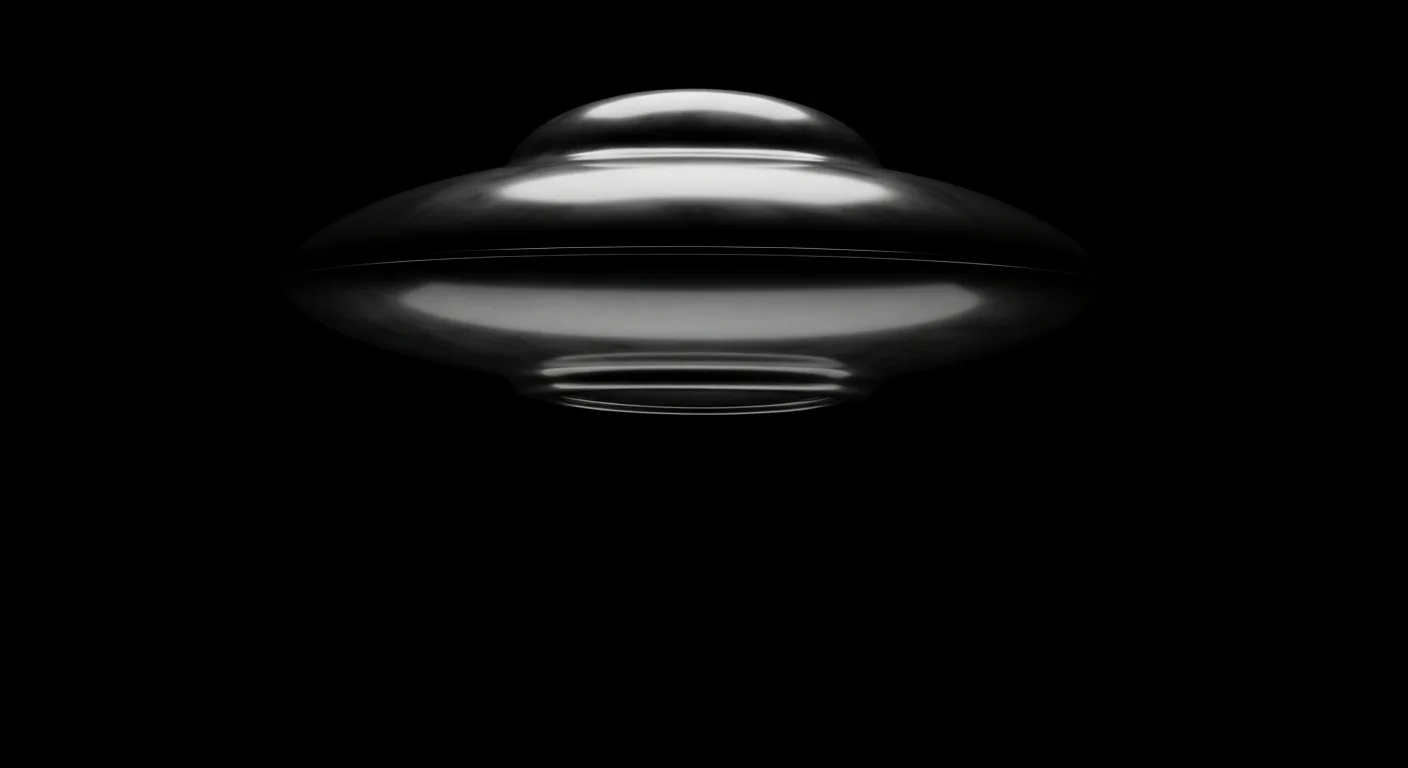
On a warm summer morning in January 1958, roughly one hundred and fifty people aboard the Brazilian Navy vessel Almirante Saldanha stood on the deck and watched something that defied explanation. A dark, Saturn-shaped object emerged from the horizon near Trindade Island, a remote volcanic outcrop in the South Atlantic, circled the island at extraordinary speed, and vanished into the sky. Among those witnesses was a professional photographer who managed to capture four frames of the object on his Rolleiflex camera. What followed was one of the most thoroughly investigated UFO cases in history, the only known instance in which a national government examined photographic evidence of an unidentified flying object and publicly declared it authentic. More than six decades later, the Trindade Island photographs remain among the most compelling and controversial pieces of UFO evidence ever produced.
The Island at the Edge of the World
To appreciate the significance of the Trindade Island encounter, one must first understand the extraordinary remoteness of the location where it occurred. Trindade Island lies approximately 1,140 kilometers off the coast of Espirito Santo, Brazil, a tiny volcanic speck in the vastness of the South Atlantic Ocean. Barely 5 kilometers long and 2.5 kilometers wide, the island is a jagged, inhospitable place dominated by the peak of Desejado, which rises some 600 meters above the surrounding sea. There are no permanent civilian inhabitants. The terrain is rugged and largely barren, sculpted by millennia of wind and wave into dramatic cliffs and rocky formations that give the island an almost otherworldly appearance.
The Brazilian Navy had maintained a small garrison on Trindade since the early twentieth century, and in 1957 the island took on new importance as a research station for the International Geophysical Year, a global scientific collaboration that ran from July 1957 through December 1958. Scientists from multiple Brazilian institutions were conducting meteorological, oceanographic, and geological studies on and around the island. The Almirante Saldanha, a former training ship converted into an oceanographic research vessel, served as the primary supply and transport ship for the station, making regular voyages between the island and the mainland.
It was during one of these routine voyages that the crew and passengers of the Almirante Saldanha would witness something that would thrust this obscure island into international headlines and spark a debate that continues to this day.
The Photographer and His Camera
Among the civilians aboard the Almirante Saldanha during its January 1958 voyage was Almiro Barauna, a forty-one-year-old photographer from Rio de Janeiro. Barauna was no amateur. He had worked as a professional photographer for newspapers and magazines, had extensive experience in underwater photography, and was a member of the Icarai Club for Underwater Hunting and Exploration. He had been invited on the voyage to take underwater photographs of the marine life around Trindade Island as part of the scientific program.
Barauna brought with him a Rolleiflex Model E camera fitted with a Planar f/2.8 lens, loaded with Ilford HP3 film, a fast black-and-white stock well suited to the bright tropical conditions. He had been using the camera throughout the voyage to photograph marine subjects and geological features, so it was loaded, wound, and ready to shoot when events took an unexpected turn.
Barauna’s credentials would later become both his greatest asset and his most significant liability. Supporters pointed to his professional experience as evidence that the photographs were genuine and properly exposed. Critics noted that his skill with cameras and darkroom techniques also meant he possessed the expertise to create a convincing hoax. This tension between competence and capability for deception would shadow the case throughout its history.
The Sighting
The morning of January 16, 1958 began unremarkably. The Almirante Saldanha was preparing to depart Trindade Island after completing its supply run to the scientific station. Crew members, naval officers, and civilian scientists moved about the deck, attending to the routine business of departure. The weather was clear, with good visibility across the waters surrounding the island.
At approximately 12:15 in the afternoon, retired Brazilian Air Force captain Jose Teobaldo Viegas, who was among the civilians on deck, spotted something unusual in the sky near the island’s Galo Crest peak. He called out to those around him, pointing toward the object. Within moments, dozens of people on deck were staring at the sky, watching a dark object approaching the island from the east at remarkable speed.
Barauna, who was on deck near the ship’s bow, heard the commotion and looked up. He later described his first impression of the object as a bright point of light moving rapidly toward the island. As it drew closer, its shape became more distinct. The object appeared flattened, like a disc viewed at a slight angle, with a pronounced bulge or ring around its equator that gave it the appearance of the planet Saturn. It was dark against the bright sky, reflecting sunlight along its upper surface.
Despite his shock, Barauna’s professional instincts took over. He raised his Rolleiflex and began shooting. In the span of approximately fourteen seconds, he managed to capture four photographs of the object as it performed what witnesses described as a remarkable aerial display. The object approached the island, appeared to slow or hover briefly near Galo Crest, accelerated away, then seemed to reverse direction and make a second pass before finally departing at tremendous speed and vanishing over the Atlantic.
Barauna later admitted that his hands were trembling so badly that framing the shots was extremely difficult. The twin-lens reflex design of the Rolleiflex, which required the photographer to look down into a waist-level viewfinder rather than bringing the camera to the eye, made tracking a fast-moving aerial object especially challenging. He also reported that in his excitement, he accidentally over-advanced the film on two frames, resulting in blank exposures. Despite these difficulties, four of his six attempted shots captured the object.
The witnesses on deck reacted with a mixture of astonishment and confusion. Some described the object as luminous and flattened. Others said it appeared to change brightness as it moved, growing dimmer as it passed behind or near the island’s peaks and brightening again as it emerged into open sky. Several witnesses reported that the object’s approach coincided with unusual behavior from the ship’s electronic equipment, though the specifics of these malfunctions were never formally documented.
The Developing of the Negatives
What happened in the minutes and hours following the sighting is almost as significant as the sighting itself, because the chain of custody of the photographic evidence would become a central point of contention in all subsequent analysis.
Commander Carlos Alberto Bacellar, the officer in charge of the Trindade scientific station, was aboard the Almirante Saldanha at the time of the sighting. Aware of the potential importance of Barauna’s photographs, Bacellar ordered that the film be developed immediately in the ship’s darkroom. This was a critical decision. By developing the negatives aboard the ship, under semi-controlled conditions and with naval personnel observing the process, Bacellar ensured that the photographs could not later be dismissed as having been tampered with during some unobserved period between exposure and processing.
Barauna took the film to the ship’s improvised darkroom, accompanied by Commander Bacellar and other officers. He developed the negatives using standard processing techniques. When the negatives emerged from their chemical bath, the dark Saturn-shaped object was clearly visible in four frames, precisely where witnesses had seen it in the sky. Commander Bacellar examined the wet negatives himself and confirmed that they showed the object the crew had observed.
The negatives were still damp when Bacellar passed them among the assembled officers and crew members on deck, allowing dozens of witnesses to confirm that the images matched what they had seen with their own eyes. This impromptu verification session, conducted within an hour of the sighting itself, provided a layer of authentication that few UFO photographs have ever received.
However, there was one complication. Although the negatives were developed aboard ship under observation, Barauna retained possession of them when the Almirante Saldanha returned to port. He produced the first prints himself in his own darkroom in Rio de Janeiro. Critics would later argue that this gap in custody, between the development of the negatives and the production of prints, theoretically allowed Barauna an opportunity to manipulate the images, though no evidence of such manipulation was ever found.
The Brazilian Navy Investigation
Upon the Almirante Saldanha’s return to Rio de Janeiro, Commander Bacellar submitted a formal report on the sighting to the Brazilian Navy’s intelligence service, the Servico Secreto da Marinha. The report included Barauna’s negatives, statements from multiple witnesses, and Bacellar’s own account of the events. The Navy launched a thorough investigation.
The negatives were examined by the Navy’s own photographic laboratory, the Photogrammetric Service. Technicians subjected the film to detailed analysis, looking for any evidence of double exposure, superimposition, retouching, or other forms of manipulation. They examined the grain structure of the film, the consistency of exposure across the frames, and the relative positions of the object in relation to identifiable features of the island’s terrain. Their conclusion was unequivocal: the negatives showed no evidence of tampering. The object depicted in the photographs was physically present in the sky at the time the images were captured.
The Navy also interviewed multiple witnesses from the Almirante Saldanha. Though the exact number of formal interviews remains unclear, statements were taken from both military personnel and civilians who had been on deck during the sighting. These statements were broadly consistent in their descriptions of the object’s appearance, behavior, and trajectory, lending significant weight to the photographic evidence.
The investigation produced a classified report that was submitted through the naval chain of command, eventually reaching the desk of President Juscelino Kubitschek. What happened next was unprecedented in the history of UFO research anywhere in the world.
The Presidential Authorization
President Kubitschek personally examined the Trindade photographs and the accompanying investigation report. In a decision that stunned both the Brazilian public and the international community, Kubitschek authorized the release of the photographs to the press, stating that they were authentic. On February 21, 1958, the photographs appeared on the front page of the Jornal do Brasil, one of the country’s most prominent newspapers, and from there they spread rapidly through the global media.
The significance of this presidential action cannot be overstated. In 1958, at the height of Cold War tensions, governments around the world were engaged in systematic suppression and dismissal of UFO reports. The United States Air Force’s Project Blue Book was actively debunking sightings, and most other nations simply ignored the subject. For the president of a major nation to personally examine UFO photographs and publicly declare them genuine was without precedent.
Kubitschek’s motivations remain debated. Some suggest he was genuinely convinced by the evidence. Others have proposed more political explanations, noting that sensational photographs could distract from domestic difficulties. Whatever his reasons, the effect was dramatic. The Trindade photographs became the most famous UFO images in the world, debated in parliaments, analyzed by scientists, and scrutinized by skeptics and believers alike.
The Brazilian Navy, for its part, maintained a careful official position. While the Navy confirmed that the photographs had been taken aboard one of its vessels, that its own laboratory had found no evidence of fakery, and that multiple naval personnel had witnessed the object, it stopped short of declaring what the object actually was. The official position remained that the photographs depicted an unidentified flying object, emphasis on “unidentified.”
Analysis and Controversy
The Trindade photographs attracted the attention of photographic experts, aeronautical scientists, and UFO researchers from around the world. The four images, when examined in sequence, appeared to show a solid, three-dimensional object moving through space relative to the island’s terrain. The object’s apparent size, based on triangulation with known geographic features of Trindade Island, was estimated at roughly 40 meters in diameter, though estimates varied depending on the assumptions used.
The Saturn-like shape of the object was its most distinctive feature. It appeared as a flattened disc with a pronounced equatorial ridge or ring, darker than the surrounding sky but with areas of brightness that suggested a reflective surface catching sunlight. The shape was consistent across all four frames, which was significant because a hoax involving a small model thrown into the air would likely show inconsistencies in shape, orientation, and apparent size as the model tumbled.
Dr. Olavo Fontes, a prominent Brazilian UFO researcher and medical doctor who investigated the case extensively, argued that the photographs represented some of the strongest evidence for the physical reality of UFOs. He pointed to the multiple witnesses, the controlled development of the negatives, the Navy’s own analysis, and the consistency of the photographic evidence as forming a mutually reinforcing body of proof that was extremely difficult to dismiss.
Skeptics, however, raised several objections. Some suggested that Barauna could have photographed a model against a backdrop of the island, perhaps using a small object suspended from a fine wire or thrown into the air. The fact that the object appeared relatively small in the photographs, and that atmospheric haze made fine detail difficult to discern, lent some plausibility to the model hypothesis. Others questioned why Barauna was apparently the only person who managed to photograph the object, despite the presence of roughly one hundred and fifty witnesses on deck. If the sighting lasted fourteen seconds, as Barauna claimed, it seemed odd that no one else reached for a camera.
The U.S. Navy and the CIA both took an interest in the Trindade photographs. Declassified documents reveal that American intelligence analysts examined the images and interviewed personnel connected with the case. Their assessments were mixed. Some analysts considered the photographs genuine but unexplainable. Others suspected a hoax, noting that Barauna had previously created trick photographs of objects appearing in the sky as part of a humorous newspaper feature on flying saucers. This detail, which Barauna himself had openly acknowledged, provided ammunition for those who wanted to dismiss the case entirely.
The trick photography issue deserves careful examination. Barauna had indeed produced faked UFO photographs prior to the Trindade sighting, but he had done so openly and for humorous purposes, not to deceive. Supporters argued that a skilled photographer who wanted to perpetrate a hoax would not have drawn attention to his ability to create such images. Critics countered that his demonstrated skill made it impossible to rule out fabrication.
The Witnesses’ Testimony
While much of the debate has centered on the photographs themselves, the testimony of the witnesses aboard the Almirante Saldanha deserves equal attention. Multiple witnesses provided independent accounts that were consistent in their essential details. Captain Viegas, who first spotted the object, described it as approaching the island at high speed from the east, slowing as it neared the peaks, and then executing a sharp turn before accelerating away. Several naval officers confirmed this account, adding details about the object’s luminosity and its Saturn-like shape. Civilian scientists with no particular interest in UFOs corroborated the military accounts.
The diversity of the observers strengthened the case considerably. These were not enthusiasts gathering in hopes of a sighting but military professionals and scientists going about routine duties, interrupted by something they could not explain. Their descriptions were matter-of-fact rather than sensational, consistent with trained observers reporting an anomalous event. However, skeptics noted that not all of the one hundred and fifty people on deck actually saw the object, and that some who were later interviewed could not confirm the sighting. The precise number of direct witnesses, as opposed to those simply present on deck, remains uncertain.
Legacy and Significance
The Trindade Island photographs occupy a unique position in the history of UFO research. They are among the very few UFO images to have been examined and authenticated by a national military organization. They were witnessed by dozens of trained observers aboard a government vessel. They were subjected to expert photographic analysis that found no evidence of tampering. And they were publicly endorsed by a sitting head of state. No other UFO case in history can claim all of these elements simultaneously.
The case also illustrates the fundamental difficulty of UFO evidence. Despite the extraordinary convergence of witnesses, photographic documentation, and official validation, the Trindade photographs remain contested. The gap between what believers see as overwhelming proof and what skeptics regard as insufficient evidence reflects a broader epistemological divide that has characterized the UFO debate since its inception.
In the decades since January 1958, the Trindade photographs have been reanalyzed using digital imaging techniques unavailable to the original investigators. Some of these analyses have supported the authenticity of the images, identifying three-dimensional characteristics of the object that would be difficult to fake with the technology available in 1958. Others have raised new questions, suggesting that certain aspects of the images are inconsistent with a large, distant object and more consistent with a small, nearby model.
The Brazilian government has never retracted its position on the photographs. The Navy’s finding that the negatives show no evidence of manipulation remains on record. The presidential authorization for their release has never been rescinded or repudiated. Whatever circled Trindade Island on that bright January morning in 1958, the Brazilian government treated it with a seriousness that most nations have never shown toward the UFO phenomenon.
Trindade Island itself remains a remote and restricted military installation, its volcanic peaks standing as they did on the day when something unexplained passed over them and was captured on film. For those who study the UFO phenomenon, the Trindade photographs endure as a reminder that some of the most compelling evidence for the unexplained comes not from lone observers on deserted roads but from crowded decks under clear skies, documented by professionals and validated by institutions with far more to lose than to gain from acknowledging the unknown.
Sources
- Project Blue Book — National Archives — USAF UFO investigation files, 1947–1969
- CIA UFO/UAP Reading Room — Declassified CIA documents on UAP