The O'Hare Airport UFO
A metallic disc hovered over one of America's busiest airports before shooting into the clouds.
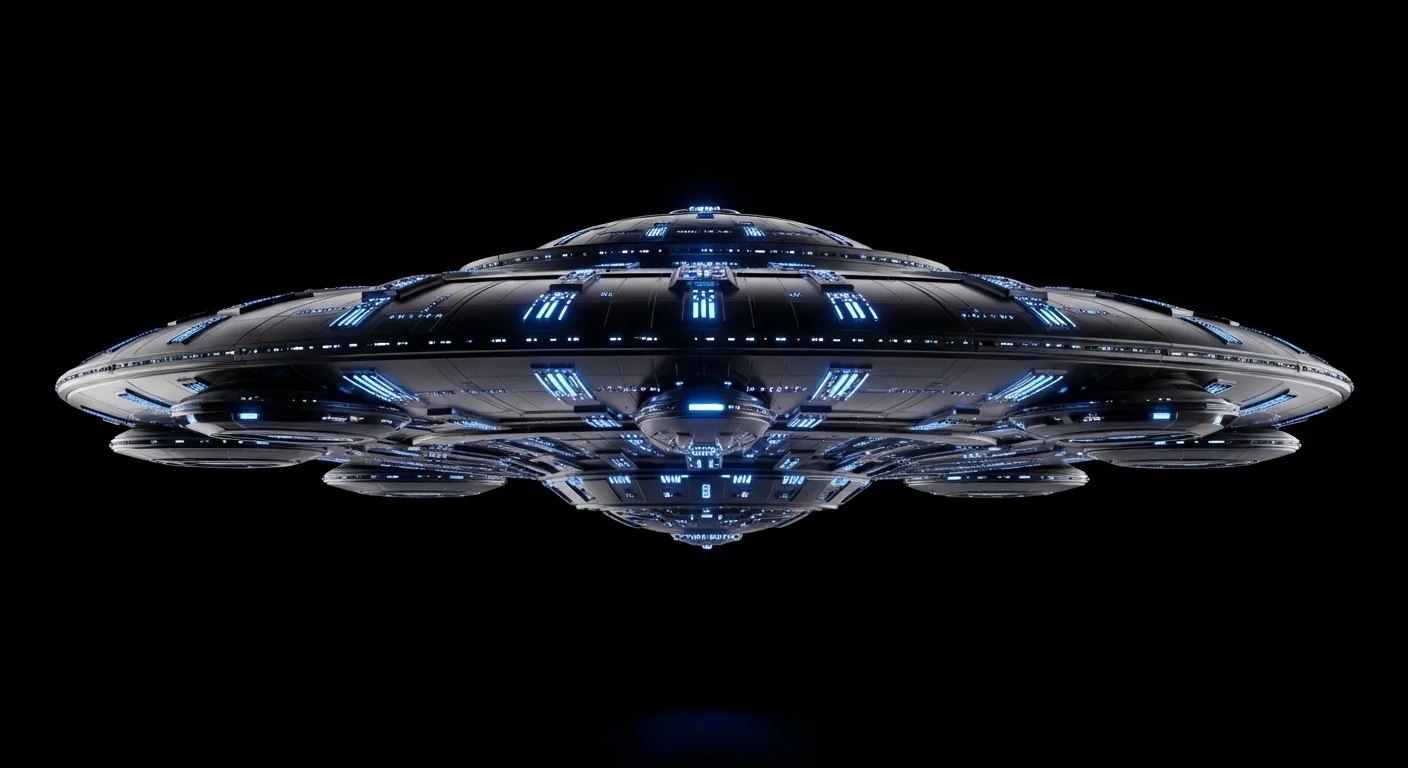
On the afternoon of November 7, 2006, a metallic disc-shaped object hovered silently above Gate C17 at Chicago’s O’Hare International Airport, one of the busiest airports in the world, in full view of multiple United Airlines employees before shooting straight upward through the overcast cloud layer and punching a perfectly circular hole in the clouds that remained visible for several minutes. The sighting, witnessed by at least twelve aviation professionals including pilots and mechanics who knew precisely what belonged in the sky above their workplace, was initially denied by the Federal Aviation Administration before a Freedom of Information Act request by the Chicago Tribune forced an acknowledgment that reports had indeed been filed. The O’Hare incident became one of the most widely discussed UFO cases of the twenty-first century, not because of what was seen, which was remarkable enough, but because of what happened afterward: the systematic attempt by authorities to make the sighting disappear, and the refusal of the witnesses to let them succeed.
The Busiest Airspace in America
O’Hare International Airport occupies a special place in American aviation. Located on the northwest side of Chicago, it served in 2006 as the world’s second-busiest airport by passenger traffic and the busiest by aircraft movements, meaning that more takeoffs and landings occurred at O’Hare on any given day than at any other airport on the planet. The airspace above O’Hare was among the most tightly controlled and intensely monitored in the world, managed by air traffic controllers who tracked every aircraft within miles of the field and coordinated arrivals and departures with a precision that left no room for unidentified objects.
The people who worked at O’Hare, from the pilots in the cockpits to the mechanics on the ramp to the gate agents in the terminals, were immersed in aviation. They spent their days surrounded by aircraft of every type, and they had developed an intuitive familiarity with the shapes, sounds, and behaviors of flying machines that few other populations could match. A United Airlines mechanic working the ramp at O’Hare had likely seen tens of thousands of aircraft pass through his or her field of vision. A pilot taxiing for departure had spent a career learning to identify objects in the sky quickly and accurately. These were not casual observers prone to mistaking Venus for a spacecraft or confusing a weather balloon with an alien vehicle. They were experts in their field, and when they said they saw something that did not belong in the sky above their airport, their assessment deserved serious attention.
The Sighting
The events of November 7 unfolded during the late afternoon, at approximately 4:15 PM Central Time, as the airport was operating at full capacity in the gathering dusk of a November day. The sky was overcast, with a solid cloud layer at approximately 1,900 feet, a common condition at O’Hare during the autumn months.
A United Airlines ramp employee was the first to notice the object. Looking up from his work near Gate C17 at Terminal C, he saw a dark gray, metallic disc hovering directly above the gate at an altitude roughly consistent with the base of the cloud layer. The object was solid, clearly defined against the gray sky, and completely motionless. It made no sound.
The employee alerted his colleagues, and within moments, a group of United Airlines personnel had gathered to observe the object. Among them were pilots preparing for departure, mechanics working on aircraft, and supervisory staff. All confirmed that they were seeing the same thing: a disc-shaped object, dark gray or metallic in color, hovering silently above one of the busiest gates at one of the busiest airports in the world.
The object’s size was estimated by witnesses to be roughly six to twenty-four feet in diameter, though precise size estimates were difficult given the absence of reference points at the altitude at which it hovered. Its shape was consistently described as disc-like or saucer-shaped, with a smooth, unbroken surface that showed no wings, no tail, no engines, and no other features associated with conventional aircraft. It was, to all appearances, a solid metallic disc, and nothing in the extensive aviation experience of the witnesses could account for it.
The Departure
The object hovered above Gate C17 for several minutes, long enough for multiple observers to study it carefully and for some to attempt, unsuccessfully, to reach supervisors or air traffic control to report what they were seeing. Then, without warning, the object moved. It shot straight upward at tremendous speed, accelerating from a dead hover to a velocity that carried it through the cloud layer in what witnesses described as an instant.
What happened next was, in many respects, the most remarkable aspect of the entire event. As the object passed through the overcast cloud layer, it left behind a perfectly circular hole in the clouds. The hole was clearly visible from the ground, a distinct opening in the otherwise solid overcast through which the blue sky above could be seen. The hole remained visible for several minutes before the surrounding clouds slowly closed in to fill it.
This physical effect on the cloud layer was significant because it provided a form of corroboration that went beyond eyewitness testimony. Clouds are water vapor, and a hole punched through a cloud layer suggests the passage of an object generating sufficient energy to disperse or evaporate the moisture in its path. The circular shape of the hole was consistent with the disc shape described by the witnesses, and its persistence for several minutes indicated that the energy involved was substantial. Whatever created the hole was not simply a bird, a balloon, or a piece of debris. It was something that moved with enough force and energy to physically alter the atmosphere as it passed through it.
The Witnesses
The twelve United Airlines employees who observed the object represented a cross-section of aviation expertise. Several were pilots, individuals who had spent their careers learning to identify objects in the sky and to assess potential threats to flight safety. Others were mechanics, men and women who understood the engineering of aircraft and could distinguish at a glance between a conventional aircraft and something entirely different. Still others were ramp workers, gate agents, and supervisory personnel whose daily exposure to airport operations gave them a deep familiarity with the normal sights and sounds of their workplace.
All of the witnesses agreed on the essential details of the sighting: a metallic disc, hovering silently, departing upward at high speed, leaving a hole in the clouds. There was no disagreement about the basic nature of what they had seen, only variations in the specific details that would be expected from multiple observers viewing the same event from slightly different positions and angles.
The willingness of these witnesses to report what they had seen was itself noteworthy. Aviation professionals, particularly pilots, faced significant professional risks in reporting UFO sightings. The aviation industry maintained a culture of rational, fact-based decision-making, and an employee who reported seeing a flying saucer could expect skepticism, ridicule, and potentially adverse career consequences. The fact that twelve professionals were willing to go on record with their observations suggested that they considered what they had seen to be significant enough to outweigh the personal costs of reporting it.
Several witnesses expressed frustration in subsequent interviews about the way their observations were received by their employer and by the authorities. They emphasized that they were not UFO enthusiasts or conspiracy theorists but working professionals who had seen something extraordinary in the course of their duties and felt an obligation to report it. Their frustration was compounded by the official response, which initially denied that any report had been made.
The Official Response
The initial response of the FAA to the O’Hare sighting was one of denial. When contacted by journalists, FAA officials stated that they had received no reports of unusual activity at O’Hare on November 7 and that no investigation was warranted. This denial stood for approximately two months, during which the sighting received minimal media attention despite the extraordinary nature of the event and the credibility of the witnesses.
The denial unraveled in January 2007 when the Chicago Tribune, acting on tips from the witnesses and their contacts, filed a Freedom of Information Act request for any records related to the November 7 sighting. The FOIA request revealed that reports had indeed been filed, that air traffic controllers had been contacted about the object, and that the FAA had been aware of the sighting from the day it occurred. The agency’s initial denial had been, to put it plainly, false.
Confronted with the evidence produced by the FOIA request, the FAA changed its position. Officials now acknowledged that reports had been received but attributed the sighting to a “weather phenomenon,” specifically suggesting that the witnesses had seen a hole-punch cloud, a natural atmospheric phenomenon in which a gap forms in a cloud layer due to the passage of an aircraft through supercooled water droplets. This explanation, however, got the sequence of events backward. The witnesses had not seen a hole in the clouds and mistaken it for a UFO. They had seen a disc-shaped object hovering above their gate and then watched it create a hole in the clouds as it departed upward. The hole was a consequence of the object’s departure, not the cause of the sighting.
The FAA’s handling of the O’Hare case became, for many observers, a case study in institutional dishonesty. The initial denial, the subsequent reversal forced by FOIA, and the inadequate weather explanation combined to create the impression that the agency was more interested in making the sighting go away than in understanding what had occurred. This impression fueled broader public skepticism about the government’s handling of UFO reports and contributed to the growing demand for transparency that would eventually produce legislative action and the establishment of dedicated UAP investigation programs.
The Chicago Tribune and Public Response
The Chicago Tribune’s investigation of the O’Hare sighting, published on January 1, 2007, became the most widely read story in the newspaper’s online history at that time. The article, which detailed the sighting, the witnesses’ accounts, and the FAA’s shifting response, struck a nerve with a public that was increasingly impatient with official dismissals of credible UFO reports.
The story generated an extraordinary volume of reader response, with the Tribune’s website recording millions of page views in the days following publication. The intensity of public interest reflected a broader cultural shift in attitudes toward UFOs. The stigma that had long attached to the subject was beginning to erode, and the O’Hare case, with its credible witnesses, its physical evidence in the form of the cloud hole, and its documented official cover-up, provided a catalyst for public discussion that had been lacking.
The Tribune’s success with the story also demonstrated the role that investigative journalism could play in UFO disclosure. Without the newspaper’s FOIA request, the FAA’s initial denial would have stood, and the sighting would likely have been forgotten. The case illustrated that the most important barrier to understanding the UFO phenomenon was not the absence of evidence but the suppression of evidence by institutions that preferred silence to the uncomfortable questions that disclosure would raise.
Physical Evidence and Scientific Interest
The hole punched in the cloud layer by the departing object attracted particular attention from researchers because it represented a rare instance of physical evidence associated with a UFO sighting. Most UFO reports involve eyewitness testimony and sometimes photographic or video evidence, but few involve a demonstrable physical effect on the environment that can be observed independently of the witnesses themselves.
The cloud hole was visible to anyone at the airport who looked up at the sky in the minutes following the object’s departure. It was not dependent on the testimony of the twelve primary witnesses. It was an objective physical phenomenon, a gap in the clouds that either existed or did not exist, and its existence was confirmed by multiple observers beyond the original witness group.
The mechanism by which the object created the hole was a matter of scientific speculation. Some researchers suggested that the object’s propulsion system generated sufficient heat to evaporate the water droplets in its path, creating a tube of clear air through the cloud layer. Others proposed that the object generated electromagnetic effects that disrupted the cloud structure. Still others suggested more exotic possibilities involving gravitational or inertial effects that are not currently understood by physics. Whatever the mechanism, the hole demonstrated that the object was not an illusion, a misperception, or a psychological phenomenon. It was a physical object that interacted with the physical environment in a measurable way.
A Turning Point
The O’Hare Airport UFO sighting of November 7, 2006, occupies an important position in the modern history of unidentified aerial phenomena. It was not the first UFO sighting at a major airport, nor was it the most dramatic. But it combined several elements that made it unusually significant: highly credible witnesses with deep aviation expertise, a sighting in broad daylight at one of the world’s busiest airports, a physical effect on the cloud layer that corroborated the witnesses’ account, and a documented attempt by the FAA to deny and then minimize the event.
The case demonstrated that the UFO phenomenon was not confined to remote areas, military installations, or the predawn hours when witnesses might be groggy or disoriented. It occurred in the middle of an ordinary working day, at a facility where thousands of people were going about their business, and it was witnessed by professionals whose ability to identify objects in the sky was the foundation of their livelihoods. These were not people who could be dismissed as unreliable, and their testimony could not be reasonably attributed to misidentification of a conventional phenomenon.
The O’Hare sighting also foreshadowed the institutional dynamics that would characterize the UAP disclosure movement in subsequent years. The pattern of official denial, forced disclosure through FOIA or congressional pressure, and inadequate explanation would repeat itself again and again as the government was slowly, reluctantly compelled to acknowledge that something was operating in American airspace that could not be identified or explained. The aviation professionals at Gate C17 who looked up and saw something impossible hovering above their workplace were among the early witnesses in a process that continues to unfold, a process that began with denial and has not yet arrived at answers.
The metallic disc is gone. The hole it left in the clouds closed long ago. But the questions it raised remain open, as clear and as troubling as the circle of blue sky that appeared above O’Hare on that November afternoon, a window punched through the ordinary world into something that lies beyond our current understanding.
Sources
- CIA UFO/UAP Reading Room — Declassified CIA documents on UAP