Petit-Rechain Triangle Photo
The most famous UFO photograph of the 1990s showed a black triangle over Belgium with lights at each corner. For 21 years it was considered authentic evidence of the Belgian wave. Then the photographer confessed—but the wave itself was real.
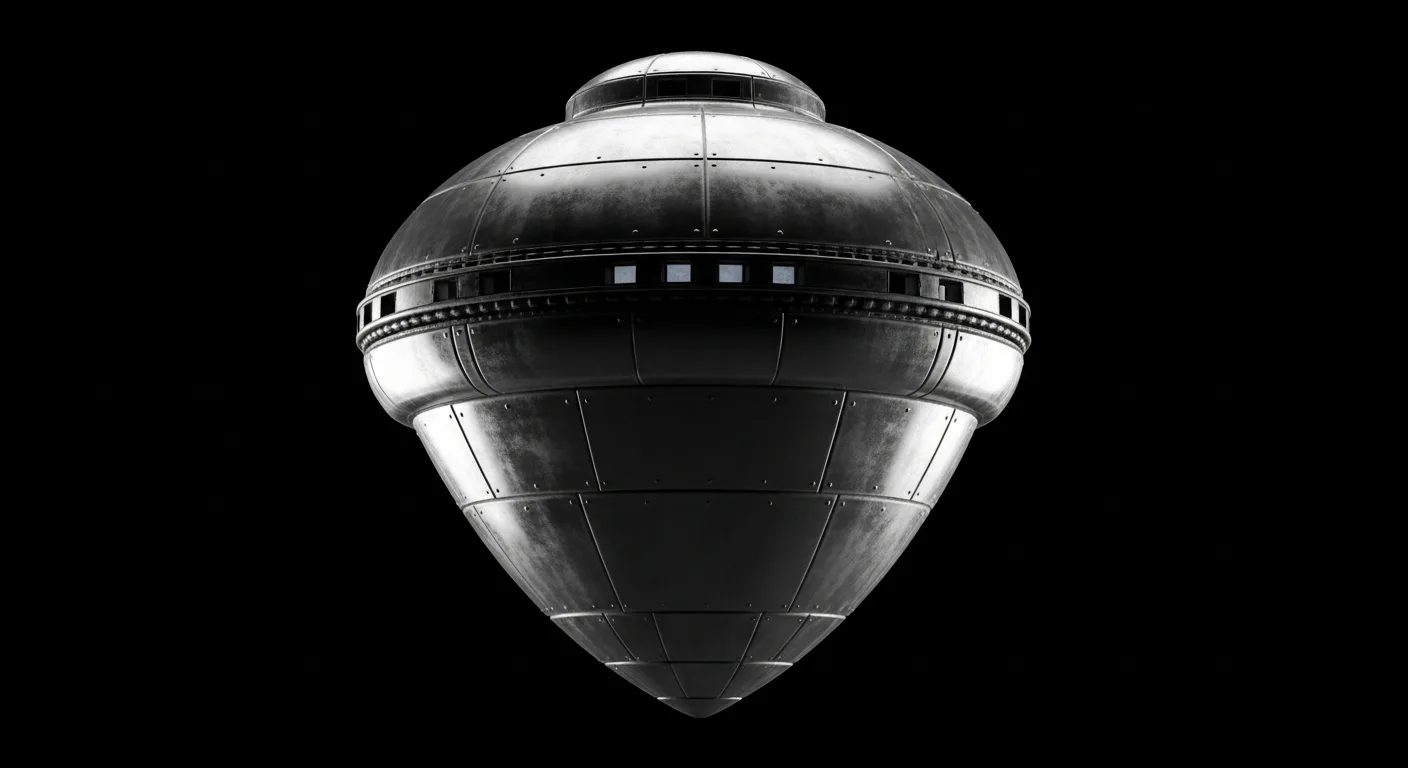
For twenty-one years, one photograph defined the Belgian UFO wave. It showed what appeared to be a large, dark, triangular craft photographed from below against the night sky, with bright lights at each corner and a fainter light at the center. The image was sharp, detailed, and compelling—a visual confirmation of what thousands of witnesses across Belgium had been describing since November 1989. It appeared on the covers of books, in documentary films, on news broadcasts, and in magazine articles around the world. It became the single most reproduced UFO photograph of the 1990s, the image that came to mind whenever anyone mentioned the Belgian triangle wave. And then, in 2011, the man who took it admitted that it was a fake—a piece of spray-painted styrofoam photographed in his backyard. The confession sent shockwaves through the UFO research community and handed skeptics a potent weapon. But the deeper truth of the Belgian wave—the truth supported by radar data, F-16 intercepts, and thirteen thousand eyewitness reports—remained untouched by the revelation. The photograph was a lie. The wave was real. And the tension between these two facts contains lessons that UFO research has still not fully absorbed.
The Image That Launched a Thousand Arguments
The photograph known as the Petit-Rechain image first surfaced in the spring of 1990, during the height of the Belgian UFO wave. According to the story that accompanied it, the photograph had been taken on the night of April 4, 1990, by a young man in the small town of Petit-Rechain, near Verviers in eastern Belgium. The photographer, who initially remained anonymous, claimed that he had been in his backyard when he noticed a large, triangular object hovering overhead. He grabbed his camera—a simple point-and-shoot model—and managed to capture a single image before the object moved away.
The resulting photograph was striking. It showed a dark, roughly triangular shape against a black sky, with three bright lights arranged at the corners and a dimmer, reddish light near the center. The object appeared large, solid, and clearly structured—not a point of light or an ambiguous smear but a defined, three-dimensional craft with discernible geometry. The image had the slightly blurred, grainy quality that one might expect from a handheld night photograph taken with consumer-grade equipment, which paradoxically enhanced its apparent authenticity. A hoaxer, the reasoning went, would have produced a cleaner image; the slight imperfections of the Petit-Rechain photo suggested the hasty, imperfect conditions of a genuine sighting.
The photograph was submitted to SOBEPS, the Belgian Society for the Study of Space Phenomena, which had been systematically investigating the UFO wave in cooperation with the Belgian military. SOBEPS researchers examined the image and declared it consistent with other evidence from the wave. The photograph was subsequently published widely, appearing in SOBEPS’s own reports, in media coverage of the wave, and in UFO literature around the world.
Analysis and Acceptance
In the years following its publication, the Petit-Rechain photograph was subjected to extensive technical analysis by researchers in multiple countries. Dr. Auguste Meessen, a physicist at the Catholic University of Louvain and a key figure in SOBEPS, conducted a detailed examination of the image and concluded that it showed characteristics consistent with a genuine photograph of a large, luminous object. He noted the light distribution patterns, the apparent depth of the object, and the atmospheric effects visible in the image as supporting its authenticity.
Other analysts reached similar conclusions, though some expressed reservations. The image’s resolution was limited by the camera used, making detailed analysis difficult. The lighting patterns could be interpreted in multiple ways, and the absence of reference points in the frame—no stars, no horizon, no buildings—made it impossible to determine the object’s actual size or distance. Despite these limitations, the general consensus among researchers who examined the photograph was that it was either genuine or an extremely sophisticated fake.
This consensus was reinforced by the broader context of the Belgian wave. The photograph matched, in every observable detail, the descriptions provided by thousands of independent witnesses. It showed a triangular craft with lights at the corners—exactly what police officers, military personnel, and ordinary citizens had been reporting for months. The temptation to accept the photograph as authentic was strengthened by the fact that it depicted precisely what so many credible people claimed to have seen.
The image became a cornerstone of the Belgian wave’s documentary record. It was cited in academic papers, featured in television documentaries, and reproduced in books about the wave and about UFOs generally. For researchers and enthusiasts, it provided something that UFO cases almost never offer—a clear, detailed photograph of the reported object, taken by a civilian during a well-documented wave of sightings.
The Confession
On July 26, 2011, everything changed. In an interview with Belgian television, the photographer—now identified as Patrick Marechal—admitted that the Petit-Rechain photograph was a hoax. The object in the image was not a massive triangular craft hovering over eastern Belgium. It was a small piece of styrofoam, cut into a triangular shape, spray-painted dark, fitted with small lights, and photographed from below against the night sky. The entire production had taken a few hours and cost virtually nothing.
Marechal, who had been in his late teens or early twenties at the time, explained that the hoax had been conceived as a joke—a bit of fun during the excitement of the UFO wave, never intended to be taken seriously or to achieve the fame that it eventually did. When the photograph was published and began to be treated as genuine evidence, Marechal found himself trapped. Confessing immediately would have brought embarrassment and possibly legal consequences. As the years passed and the photograph became increasingly famous, the stakes of confession grew higher. He carried the secret for twenty-one years before finally coming forward.
The confession was detailed and convincing. Marechal described the construction of the model, the lighting setup, and the photographic technique with the straightforward specificity of someone who had done the work and remembered it clearly. He expressed regret for the deception and acknowledged the damage it had done to serious UFO research. He did not appear to take pleasure in the revelation; if anything, he seemed relieved to be free of a burden he had carried for more than two decades.
The Fallout
The impact of Marechal’s confession rippled through the UFO research community and the broader public in complex and sometimes contradictory ways. For skeptics, the hoax was a vindication—proof that even the most apparently compelling photographic evidence could be fabricated by an amateur with minimal resources. The Petit-Rechain photograph had been analyzed by physicists, examined by image specialists, and accepted by researchers as genuine. If all of that expertise could be fooled by a piece of styrofoam and some spray paint, what confidence could anyone place in any UFO photograph?
For believers and researchers, the confession was a blow, but its significance was debatable. The Petit-Rechain photograph, while famous, had never been the primary evidence for the Belgian wave. The wave’s credibility rested on the testimony of thirteen thousand witnesses, the radar data from the F-16 intercepts, the cooperation of the Belgian military, and the systematic investigation conducted by SOBEPS. The photograph was, in a sense, decorative—a compelling visual aid for a case that was fundamentally built on other foundations.
Colonel Wilfried De Brouwer, who had commanded the Belgian Air Force’s response to the wave and had presented the military’s findings at the 1990 press conference, responded to the confession with characteristic composure. The photograph, he acknowledged, had been “nice to have” but was never essential to the military’s case. The radar data, the pilot reports, and the thousands of witness accounts remained exactly as they had been before the confession. The wave was real, even if this particular photograph was not.
The Damage Done
Despite De Brouwer’s measured response, the damage inflicted by the Petit-Rechain hoax was real and lasting. In the public mind, the photograph and the wave had become inseparable. For millions of people who had never read the SOBEPS reports or examined the radar data, the photograph was the Belgian wave. When it was revealed as a fake, the entire phenomenon was discredited by association.
This effect was not logical, but it was powerful. Media coverage of the confession focused almost exclusively on the debunking of the photograph, with little attention paid to the evidence that remained intact. Headlines announced that the famous Belgian UFO photo was a fake, and readers drew the natural but incorrect conclusion that the Belgian UFO wave had been debunked. The nuance—that one photograph had been faked while thousands of sightings remained unexplained—was lost in the noise.
Skeptics exploited the confession aggressively, using it to cast doubt not only on the Belgian wave but on UFO photography in general. If this photograph could fool experts for two decades, they argued, then no UFO photograph could be trusted. The argument was logically fallacious—the failure of one piece of evidence does not invalidate all evidence of the same type—but it was rhetorically effective. The Petit-Rechain hoax became a standard weapon in the skeptical arsenal, deployed whenever photographic evidence of UFO phenomena was presented.
The Evidence That Remains
The destruction of the Petit-Rechain photograph as evidence leaves the Belgian wave resting on its true foundations—and those foundations are formidable. The wave’s evidentiary base includes:
The testimony of over thirteen thousand witnesses, collected over eighteen months, from all regions of Belgium and from witnesses of every background and profession. These accounts describe, with remarkable consistency, large triangular craft with lights at the corners and a central red light, capable of hovering silently and accelerating to extraordinary speeds.
Radar data from multiple ground stations and from the onboard systems of Belgian Air Force F-16 fighters, documenting objects that demonstrated acceleration exceeding forty times the force of gravity—maneuvers that would destroy any known aircraft and kill any human pilot.
The official acknowledgment of the Belgian Air Force, presented at a public press conference, that its fighters had engaged unidentified objects and been unable to identify or intercept them.
The systematic investigation conducted by SOBEPS in cooperation with the military, producing two volumes of detailed documentation that have withstood three decades of scrutiny.
Police reports from across Belgium, filed by law enforcement officers who observed the triangular craft during the course of their duties and documented their observations through official channels.
None of this evidence was affected by Marechal’s confession. Not a single witness report was invalidated. Not a single radar return was erased. Not a single military record was altered. The Belgian wave stands on its own merits, with or without the Petit-Rechain photograph, and those merits are substantial.
Lessons for the Field
The Petit-Rechain affair offers lessons that the UFO research community has been slow to fully absorb. The most obvious is the danger of over-reliance on photographic evidence. In an era when images can be fabricated with increasing ease and sophistication, photographs should be treated as supplementary evidence at best—supporting witness testimony and instrumental data rather than serving as primary proof. The Belgian wave did not need the Petit-Rechain photograph. The fact that it became so closely associated with the image was a failure of emphasis, not of evidence.
A deeper lesson concerns the relationship between individual pieces of evidence and the cases they support. The Petit-Rechain hoax demonstrated how the debunking of a single element can be used to discredit an entire body of evidence, even when the debunked element was never central to the case. Researchers and communicators must be clearer about what constitutes the core evidence for their cases and must not allow peripheral elements—however visually compelling—to become synonymous with the phenomenon they document.
The affair also illustrates the persistence of hoaxes and the difficulty of detecting them in real time. Marechal’s fake was accepted for twenty-one years by researchers who examined it carefully and applied their professional expertise. The failure was not one of effort or intelligence but of the inherent limitations of photographic analysis. A photograph, unlike a radar return or a witness under cross-examination, cannot reveal the circumstances of its creation. It shows what it shows, and what it shows may be a lie.
The Wave Was Real
The final and most important truth about the Petit-Rechain affair is this: one fake photograph does not make thirteen thousand witnesses into liars. One piece of styrofoam does not erase the radar returns from Belgian Air Force ground stations. One young man’s prank does not invalidate the testimony of fighter pilots who pursued objects they could not catch and could not explain.
The Belgian triangle wave of 1989-1991 was real. It was documented by military and civilian investigators working together with a transparency and rigor that has rarely been equaled. It produced evidence across multiple independent channels—visual, instrumental, testimonial—that converges on a single conclusion: something was in the skies over Belgium that defied identification and exceeded the capabilities of the most advanced military technology available to the Western alliance.
Patrick Marechal faked a photograph. He did not fake thirteen thousand sightings. He did not fake the radar data. He did not fake the F-16 intercepts. He did not fake the Belgian Air Force press conference. He created one fraudulent image and, in doing so, inadvertently demonstrated how fragile public understanding can be when a compelling visual symbol is confused with the deeper reality it was thought to represent.
The Belgian wave does not need the Petit-Rechain photograph to be extraordinary. It was extraordinary before the photograph existed, and it remains extraordinary now that the photograph has been exposed. The triangles were real. The evidence is intact. And the questions raised by eighteen months of unexplained aerial phenomena over a European NATO member state remain as urgent and as unanswered as the night the first triangle appeared over Eupen in November 1989.
Sources
- CIA UFO/UAP Reading Room — Declassified CIA documents on UAP