The Belgian UFO Wave
Thousands witnessed triangular craft over Belgium, tracked by radar and pursued by F-16 fighters.
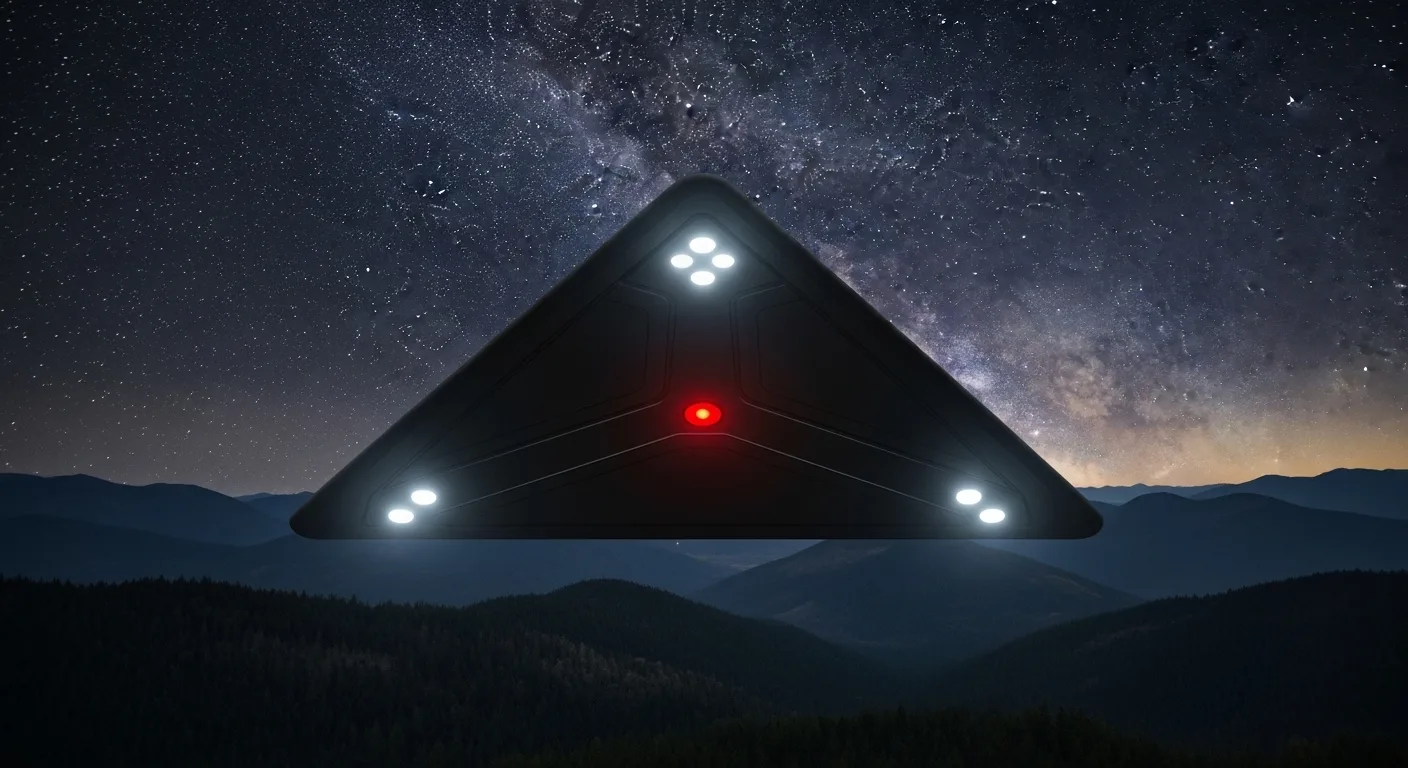
The Belgian UFO wave of 1989-1990 stands apart from the vast majority of UFO cases for one simple reason: the evidence did not rely on a single blurry photograph, the testimony of a lone farmer in a remote field, or an anonymous tip phoned in to a tabloid newspaper. Over the course of five extraordinary months, more than 13,500 people across Belgium reported seeing large, silent, triangular craft moving through their skies. Among those witnesses were police officers on patrol, military personnel, air traffic controllers, scientists, and engineers—people trained to observe, identify, and report what they saw. The Belgian Air Force scrambled F-16 interceptors and captured radar data that appeared to confirm what thousands of eyes had already seen. And in an act virtually unprecedented in the history of government responses to the UFO phenomenon, the Belgian military opened its files, shared its radar recordings, and publicly admitted that it could not explain what had happened over its airspace. Whatever one believes about the nature of these craft, the Belgian wave remains one of the most rigorously documented and officially acknowledged UFO events in history.
The Cold War Backdrop
To understand why the Belgian UFO wave carried such weight, one must consider the moment in which it occurred. In November 1989, the Berlin Wall had just fallen. The Cold War order that had defined European life for four decades was collapsing in real time, and NATO’s frontline nations—Belgium among them—were in a state of heightened alertness. Belgian airspace was closely monitored by military radar installations, and the country’s armed forces were trained to detect and respond to any unauthorized incursion. This was not a sleepy backwater with neglected radar coverage. It was one of the most surveilled corridors of airspace in the Western world.
It was into this tense, closely watched environment that the triangular craft appeared. The timing meant that military authorities could not simply dismiss the reports. If unknown aircraft were penetrating Belgian airspace during a period of geopolitical upheaval, the implications were serious regardless of whether the craft were terrestrial or otherwise. The Belgian Air Force had every incentive to investigate thoroughly, and it did.
The Night Over Eupen
The wave began on the evening of November 29, 1989, in the German-speaking eastern cantons of Belgium. At approximately 5:30 PM, two gendarmerie officers—Heinrich Nicoll and Hubert von Montigny—were patrolling near the town of Eupen when they observed a large, dark, triangular object hovering silently over a field adjacent to the road. The craft was equipped with three powerful white lights at its corners and a pulsating red or orange light at its center. It was enormous, the officers estimated, far larger than any conventional aircraft they had seen.
Nicoll and von Montigny were experienced officers, accustomed to identifying aircraft in the skies above their patrol routes. They knew the difference between a helicopter, a military jet, and a civilian airliner. What they were watching did not correspond to any of these. The object was nearly motionless, hovering with a stability that no helicopter could match, and it made no sound whatsoever—no rotor noise, no engine whine, nothing. When it finally moved, it did so with a fluid, unhurried grace, gliding slowly toward the town of Eupen before stopping again to hover over the Gileppe Dam.
Over the next two hours, the officers followed the object along their patrol route, observing it from multiple vantage points and radioing their observations to dispatch. They were not alone. That same evening, at least seventeen separate groups of witnesses reported seeing the same or similar craft in the Eupen-Kettenis-Lontzen corridor. These included other gendarmerie patrols, civilians who had been driving on local roads, and residents who had stepped outside after hearing neighbors exclaim at what was in the sky. The descriptions were remarkably consistent: a large triangle, three bright corner lights, a central pulsing light, silent or nearly silent operation, and the ability to hover motionless before moving off at varying speeds.
The Eupen sighting was not a fleeting glimpse. Officers and civilians observed the craft for extended periods, some for more than an hour. Multiple witnesses watched it simultaneously from different locations, allowing for rough triangulation of its position and confirmation that this was a single large object at altitude rather than a trick of light or atmospheric phenomenon. By the end of that November evening, the Belgian gendarmerie had logged enough credible reports to recognize that something genuinely unusual had occurred.
The Wave Builds
What happened at Eupen was only the beginning. Over the following weeks and months, sightings spread across Belgium. Reports came in from Liege, Brussels, Namur, Wavre, and dozens of smaller towns and villages. The craft—or craft, as some witnesses believed there was more than one—were seen over highways, residential neighborhoods, forests, and industrial areas. They appeared at various times of day and night, though evening sightings predominated.
The consistency of the descriptions was striking. Witness after witness described a triangular platform, dark in color, with three bright lights arranged at the vertices and a softer, often pulsating light at the center. Size estimates varied, but most witnesses described a craft far larger than any conventional aircraft, with some suggesting a wingspan of thirty meters or more. The silence of the object was a recurring detail that troubled even skeptical analysts. Any known aircraft of that size would produce considerable noise, particularly at the low altitudes at which the craft were often observed. Helicopters hovering at a few hundred meters would be unmistakably loud. These objects produced nothing—or at most, a faint, low-frequency hum that some witnesses compared to a distant electrical transformer.
The witness pool was extraordinary in its breadth. By the time the wave subsided in the spring of 1990, the Belgian Society for the Study of Space Phenomena (SOBEPS) had catalogued over 2,600 detailed sighting reports, representing an estimated 13,500 individual witnesses. These were not credulous enthusiasts seeking attention. The majority were ordinary citizens going about their lives who happened to look up at the wrong—or right—moment. A significant number were trained observers: police officers, military personnel, pilots, and engineers whose professional credibility lent weight to their accounts.
Among the most compelling civilian reports were those from witnesses who observed the craft at close range. Several motorists described encounters on rural roads where the triangular object passed directly overhead at low altitude, filling their windshields with its dark underside and blazing lights. Some reported that their car radios experienced interference during these close passages, a detail consistent with strong electromagnetic fields. Others described a sensation of oppressive stillness, as if the air itself had thickened around the craft.
The F-16 Intercept: March 30-31, 1990
The most dramatic episode of the Belgian wave occurred on the night of March 30-31, 1990, when the Belgian Air Force committed two F-16 Fighting Falcons to intercept an unknown object that was being tracked on multiple radar systems simultaneously. This event elevated the Belgian wave from a collection of eyewitness reports—however impressive—to a case supported by military-grade instrumentation and the testimony of fighter pilots.
The sequence began on the evening of March 30, when gendarmerie Captain Marcel Alfarano reported a bright, unusual light in the sky above Wavre, south of Brussels. The observation was confirmed by the Glons radar station, which detected an unknown target in the area. The Semmerzake Tracking Radar Center, a separate NATO installation, independently confirmed the contact. With two military radar systems tracking the same unknown object and ground witnesses confirming a visual, Colonel Wilfried De Brouwer of the Belgian Air Force authorized the scramble of two F-16s from Beauvechain Air Base.
What followed was an extraordinary engagement that lasted over an hour. The F-16 pilots acquired the target on their onboard radar systems and attempted to close for visual identification. The object responded to each approach with evasive maneuvers that the pilots and radar operators later described as far beyond the capabilities of any known aircraft.
The radar data from the F-16s told a remarkable story. On three separate occasions, the pilots achieved radar lock on the target—a significant accomplishment that confirmed the object was a solid, radar-reflective body rather than an atmospheric anomaly or electronic ghost. Each time a lock was achieved, the object broke it through sudden, violent acceleration. The radar recordings showed the target dropping from approximately 10,000 feet to near ground level in a matter of seconds, implying a rate of descent that would subject any conventional aircraft and its occupants to catastrophic gravitational forces. In another sequence, the object accelerated from a near hover to speeds exceeding 1,000 kilometers per hour almost instantaneously, before decelerating just as abruptly.
The pilots themselves were shaken by the encounter. They were experienced aviators, accustomed to the performance envelope of military aircraft, and what they had witnessed on their instruments exceeded anything in their training or experience. The F-16 is among the most agile fighter aircraft in the world, capable of sustaining nine-G turns, yet the unknown object had outperformed it with apparent ease. The implied G-forces of the maneuvers recorded on radar—estimated at 40 G or more during some transitions—would be instantly fatal to any human pilot and would tear apart any known airframe.
Colonel De Brouwer later stated that the radar data had been reviewed by technical experts who could find no conventional explanation. The recordings were not consistent with atmospheric ducting, electronic countermeasures, or equipment malfunction. The three independent radar systems—two ground stations and the F-16 onboard systems—had all tracked the same object performing the same maneuvers, a concordance that made equipment error vanishingly unlikely.
The Petit-Rechain Photograph
No discussion of the Belgian wave is complete without addressing the photograph that both defined and complicated the case. On the night of April 4, 1990, a photograph was taken in the town of Petit-Rechain that appeared to show a triangular craft with bright lights against a dark sky. The image was compelling—it seemed to capture exactly what thousands of witnesses had been describing—and it quickly became the iconic visual representation of the Belgian wave.
For over two decades, the Petit-Rechain photograph was reproduced in books, documentaries, and newspaper articles worldwide. It appeared to provide the hard photographic evidence that so many UFO cases lacked. Then, in July 2011, the photographer—identified as Patrick Maréchal—confessed that the image was a hoax. He and a friend had constructed a small model from polystyrene, affixed lights to it, and photographed it against the night sky. What millions had taken for a massive craft at altitude was in fact a small prop held at arm’s length.
The confession sent shockwaves through the UFO research community, and skeptics seized upon it as grounds to dismiss the entire Belgian wave. This response, however, fundamentally misrepresented the nature of the evidence. The Petit-Rechain photograph was never central to the case. It was one image, taken by one individual, on one night. The Belgian wave rested on a foundation of over 13,500 witnesses, multiple radar tracks, an F-16 intercept, and the official findings of the Belgian Air Force. Removing the photograph from the evidentiary record left this foundation entirely intact.
Indeed, serious UFO researchers had always treated the photograph with appropriate caution, noting that a single image—however suggestive—could never carry the same weight as corroborated radar data and mass eyewitness testimony. The hoax was embarrassing, certainly, but it said nothing about the credibility of the police officers at Eupen, the radar operators at Glons and Semmerzake, or the F-16 pilots who had tried and failed to intercept an object that outperformed their aircraft by orders of magnitude. To dismiss the Belgian wave because of one fraudulent photograph would be like dismissing a murder conviction because one of fifty witnesses was found to have lied—it might diminish the case marginally, but it would not overturn the verdict.
The Belgian Air Force Responds
Perhaps the most remarkable aspect of the entire Belgian wave was the response of the Belgian military. In an era when governments routinely denied, obfuscated, or ignored UFO reports, the Belgian Air Force chose transparency. This decision, driven largely by Colonel Wilfried De Brouwer, transformed the case from an interesting regional flap into a landmark event in the history of UFO research.
De Brouwer, who held the position of Chief of Operations of the Belgian Air Staff, authorized a full briefing for the press on July 11, 1990. At this briefing, the Air Force presented radar recordings from the March 30-31 intercept, shared technical analyses of the data, and allowed pilots and radar operators to describe their experiences. De Brouwer stated plainly that the Belgian Air Force had been unable to identify the objects tracked on radar and observed by its pilots. He did not speculate on their origin, but neither did he dismiss the phenomenon or offer implausible conventional explanations.
This transparency was unprecedented. The United States Air Force had formally closed its UFO investigation program, Project Blue Book, in 1969, and had spent the intervening decades refusing to engage with the subject. The British Ministry of Defence maintained a small UFO desk but treated the topic with studied indifference. The French had established GEIPAN under their space agency, but with limited resources and visibility. No NATO air force had ever released radar data from a UFO intercept to the public, and none had ever held a press conference acknowledging that its pilots had been outmaneuvered by an unidentified craft.
De Brouwer’s willingness to cooperate extended beyond the military. The Belgian Air Force worked closely with SOBEPS, a civilian UFO research organization, sharing data and granting researchers access to military personnel and facilities. This collaboration between military and civilian investigators was extraordinary and produced the most detailed analysis of the wave’s events. SOBEPS published two substantial volumes documenting the sightings, the radar data, and the Air Force’s involvement, creating a record of unusual completeness and rigor.
In later years, De Brouwer—by then retired as a Major General—continued to speak publicly about the events. He maintained that the phenomena were real, that the radar data was genuine, and that no satisfactory conventional explanation had been found. He expressed frustration that the subject of unidentified aerial phenomena was treated as taboo by many governments and scientific institutions, arguing that the Belgian evidence warranted serious study rather than reflexive dismissal.
Why the Belgian Wave Matters
The Belgian UFO wave endures as one of the strongest cases in the UFO literature for several interlocking reasons, each of which addresses a common criticism leveled at UFO reports in general.
The problem of witness credibility is answered by the sheer number and quality of observers. More than 13,500 people saw something, and among them were trained police officers, military radar operators, and fighter pilots—professionals whose livelihoods depended on accurate observation and reporting. Mass delusion on this scale, sustained over five months across an entire nation, strains credulity far more than the straightforward conclusion that something was genuinely present in Belgian airspace.
The problem of instrumental evidence is answered by the radar data. The F-16 intercept of March 30-31 produced recordings from three independent radar systems—two ground-based and one airborne—all tracking the same object performing the same maneuvers. This is not a case of a single anomalous blip on a single screen. It is corroborated, multi-source tracking data of the kind that military analysts rely upon to identify and intercept hostile aircraft. If such data were presented in the context of a conventional military incursion, no one would question its validity.
The problem of government secrecy is answered by the Belgian Air Force’s remarkable openness. Unlike cases where researchers must fight for decades to extract information through freedom-of-information requests, the Belgian military voluntarily shared its data, presented its findings to the press, and cooperated with civilian investigators. The absence of a cover-up removes one of the most common grounds for skeptical dismissal.
The problem of the hoax is contained by the nature of the Petit-Rechain confession. Yes, one photograph was faked. But the Belgian wave was never a photographic case. It was an evidentiary case built on mass testimony, radar tracking, and military engagement. The hoax of a single image does not contaminate the thousands of independent observations that preceded it, accompanied it, and would have been equally compelling without it.
Taken together, these elements make the Belgian wave extraordinarily difficult to explain away. Conventional hypotheses—military aircraft, atmospheric phenomena, mass hysteria—have been proposed and found wanting. No known military aircraft of that era could hover silently, accelerate to supersonic speeds instantaneously, and execute maneuvers at 40 G. Atmospheric phenomena do not register as solid targets on fighter radar. Mass hysteria does not produce consistent descriptions from independent witnesses across multiple months and locations, and it certainly does not trigger radar returns.
The Silence of the Triangle
What remains after all the analysis, all the debate, all the years of argument, is a central mystery that has never been resolved. For five months in 1989 and 1990, large triangular craft operated freely over a NATO nation. They were seen by thousands, tracked by radar, and pursued by fighter jets. They demonstrated technological capabilities far in excess of anything in the known human inventory. And then they stopped. The wave ended as inexplicably as it had begun, the skies over Belgium returning to their ordinary traffic of commercial airliners and military jets.
The Belgian Air Force never identified the craft. No government has ever claimed responsibility for the flights. No aerospace company has ever revealed a secret program that would account for the performance characteristics recorded on radar. The triangles of Belgium remain unidentified in the most literal sense of the word—objects that were observed, measured, and documented, but never explained.
For those who lived through the wave, the memory remains vivid. The police officers who followed the craft along dark roads outside Eupen, the radar operators who watched their screens in disbelief, the fighter pilots who pushed their aircraft to their limits in pursuit of something that treated the laws of physics as suggestions rather than rules—all of them carry the knowledge that something extraordinary happened over Belgium in those months. The evidence they gathered has not faded with time. The radar recordings still show the same impossible maneuvers. The witness statements still describe the same silent, triangular form.
The Belgian UFO wave does not prove the existence of extraterrestrial visitors. It does not prove the existence of secret military technology decades ahead of the public inventory. What it proves, with a weight of evidence that few UFO cases can match, is that something was there. Something real, something physical, something that reflected radar and emitted light and moved through the atmosphere of a sovereign nation with impunity. The question of what it was remains open—one of the great unsolved puzzles of the modern age, waiting, like the silent triangles themselves, for an answer that has yet to arrive.
Sources
- CIA UFO/UAP Reading Room — Declassified CIA documents on UAP