JAL Flight 1628 UFO Encounter
A Japan Air Lines cargo flight over Alaska was paced by two small UFOs and then a massive 'mothership' the size of two aircraft carriers. Captain Kenju Terauchi, a veteran pilot, reported the 50-minute encounter. FAA radar confirmed unknown returns. One of aviation's best-documented cases.
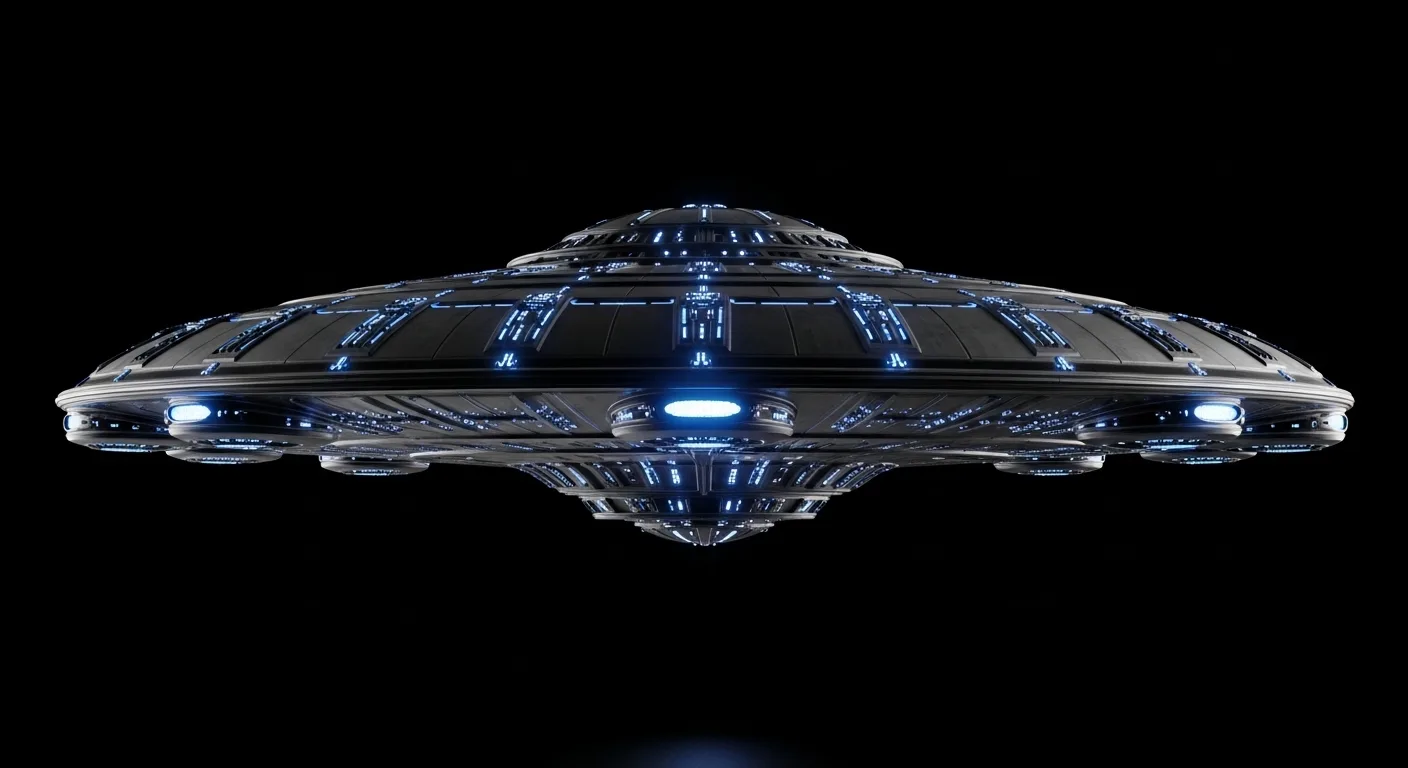
On the evening of November 17, 1986, the vast emptiness of the Alaskan interior stretched beneath Japan Air Lines Flight 1628 like a frozen ocean of darkness. Captain Kenju Terauchi, a former fighter pilot with twenty-nine years of flying experience, guided his Boeing 747-200F cargo aircraft through the subarctic night on a routine leg from Reykjavik, Iceland, to Anchorage, Alaska, carrying a load of Beaujolais wine bound for Tokyo. It was precisely the kind of flight that seasoned aviators describe as unremarkable—clear skies, calm air, the autopilot handling the monotony of cruise altitude while the crew monitored instruments and watched the stars. What happened next over the frozen wilderness of interior Alaska would transform this routine cargo run into one of the most compelling and thoroughly documented UFO encounters in aviation history, a case that would draw the attention of the Federal Aviation Administration, the United States military, and researchers around the world.
Into the Alaskan Night
JAL Flight 1628 had departed Paris with its cargo of French wine, stopping in Reykjavik before continuing across the North Atlantic and over the Canadian Arctic toward Alaska. The crew consisted of three experienced aviators: Captain Terauchi in the left seat, First Officer Takanori Tamefuji in the right seat, and Flight Engineer Yoshio Tsukuba monitoring the aircraft’s systems from his station behind the pilots. All three were veterans of international routes, accustomed to the long hours of transoceanic flying and the peculiar isolation of crossing vast stretches of uninhabited terrain in darkness.
As the 747 crossed into Alaskan airspace northeast of Fairbanks at approximately 5:09 PM local time, cruising at 35,000 feet, Captain Terauchi noticed lights ahead and slightly below the aircraft. At first, he assumed they belonged to military traffic—Eielson Air Force Base and Fort Wainwright were both in the region, and military aircraft were common in Alaskan skies during the Cold War era. The lights appeared to be moving in the same direction as the 747, and Terauchi initially gave them little thought.
Within minutes, however, the lights began behaving in ways that no conventional aircraft could explain. They suddenly shifted position, moving directly in front of the 747 at a distance Terauchi estimated at several thousand feet. The objects appeared to stop abruptly, holding a fixed position relative to the cargo jet despite its cruising speed of roughly 530 knots. Terauchi contacted the Anchorage Air Route Traffic Control Center to ask whether there was any traffic in the area. The controller reported that no other aircraft were showing on radar in the vicinity of Flight 1628.
Two Craft of Fire
What Captain Terauchi and his crew observed next defied easy categorization. Two distinct objects materialized clearly in front of and slightly below the 747, arranged in a stacked formation. Each object displayed arrays of lights—some glowing steadily, others pulsing or flickering—in what Terauchi described as nozzles or thrusters that emitted jets of flame. The lights were so intense that Terauchi could feel warmth on his face through the cockpit windows, despite the fact that the outside air temperature at their altitude was approximately minus 60 degrees Celsius.
Terauchi later produced detailed drawings of what he observed. The two smaller craft appeared to be rectangular or square in shape, each featuring two bands of lights that alternated in luminosity. The objects moved with a precision and coordination that suggested intelligent control, maintaining their position relative to the 747 with effortless stability. When the cargo jet altered its heading slightly, the objects adjusted instantaneously, as if locked to the aircraft by some invisible tether.
First Officer Tamefuji also observed the lights, though from his position in the right seat his perspective was slightly different. He described seeing two sets of lights that appeared to be flames or exhaust from jet engines, though their arrangement and behavior were unlike anything in his experience. He noted that the lights were amber and whitish-green, and that they seemed to rearrange themselves—shifting formation in ways that no fixed-wing aircraft or helicopter could replicate.
Flight Engineer Tsukuba, positioned behind the pilots at his instrument panel, could see the lights through the cockpit windows as well. He confirmed the unusual coloring and the apparent heat emanating from the objects. All three crew members were in agreement that what they were seeing bore no resemblance to any known aircraft type, military or civilian.
The two smaller craft maintained their position in front of the 747 for approximately seven minutes, during which Terauchi attempted to contact Anchorage Center multiple times for radar confirmation. The controller checked with military radar facilities but initially received no confirmation of additional targets. The objects then performed a maneuver that startled the entire crew—they abruptly shifted from their position directly ahead to a position abeam, off the left side of the aircraft, executing the repositioning in what appeared to be an instant.
The Mothership
It was at this point that the encounter escalated from extraordinary to almost incomprehensible. As the two smaller objects moved to the side, Captain Terauchi became aware of a third presence—something vastly larger than the initial pair of craft. Looking to his left and slightly behind the aircraft, he saw what he would later describe as an enormous object, its outline faintly visible against the ambient light of the stars and the dim glow of the snow-covered terrain far below.
The object was immense. Terauchi, drawing on his decades of aviation experience to judge distances and relative sizes, estimated that the craft was the size of two aircraft carriers placed side by side. It appeared to be roughly walnut-shaped or cylindrical, with a surface that was dark but faintly reflective. The object carried no conventional navigation lights, no anti-collision strobes, nothing that would identify it as any known type of aircraft or vessel. It was simply there—a colossal presence hanging in the frozen sky with no apparent means of propulsion and no sound that could be heard above the 747’s own engines.
Terauchi’s blood ran cold. He had spent years flying fighter jets and commercial aircraft, and he possessed the trained observer’s ability to assess aerial phenomena rationally. Nothing in his experience had prepared him for an object of this scale hovering silently in the atmosphere. He immediately informed Anchorage Center of the massive object and requested permission to deviate from his assigned heading to put distance between his aircraft and the unknown craft.
The Anchorage controller, recognizing the urgency in Terauchi’s voice, authorized a series of heading changes. Terauchi turned the 747 first to the left, then requested a full 360-degree turn. Throughout these maneuvers, which covered several minutes and dozens of miles, the enormous object appeared to match every change in course, maintaining its relative position as if shadowing the cargo jet. The smaller craft had by this time disappeared from view, leaving only the massive object as an escort.
Radar Confirmation
The question of radar evidence would become one of the most contested aspects of the JAL Flight 1628 case. During the encounter, the Anchorage Air Route Traffic Control Center made multiple attempts to verify the presence of unknown objects on radar. The initial FAA radar returns were ambiguous—primary radar at Anchorage did intermittently show a target in the vicinity of Flight 1628, though the returns were not consistent enough to establish continuous tracking.
More significant were the returns from military radar operated by the Regional Operations Control Center at Elmendorf Air Force Base. Controllers there reported detecting what appeared to be a primary radar return near the position reported by Captain Terauchi, though the military was initially reluctant to confirm these readings publicly. The radar data would later become a focal point of the FAA investigation and a subject of considerable debate among researchers.
What is beyond dispute is that the FAA took the encounter seriously enough to launch a formal investigation. John Callahan, then the Division Chief of the Accidents and Investigations branch of the FAA, was assigned to review the case. Callahan would later describe his involvement as a career-defining moment—and one that opened his eyes to the reality of the UFO phenomenon and the institutional reluctance to address it honestly.
Callahan gathered an extensive body of evidence: the air traffic control voice recordings capturing the real-time communications between Flight 1628 and Anchorage Center, the radar data tapes from both FAA and military facilities, written statements from the crew, and Captain Terauchi’s detailed drawings and written account of the encounter. The assembled evidence painted a picture of an event that could not be easily dismissed as misidentification or pilot error.
A Pilot’s Reckoning
Captain Kenju Terauchi was, by all accounts, an exemplary aviator. Born in Japan, he had served as a fighter pilot before transitioning to commercial aviation, eventually rising to the rank of captain on Japan Air Lines’ international routes. His colleagues described him as methodical, composed under pressure, and not given to flights of fancy. He was precisely the sort of witness whose testimony carried weight—a trained observer with decades of experience distinguishing between ordinary and extraordinary aerial phenomena.
In the immediate aftermath of the encounter, Terauchi filed a detailed report with both Japan Air Lines and the FAA, providing written descriptions, sketches, and timeline reconstructions of the event. He did not embellish or speculate wildly about the nature of what he had seen. He simply reported what he and his crew had observed: objects displaying characteristics—size, speed, maneuverability, and luminosity—that exceeded the capabilities of any known aircraft.
The response to Terauchi’s candor was swift and painful. When the story reached the media in late December 1986, it generated international headlines. A veteran airline captain reporting a UFO encounter over American soil, with radar confirmation and crew corroboration, was the kind of story that the press could not resist. Terauchi found himself at the center of a media firestorm, giving interviews and fielding questions from journalists around the world.
Japan Air Lines, acutely sensitive to its reputation and the perception of its flight crews’ reliability, responded by removing Terauchi from flight duties. He was reassigned to a desk position for several months—a move widely interpreted as punishment for speaking publicly about the encounter, though JAL officially characterized it as a routine reassignment. The message to other pilots was clear: reporting UFO encounters carried professional consequences.
Despite the pressure, Terauchi never recanted his account. In subsequent interviews over the years, he maintained every detail of his original report. His crew members, while less publicly vocal, similarly stood by their statements. Terauchi was eventually returned to flight status and continued his career with Japan Air Lines, but the encounter remained the defining event of his professional life—a moment when the ordinary world cracked open to reveal something beyond comprehension.
The FAA Investigation
John Callahan’s investigation of the JAL Flight 1628 encounter would prove to be one of the most thorough official examinations of a UFO case ever conducted by a United States government agency. Callahan assembled a team that reviewed every piece of available data: radar tapes, voice recordings, weather data, military flight schedules, and the crew’s testimony.
The investigation initially attempted to find conventional explanations. Could the crew have misidentified a celestial body—Jupiter was bright in the sky that evening? Could atmospheric conditions have created unusual optical effects? Could military aircraft operating in the area have been responsible for the sightings? Each possibility was examined and found insufficient to explain the full scope of what had been reported.
The radar data proved particularly problematic for debunkers. While the returns were intermittent rather than continuous, they appeared at positions consistent with the crew’s visual observations, suggesting that something physical was present in the airspace near Flight 1628. Attempts to attribute the radar returns to split-target effects—a known phenomenon where a single aircraft produces secondary radar echoes—were not entirely convincing, as the geometry and timing did not always align with this explanation.
Callahan later recounted that he was summoned to a meeting at FBI headquarters to present his findings. In the room were representatives from the FBI, the CIA, and President Reagan’s scientific advisory staff. Callahan played back the radar data and air traffic control recordings, and presented the crew’s statements and drawings. When the presentation concluded, he recalled, one of the CIA representatives instructed him that the event “never happened” and that the assembled officials were to keep the matter confidential.
What the CIA representatives did not know was that Callahan had made copies of all the evidence before the meeting. Years later, after his retirement from the FAA, Callahan went public with the materials, becoming one of the most credible whistleblowers in the history of UFO research. He testified at the National Press Club in 2001 as part of the Disclosure Project, presenting the radar data and recordings to the media and calling on the government to release information about UFO encounters that had been suppressed.
What the Crew Saw: The Details
In the years following the encounter, researchers pieced together a comprehensive timeline from crew statements, radar data, and air traffic control recordings. The sequence of events, reconstructed in detail, reveals an encounter that lasted approximately fifty minutes and covered several hundred miles of Alaskan airspace.
The initial sighting occurred at approximately 5:09 PM Alaska Standard Time, when the two smaller objects appeared ahead of the aircraft. For the next seven to eight minutes, these objects maintained their position in front of the 747, displaying their arrays of pulsing, flame-like lights. The heat radiated by the objects was intense enough to illuminate the cockpit, casting shadows and warming the faces of the crew through the windscreen.
At approximately 5:18 PM, the two smaller objects repositioned themselves to the left side of the aircraft, and the massive third object became visible. For the next thirty-five to forty minutes, this enormous craft shadowed the 747 through multiple heading changes, altitude variations, and the full 360-degree turn authorized by Anchorage Center. The object appeared to maintain a constant distance of several miles, close enough to be clearly visible but far enough to resist precise measurement.
Captain Terauchi described the surface of the large object as dark and somewhat textured, comparing its shape to a shelled walnut—rounded but with an irregular surface that caught and reflected ambient light in unpredictable ways. He saw no windows, no markings, no protrusions of any kind that would suggest conventional engineering. The object simply existed as a massive, silent presence in the sky, defying every principle of aerodynamics and propulsion that Terauchi understood.
The encounter ended gradually rather than abruptly. As Flight 1628 approached Fairbanks and the surrounding area’s light pollution became visible, the large object appeared to recede and eventually vanish. Whether it departed at speed, climbed to a higher altitude, or simply turned off whatever made it visible, the crew could not determine. By the time the 747 began its approach into Anchorage, the skies were empty and ordinary once more.
Legacy of the Encounter
The JAL Flight 1628 case occupies a singular position in the annals of UFO research. Unlike many reported encounters, which rely on the testimony of a single untrained observer, this case offers the convergence of multiple types of evidence: the observations of three experienced aviation professionals, radar data from both civilian and military facilities, real-time air traffic control communications, and a thorough investigation by the FAA.
The case also illustrates the institutional dynamics that have long surrounded the UFO phenomenon. The pressure placed on Captain Terauchi, the CIA’s attempt to suppress the investigation’s findings, and JAL’s quiet removal of its star pilot from cockpit duties all speak to a pattern of institutional reluctance to engage with reports that challenge conventional understanding. Terauchi’s willingness to endure professional consequences rather than retract his testimony adds credibility to a case that needs little embellishment.
For skeptics, the JAL Flight 1628 encounter remains open to alternative interpretation. The intermittent nature of the radar returns leaves room for doubt about whether a physical object was truly present, and some researchers have proposed that unusual atmospheric conditions—possibly related to ice crystals or temperature inversions—could have produced both the visual phenomena and the anomalous radar signatures. The planet Jupiter, which was visible in the relevant portion of the sky that evening, has been offered as a potential source of the initial lights, though this explanation struggles to account for the heat felt by the crew or the massive object seen later in the encounter.
What cannot be disputed is that three experienced aviators saw something over Alaska that night that they could not explain, that ground-based radar detected something anomalous in the same area, and that the Federal Aviation Administration conducted an investigation whose findings were significant enough to attract the attention of multiple intelligence agencies. Whatever one believes about the nature of what Captain Terauchi and his crew encountered, the evidence demands consideration rather than dismissal.
The Frozen Sky Remembers
Nearly four decades after the encounter, the airspace over interior Alaska remains one of the loneliest stretches of sky in the Northern Hemisphere. Cargo flights and passenger aircraft still transit this corridor daily, crossing the same frozen wilderness that lay beneath JAL Flight 1628 on that November evening. The terrain below is largely unchanged—vast expanses of boreal forest, frozen rivers, and mountains that have never known permanent human habitation.
Pilots who fly these routes today are generally aware of the Terauchi case, though few discuss it openly. The professional stigma attached to UFO reporting, while diminished somewhat in recent years by the U.S. military’s acknowledgment of unidentified aerial phenomena, remains a powerful deterrent. The unspoken consensus among many aviators is that some things are better left unreported—a silence that may conceal encounters as significant as the one that Captain Terauchi chose to document.
John Callahan spent the final years of his career and his retirement advocating for transparency regarding UFO encounters reported through official channels. He argued consistently that the data he preserved from the JAL Flight 1628 investigation represented only a fraction of the evidence held by government agencies, and that the public deserved access to information about phenomena occurring in shared airspace.
Captain Terauchi continued flying until his retirement, carrying with him the memory of a night when the Alaskan darkness revealed something that the world was not yet ready to accept. He never wavered in his account, never softened its details, never succumbed to the temptation to reframe his experience in more palatable terms. What he saw was what he reported, and his report stands as one of the most credible and thoroughly documented UFO encounters ever recorded—a testament to one pilot’s integrity and to the enduring mystery of what moves through our skies unseen.
Sources
- CIA UFO/UAP Reading Room — Declassified CIA documents on UAP