Kazakhstan, January 31, 1994
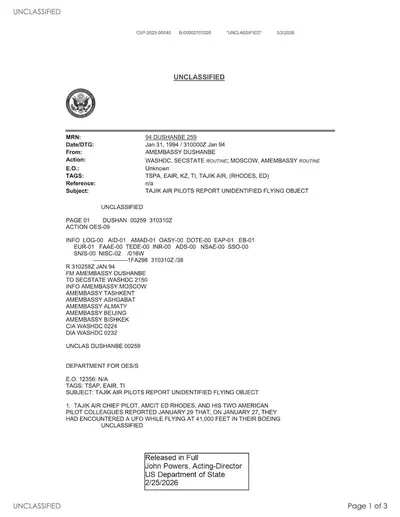
Declassified diplomatic cables reveal a 1994 pilot sighting of an unidentified object over Kazakhstan, released via the PURSUE program in 2026.
Historical Context
The incident occurring in Kazakhstan on January 27, 1994, took as its backdrop the geopolitical volatility of the post-Cold War era. Following the dissolution of the Soviet Union in 1991, the vast territories of Central Asia underwent significant political and military restructuring. During this period, the region remained a focal point for international intelligence agencies monitoring the movement of Soviet-era military assets and the stability of newly independent states. The presence of U.S. diplomatic and intelligence interests in the vicinity of former Soviet borders was a standard feature of mid-1990s foreign policy, as the United States sought to establish a presence in a landscape characterized by shifting borders and uncertain security frameworks.
The classification of Unidentified Aerial Phenomena (UAP) during the 1990s differed significantly from modern investigative frameworks. Before the establishment of contemporary task forces, sightings of anomalous objects were often processed through diplomatic channels or military intelligence rather than dedicated civilian-scientific bodies. This era was defined by a transition from the highly secretive, military-centric focus of the Cold War to a more fragmented approach to aerial anomalies. Investigations often relied on the reporting of diplomatic cables and localized military observations, which were frequently integrated into broader assessments of regional security rather than being treated as isolated astronomical or aeronautical phenomena.
The Kazakhstan Incident
On January 27, 1994, an unidentified-object incident took place within the airspace of Kazakhstan. The details of this event were officially recorded by U.S. government investigators and were later released to the public on May 8, 2026, as part of the Presidential Unsealing and Reporting System for UAP Encounters (PURSUE). The documentation regarding this specific event is contained within a U.S. Department of State diplomatic cable. This cable was transmitted from the U.S. Embassy in Dushanbe, Tajikistan, to the Secretary of State in Washington, D.C.
The nature of the sighting is categorized as a pilot or aircrew sighting, meaning the object was observed directly from the cockpit during active flight. While the document provides evidence of the sighting’s occurrence and its reporting through official diplomatic channels, the released text does not specify the exact number of witnesses involved in the observation. The existence of this case in declassified U.S. government records confirms that the incident was significant enough to warrant formal reporting by the diplomatic mission in Dushanbe to the central government in the United States.
Analytical Status and Classifications
As of the current records released under the PURSUE program, the All-domain Anomaly Resolution Office (AARO) has designated the Kazakhstan incident as unresolved by default. The federal government has maintained a position of neutrality regarding the nature of the object, meaning it has not concluded that the event was the result of anomalous activity, nor has it concluded that the event was caused by conventional means. The possibility of both extraordinary and mundane explanations remains open within the official record.
When analyzing sightings from the mid-1990s, researchers often consider a variety of conventional candidates that could mimic anomalous aerial behavior. These include the presence of experimental aircraft, which were frequently active in the region during the post-Soviet transition, or atmospheric optical phenomena such as sundogs and lenticular clouds. Other possibilities include astronomical objects like the Moon, Venus, or meteors appearing near the horizon, as well as weather balloons. The lack of a definitive conclusion in the 1994 case reflects the broader difficulty in verifying aerial observations from this period, where the absence of high-resolution sensor data often leaves the distinction between known aeronautical technology and unidentified phenomena impossible to determine.