Gulf Breeze Florida Wave
Ed Walters' photographs sparked years of UFO activity in this Florida town. Though controversy surrounds Walters himself, hundreds of other witnesses reported similar craft independently.
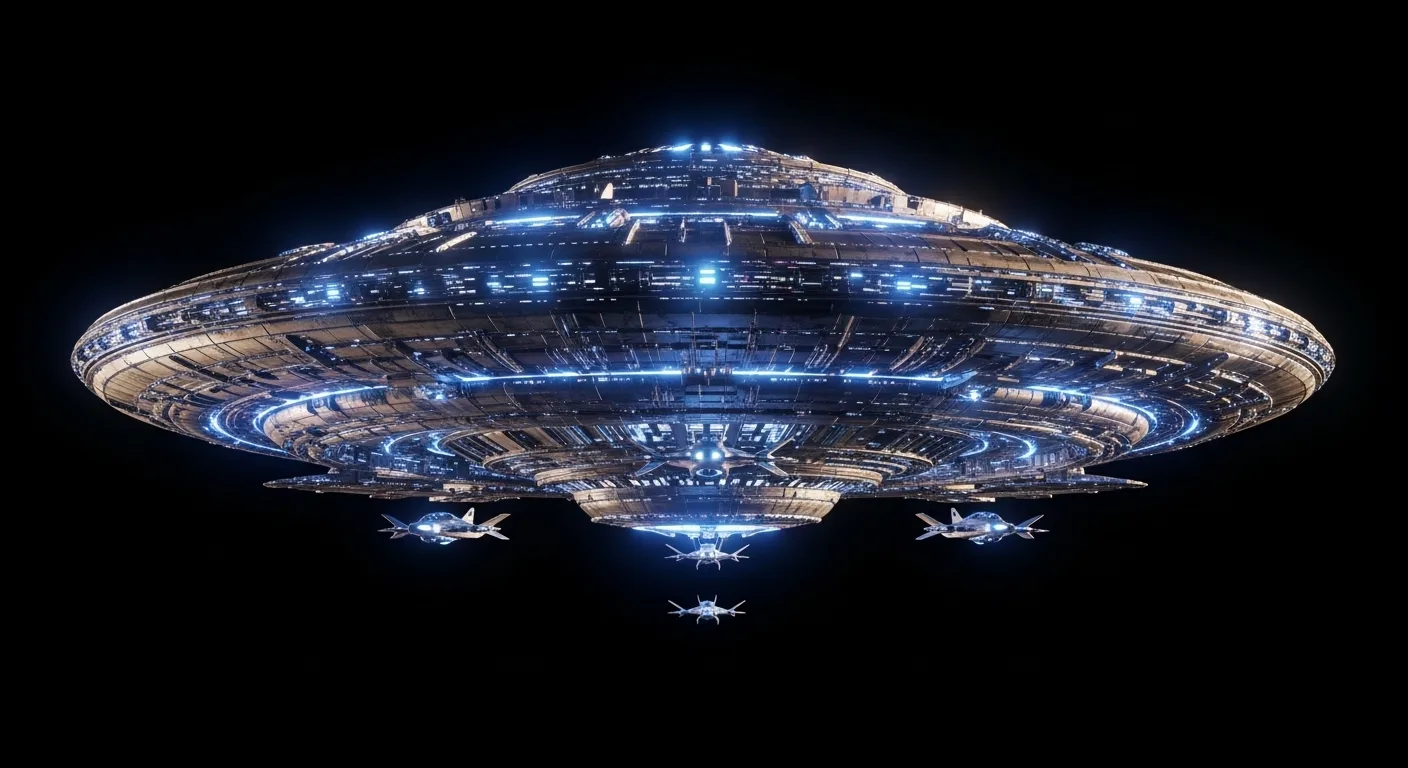
The story of Gulf Breeze, Florida, is the story of a UFO case that refuses to be simple. It is not a straightforward tale of lights in the sky witnessed by credible observers and left unexplained by the authorities, though it contains elements of that. It is not a clear-cut hoax perpetrated by an attention-seeking charlatan, though it contains elements of that as well. What happened in this small waterfront community on Pensacola Bay, beginning on a November evening in 1987 and continuing in various forms for years afterward, was something more complex and more unsettling than either narrative can accommodate. A local contractor named Ed Walters produced a series of photographs showing a disc-shaped craft with a distinctive blue beam of light, photographs that became among the most widely published UFO images in the world. When a model resembling the craft in his photographs was later found in his former home, the case seemed destined for the dustbin of debunked hoaxes. But the hundreds of other witnesses across Gulf Breeze and the surrounding communities who independently reported seeing similar objects before, during, and after Walters’ period of activity complicated any easy dismissal. Something happened in Gulf Breeze that cannot be explained by either accepting or rejecting Ed Walters, and that something remains one of the most fascinating and frustrating episodes in the history of American ufology.
A Small Town on the Bay
Gulf Breeze in 1987 was a quiet, prosperous community of approximately six thousand residents, situated on a peninsula that jutted into Pensacola Bay on the northwestern coast of Florida. The town was known for its beaches, its fishing, and its proximity to Pensacola Naval Air Station, one of the most important naval aviation facilities in the United States. The presence of the naval base meant that the residents of Gulf Breeze were thoroughly accustomed to seeing military aircraft of all types, from training jets to helicopters to the occasional experimental platform being tested over the waters of the Gulf of Mexico. They were not a population easily startled by things in the sky.
Ed Walters was a successful local building contractor in his early forties, well known in the community for his construction business and his involvement in local affairs. By all accounts, he had no particular interest in UFOs prior to November 1987, no history of unusual claims, and no apparent motivation to seek attention through sensational stories. He was, in the parlance of UFO investigation, an unlikely witness, the kind of solid, middle-class professional whose testimony would normally be given considerable weight.
On the evening of November 11, 1987, Walters was at his home on the outskirts of Gulf Breeze when he noticed a glowing object in the sky. What happened next would consume the next several years of his life and transform his quiet community into the UFO capital of the United States.
The Walters Photographs
According to Walters’ account, which he maintained consistently over many years and eventually published in a bestselling book, the object he saw that November evening was a disc-shaped craft approximately twenty feet in diameter, hovering at low altitude near his home. It emitted a bright, bluish-white light that illuminated the surrounding area, and beneath the disc was a distinctive beam of blue light that appeared to project downward toward the ground.
Walters grabbed a Polaroid camera and took several photographs of the object. The resulting images, whatever their ultimate origin, were among the most vivid and detailed UFO photographs ever produced. They showed a clearly defined, disc-shaped object against the night sky, with a glowing blue beam extending from its underside. The craft appeared solid, structured, and technological, nothing like the blurry blobs of light that constituted most UFO photography.
Over the following weeks and months, Walters continued to photograph the objects, eventually producing dozens of images using both Polaroid and 35mm cameras. Some photographs showed the craft at close range, others at greater distance. Some captured the blue beam in dramatic detail. Several appeared to show the craft hovering over recognizable Gulf Breeze landmarks, providing context and scale that made the images even more compelling.
Walters brought his initial photographs to the Gulf Breeze Sentinel, the local newspaper, which published them in late November 1987. The story exploded. Within weeks, the photographs had been picked up by national and international media, and Gulf Breeze found itself at the center of a UFO sensation that drew investigators, journalists, curiosity seekers, and skeptics from across the country and around the world.
The Broader Wave
What elevated the Gulf Breeze case from a single-witness photographic controversy to something much more significant was the fact that Ed Walters was far from the only person seeing unusual objects in the sky over northwestern Florida. In the weeks and months following the publication of Walters’ photographs, hundreds of other residents of Gulf Breeze and the surrounding communities came forward with their own reports of unusual aerial objects.
These independent witnesses described objects that were strikingly similar to what Walters had photographed: disc-shaped craft, often with associated lights, moving silently over the bay and the surrounding neighborhoods. Some witnesses reported the distinctive blue beam that was a hallmark of Walters’ photographs. Others described orange or amber lights, unusual formations, and objects that hovered for extended periods before accelerating away at tremendous speed.
The independent witnesses came from all walks of life. They included teachers, business owners, retirees, police officers, and military personnel from the nearby naval air station. Many of them had no connection to Walters and no knowledge of his photographs when they made their initial observations. Some had been experiencing sightings for weeks or months before Walters went public, suggesting that the phenomenon, whatever it was, predated his involvement and was not triggered by the publicity surrounding his photographs.
One group of witnesses became particularly significant. A collection of Gulf Breeze residents who independently experienced sightings formed an informal observation group, meeting regularly at Shoreline Park on the bay to watch for objects. Over time, this group, which included professionals with no connection to Walters, reported numerous sightings from the park, some of which were witnessed simultaneously by dozens of people. The Shoreline Park observations provided a body of testimony that existed entirely independent of the Walters controversy and that could not be explained by reference to his photographs or their possible fabrication.
MUFON Investigates
The Mutual UFO Network, the largest civilian UFO research organization in the United States, dispatched investigators to Gulf Breeze and conducted one of the most extensive field investigations in the organization’s history. The MUFON team examined Walters’ photographs, interviewed him at length, and also documented the reports of independent witnesses throughout the community.
The investigators’ assessment of Walters’ photographs was mixed. Some analysts found the images compelling, noting details of lighting, perspective, and reflection that would have been extremely difficult to fake with the Polaroid cameras Walters used. The self-developing nature of Polaroid film made certain types of photographic manipulation more difficult than with conventional film, and some investigators argued that the images showed characteristics consistent with a genuine three-dimensional object rather than a superimposed model or double exposure.
Other investigators were more skeptical. They noted that Walters, as a builder, would have had the skills to construct a convincing model and the practical knowledge to create persuasive photographic effects. They pointed to inconsistencies in some of the photographs and questioned whether the images were too good, too clear, and too dramatic to be genuine. The debate within MUFON reflected the broader division in the UFO community between those who found Walters credible and those who suspected fabrication.
The investigation of the independent witnesses, however, produced more unanimous conclusions. The MUFON team found the independent reports to be credible, consistent, and difficult to explain through conventional means. Whatever one thought of Ed Walters, the dozens of other witnesses who reported similar objects had no apparent motive to fabricate their accounts, and their observations spanned a geographic area and time period that precluded any simple explanation.
The Model in the Attic
The Gulf Breeze case took its most damaging turn in 1990 when the new owners of Ed Walters’ former home discovered a model UFO in the attic. The model, constructed from foam plates and other simple materials, bore a resemblance to the craft depicted in Walters’ photographs. Its discovery was immediately seized upon by skeptics as proof that Walters had faked his photographs by suspending the model and photographing it against the night sky.
The model was examined by skeptical investigators who concluded that it could have been used to produce images similar to Walters’ photographs. The construction was simple enough that a handy contractor could easily have made it, and the proportions roughly matched those of the object in the images. For many observers, the discovery of the model was the final nail in the coffin of the Walters case, definitive evidence that the most prominent UFO photographer in America was a fraud.
Walters vehemently denied that the model was his. He claimed that it had been planted in his home by debunkers seeking to discredit him, arguing that anyone wanting to destroy his credibility need only fabricate a model and hide it where it would eventually be found. He pointed out that he had moved out of the house before the model was discovered and that he had no control over what might have been placed there after his departure. His supporters noted that the model was crudely made and did not precisely match the object in the photographs, suggesting that it was a fabrication intended to mimic the photographs rather than the tool used to create them.
The truth about the model has never been definitively established. Walters’ defenders and detractors remain entrenched in their positions, and no evidence has emerged that conclusively proves either that Walters made the model or that someone else planted it. The model’s existence cast a permanent shadow over Walters’ photographs, but it did not explain the independent sightings that constituted the broader Gulf Breeze wave.
Pensacola Naval Air Station
The proximity of Pensacola Naval Air Station to the Gulf Breeze sighting area has been the subject of considerable speculation. The naval station was one of the primary training facilities for naval aviators, and a wide variety of aircraft operated from its runways and from the waters of Pensacola Bay. Some skeptics suggested that the UFO sightings could be attributed to military aircraft engaged in unusual training exercises or testing advanced technology.
This explanation, while not unreasonable on its face, struggled to account for the specific characteristics described by witnesses. Military aircraft, even those engaged in unusual operations, produce sound. They do not hover silently for extended periods. They do not emit blue beams of light. And their shapes and lighting configurations are well known to the residents of a community that sits adjacent to a major naval installation.
Others speculated in the opposite direction, suggesting that the naval station’s presence might be related to the UFO activity in a different way. UFO researchers have long noted a correlation between military installations, particularly those involved in nuclear weapons or advanced technology, and clusters of UFO sightings. Whether this correlation reflects the attraction of unknown intelligences to military facilities or simply the higher likelihood that military personnel will notice and report unusual aerial phenomena remains a matter of debate.
The Books and the Fame
Ed Walters, with the assistance of his wife Frances, published a book titled “The Gulf Breeze Sightings” in 1990. The book detailed his experiences, reproduced his photographs, and presented his case for the authenticity of his encounters. It became a bestseller, bringing the Gulf Breeze story to a national audience and making Walters one of the most recognized figures in American ufology.
The book’s commercial success inevitably raised questions about motive. Critics argued that Walters had fabricated his photographs in order to profit from books, speaking engagements, and media appearances. Walters countered that the financial returns from the book did not justify the disruption to his life, the damage to his reputation in some quarters, and the relentless scrutiny that his claims attracted. Whether financial gain was a motivating factor in the case remains a matter of opinion rather than established fact.
The publication of the book also had the effect of focusing public attention overwhelmingly on Walters himself, to the detriment of the broader wave of sightings that had been occurring across the Gulf Breeze community. The independent witnesses, whose testimony was in many ways more significant than Walters’ photographs, were overshadowed by the controversy surrounding the central figure. The Gulf Breeze case became, in the public mind, the Ed Walters case, and the fate of the broader phenomenon became entangled with the fate of one man’s credibility.
The Wave Continues
Throughout the late 1980s and into the 1990s, sightings continued in the Gulf Breeze area with a frequency that suggested the phenomenon was genuine and ongoing, regardless of one’s assessment of Ed Walters. The Shoreline Park observation group continued to meet and to report objects over the bay. New witnesses came forward who had no connection to Walters or to the media coverage surrounding his photographs. Military personnel from the naval station privately acknowledged seeing unusual objects, though official denials continued.
The persistence of the sightings over such an extended period was difficult to reconcile with a hoax explanation. If Walters had fabricated his photographs, that fabrication could not account for the objects independently seen by hundreds of other people over a span of years. The phenomenon in Gulf Breeze had a life of its own, one that predated Walters’ involvement and continued long after the model in the attic had undermined his credibility.
Some researchers proposed that the Gulf Breeze area might be a window zone, a geographic location where UFO activity is persistently elevated for reasons that remain unknown. Similar clusters of sightings had been documented in other locations, from Warminster in England to Hessdalen in Norway, and the pattern of sustained activity over years or decades suggested that certain locations might have characteristics, geological, electromagnetic, or otherwise, that either attracted or facilitated the phenomenon.
The Complexity of Evidence
The Gulf Breeze case remains a source of frustration for anyone seeking simple answers about the UFO phenomenon. The evidence resists both wholesale acceptance and wholesale rejection. Walters’ photographs, however visually striking, are tainted by the model discovery and by the impossibility of verifying their authenticity through any available analytical technique. His personal credibility remains a matter of passionate disagreement among researchers who have examined the case.
But the independent witnesses, the Shoreline Park observations, the military sightings, and the sheer volume and consistency of reports from across the community paint a picture of something genuinely unusual occurring in the skies over northwestern Florida. These witnesses had no financial motive, no connection to Walters, and no reason to fabricate their reports. Many of them reported their sightings reluctantly, aware that doing so might subject them to the same kind of scrutiny and ridicule that had been directed at Walters.
The Gulf Breeze case teaches a lesson about the relationship between evidence and truth in UFO investigation. The most prominent evidence in a case may not be the most reliable. The most reliable evidence may be overshadowed by the most prominent. And the truth about what happened in a given location may be far more complex than any single narrative can capture. Ed Walters may or may not have fabricated his photographs. But something was in the sky over Gulf Breeze, seen by hundreds of people over a period of years, and that something has never been explained.
Sources
- CIA UFO/UAP Reading Room — Declassified CIA documents on UAP