Papua New Guinea, January 28, 1985 — January 24, 1985
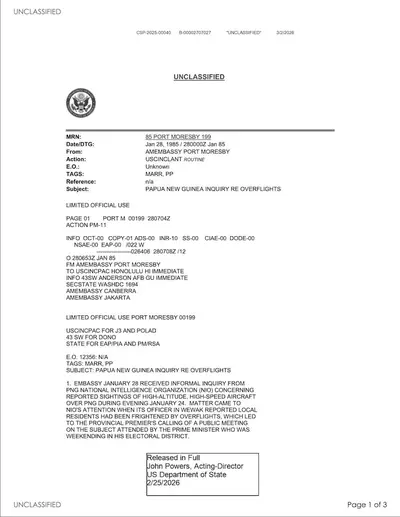
A 1985 U.S. diplomatic cable records a radar track of an unidentified object over Papua New Guinea, later released via the PURS_UE program.
Incident Overview
On January 24, 1985, an unidentified object was detected within the airspace of Papua New Guinea. The event was documented in a U.S. Department of State diplomatic cable sent from the U.S. Embassy in Port Moresby to the United States Indo-Pacific Command (USCINCPAC) in Honolulu, Hawaii. This specific communication was dated January 28, 1985. The details of this encounter remained classified for decades until the records were released to the public on May 8, 2026, as part of the Presidential Unsealing and Reporting System for UAP Encounters (PURSUE).
The primary nature of this case is classified as a radar track, meaning the unidentified object was detected via military or civilian radar equipment rather than through visual sighting alone. While the document confirms the existence of the radar detection, the released text does not specify the total number of witnesses involved in the observation or the exact number of radar returns recorded.
Historical and Geopolitical Context
The mid-1980s represented a period of significant transition in the study of Unidentified Aerial Phenomena (UAP). Following the conclusion of Project Blue Book in 1969, the systematic investigation of such objects by the United States government moved away from centralized, public-facing military programs and into more fragmented, classified channels. During this era, sightings were often processed through diplomatic and military intelligence pipelines, such as the communication between the Port Moresby embassy and the Indo-Pacific Command.
Papua New Guinea, situated in the southwestern Pacific, occupies a strategically significant geographic position. During the Cold War, the monitoring of airspace in this region was vital for maintaining maritime and aerial situational awareness. The detection of an unidentified object on radar during this period would have necessitated formal reporting through diplomatic cables to ensure that military commands, such as USCINCPAC, were aware of any potential incursions or anomalous atmospheric activity that could impact regional security or involve unauthorized foreign technology.
Analytical Framework and Classification
The documentation released under the PURSUE program is subject to the standard classification protocols of the All-domain Anomaly Resolution Office (AARO). By default, all records released through this program are designated as unresolved. The federal government has maintained a neutral stance regarding the 1985 Papua New Guinea incident, neither concluding that the event was the result of anomalous technology nor confirming it as a conventional phenomenon.
In the study of mid-1980s radar anomalies, researchers often evaluate several conventional candidates. These include the presence of experimental aircraft testing, the movement of weather balloons, or atmospheric optical phenomena such as lenticular clouds and sundogs. Additionally, astronomical objects like the Moon, Venus, or meteors appearing near the horizon can occasionally produce deceptive radar or visual signatures. The 1985 case remains categorized alongside other historical radar tracks that continue to lack a definitive, non-anomalous explanation within the available declassified record.