Adamski contactee claim Case (1967) — FBI Files
In 1967, Dr. Jose Lanuza captured photographs of metallic, dome-topped objects over Mexico, an incident later released through the PURSUE program.
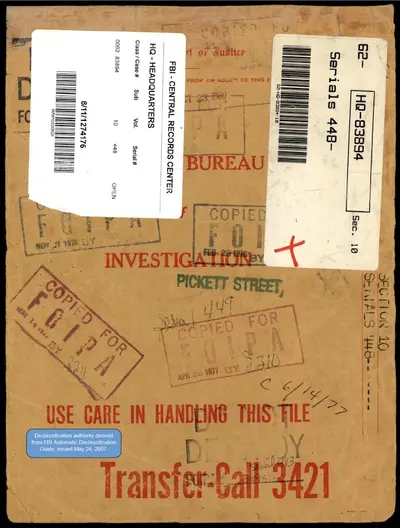
Historical Context
The late 1960s represented a period of heightened tension and surveillance within the global intelligence community. During the Cold War, the United States and its allies maintained rigorous monitoring of the skies to detect unauthorized aerial incursions. This era of atmospheric scrutiny was characterized by the presence of various high-altitude reconnaissance programs and the proliferation of Unidentified Flying Object (UFO) reports. Within the United States, the Air Force’s Project Blue Book served as the primary repository for such sightings, though the administrative burden of these reports necessitated a complex web of communication between various intelligence agencies.
The Federal Bureau of Investigation (FBI) played a significant role in the documentation of these phenomena, particularly when sightings occurred near or involved vital installations. Under established Bureau protocols, field offices in cities such as Knoxville, Albuquerque, and Los Angeles were tasked with routing UFO reports to headquarters. This centralized approach ensured that any aerial anomaly that could potentially threaten national security or involve espionage was cataloged and analyzed by federal authorities. The administrative framework of the time treated these reports not merely as folklore, but as potential security breaches requiring formal investigation.
The 1967 Mexico City Incident
On February 26, 1967, an incident occurred in Mexico City, Mexico, that would eventually become part of the public record. The documentation, which was released to the public on May 8, 202
6, as part of the Presidential Unsealing and Reporting System for UAP Encounters (PURSUE), details observations made by Dr. Jose Lanuza. A professor by profession, Dr. Lanuza was traveling via aircraft from Mexico City to Guadalajara when he observed several unidentified objects. These objects were captured in a series of photographs taken from the plane.
The visual evidence provided in the file describes the objects as having a distinct metallic appearance and a circular shape. A notable feature of these objects was a transparent dome located on their upper sections. The photographs indicate that these objects were observed at relatively low altitudes during the flight. According to the records, the photographic negatives were subjected to scrutiny by experts. These specialists concluded that there was no evidence of fakery or manipulation in the images. While the specific number of witnesses to the event is not explicitly stated in the released documentation, the primary testimony rests on the photographic evidence and the observations of Dr. Lanuza.
Analysis and Classification
The Adamski contactee claim is categorized as a case involving photographic or video evidence of an unidentified object. In the broader landscape of mid-century aerial phenomena, cases involving high-quality photographic evidence were often treated with a higher degree of investigative priority due to the difficulty of manufacturing convincing fakes during that era. The presence of a transparent dome and metallic sheen is a recurring motif in many mid-century UFO reports, often associated with the “contactee” subgenre of phenomena.
The status of this case remains officially unresolved. Under the protocols of the All-domain Anomaly Resolution Office (AARO), all records released via the PURSUE program are designated as unresolved by default. The federal government has maintained a neutral stance, neither confirming that the events were anomalous nor concluding that they were the result of conventional means.
When evaluating such sightings, investigators historically considered several conventional candidates. These include experimental aircraft, weather balloons—specifically the Project Mogul series used for detecting Soviet nuclear tests—and various atmospheric optical phenomena such as lenticular clouds, sundogs, or meteors. Additionally, bright astronomical objects like the Moon or the planet Venus, when positioned near the horizon, have frequently been identified as the source of similar sightings. The 1967 incident remains a subject of archival study due to the verified authenticity of the negatives as reported by the examining experts.