Stefan Michalak Encounter
A prospector approached a landed UFO and was burned by exhaust gases when it departed. His chest bore a grid-pattern burn matching the craft's vents, and he suffered radiation-like illness for months.
On a spring morning in 1967, the Canadian wilderness near Falcon Lake would become the site of one of the most physically compelling UFO encounters ever documented. Stefan Michalak, a 51-year-old industrial mechanic with a passion for amateur geology, set out that day to prospect for quartz and silver veins in the ancient granite of the Whiteshell Provincial Park. By afternoon, he would return with burns etched into his flesh in a pattern that would puzzle investigators for decades to come.
The Victoria Day long weekend had drawn Michalak to this remote corner of Manitoba, approximately 75 miles east of Winnipeg. An experienced outdoorsman who had prospected these rocky Canadian Shield formations many times before, he was well-equipped and familiar with the terrain. The morning of May 20th was clear and calm, ideal conditions for the geological survey work he had planned.
Background
Stefan Michalak had immigrated to Canada from Poland and built a respectable life in Winnipeg. As an industrial mechanic, he possessed both technical knowledge and a methodical mind that would prove crucial in the detailed accounts he later provided. His hobby of amateur geology had taken him into the wilderness countless times, and he approached his prospecting with the same precision he applied to his professional work. Friends and colleagues knew him as a practical, level-headed man not given to flights of fancy or tall tales.
The Sighting
At approximately 12:15 PM, as Michalak knelt examining a quartz vein near a small marshy area, a sudden disturbance overhead shattered the wilderness silence. Looking up, he observed two cigar-shaped objects descending from the sky, their surfaces glowing with an intense red luminosity that seemed to pulsate. The objects moved in tandem, their descent controlled and deliberate, nothing like any aircraft Michalak had ever witnessed.
One of the craft continued its descent and settled onto a large, flat rock formation approximately 160 feet from where Michalak crouched, now frozen in astonishment. The second object hovered briefly, as if observing the landing, before ascending rapidly and disappearing into the clouds to the west. Michalak, his scientific mind already engaged despite his shock, retrieved his notebook and began sketching the landed craft from his concealed position behind an outcropping of rocks.
The Craft
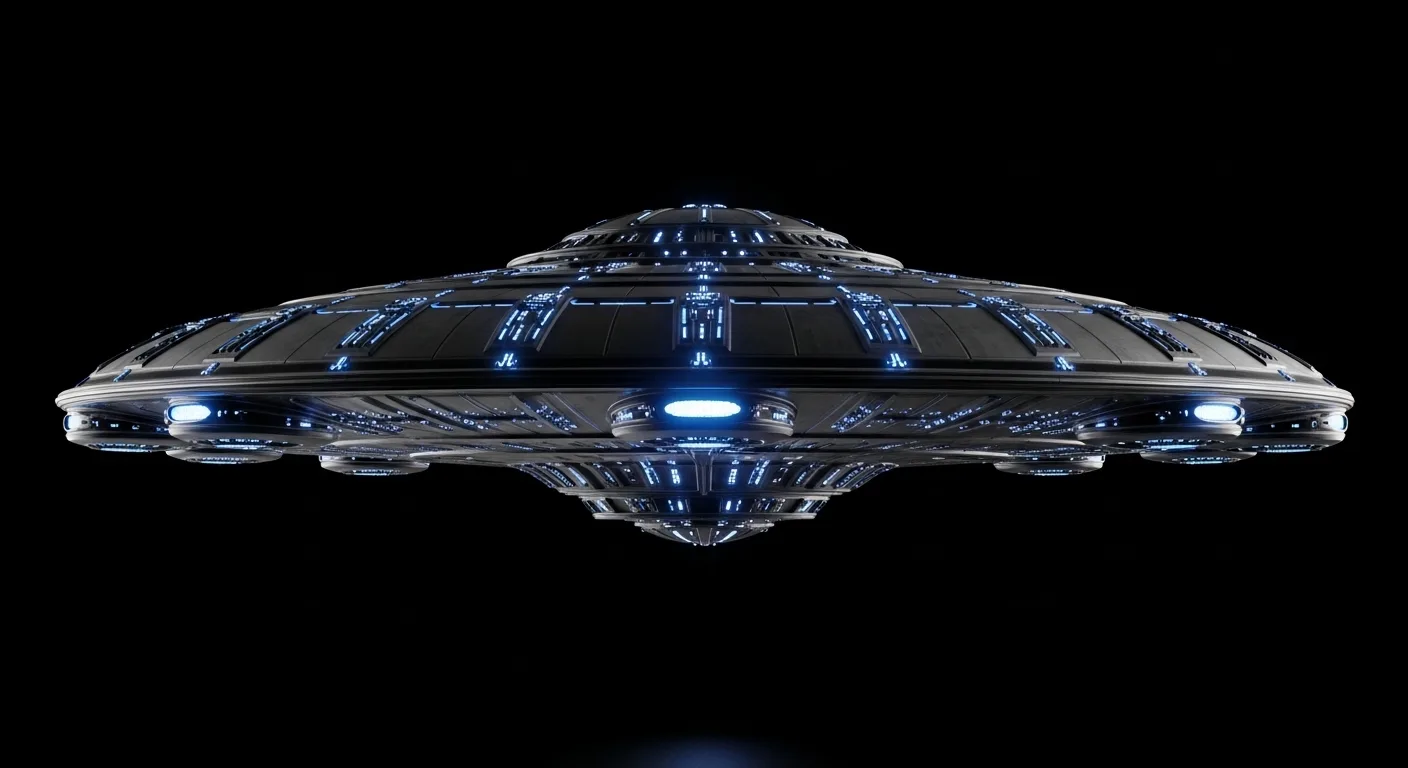
For the next half hour, Michalak observed the object from his hiding spot, his artist’s eye capturing details in quick sketches. The craft appeared disc-shaped, measuring approximately 35 to 40 feet in diameter, with a pronounced dome rising from its upper surface. What struck him most was the seamless construction, as if the entire vehicle had been molded from a single piece of metal. He could detect no rivets, seams, welds, or joints of any kind, nothing that suggested conventional manufacturing techniques.
A peculiar sulfur-like odor wafted across the distance between them, carried on the light breeze. The craft emitted a distinct humming sound, accompanied by a hissing noise that seemed to correspond with brilliant colors that played across its surface. Most notable was a section on the craft’s side that featured a grid pattern of small holes, arranged in what appeared to be a deliberate geometric configuration.
The Burn
His curiosity overwhelming his caution, Michalak slowly approached the landed craft. As he drew closer, he could feel waves of warm air emanating from the object and hear what sounded like muffled voices from within. Believing he might have stumbled upon an experimental military aircraft, perhaps American or Soviet, he called out greetings in English, Russian, German, Italian, Polish, and Ukrainian. No response came.
Emboldened, Michalak stepped close enough to peer through an open doorway in the craft’s side. He glimpsed an interior illuminated by brilliant lights, with what appeared to be a complex array of panels and instruments. As he reached out to touch the exterior surface, his leather work glove immediately melted from the intense heat of the metal.
Without warning, the doorway sealed shut with a seamless precision. The craft began to rotate, and suddenly the grid-pattern panel swung to face him directly. Before Michalak could retreat, a blast of superheated gas erupted from the holes, striking him full in the chest. His shirt immediately caught fire. Screaming in pain, he tore the burning garment from his body as the craft tilted upward and departed with tremendous speed, leaving him alone and injured in the wilderness.
Physical Evidence
The evidence left behind would prove extraordinary in its scope and consistency. The grid-pattern burns on Michalak’s chest and abdomen, arranged in the exact configuration of the holes he had observed on the craft, defied conventional explanation. His melted glove and burned shirt provided tangible artifacts. But the physical evidence extended beyond his person.
At the landing site itself, investigators found a circular area of disturbed soil and rock. Vegetation within this zone appeared burned or dehydrated. Most significantly, radiation detection equipment registered elevated levels at the site, readings that remained detectable for months afterward. Metal debris recovered from the location contained unusual isotopic signatures that analysts struggled to explain. The soil composition within the landing circle showed anomalies consistent with exposure to extreme heat or electromagnetic effects.
Medical Effects
The immediate aftermath of the encounter thrust Michalak into a medical nightmare that would persist for months. Nausea overwhelmed him almost immediately after the craft departed, followed by severe vomiting that contained a foul, dark material. Excruciating headaches developed within hours and recurred periodically for weeks. He lost more than 20 pounds in the weeks following the incident, his body seemingly unable to recover its equilibrium.
The grid-pattern burns on his chest healed slowly and left permanent scarring that he would carry for the rest of his life. Doctors who examined him found the wound pattern baffling, unable to identify any conventional source that could have created such precise, regular burns. His symptoms bore similarity to radiation exposure, though the exact mechanism remained unclear. Periodic flare-ups of illness continued for months, leading some physicians to speculate about lingering effects from whatever energy had struck him.
Significance
The Falcon Lake case stands as one of the most thoroughly investigated and well-documented UFO encounters in Canadian history, perhaps in all of North American UFO research. The extensive physical evidence separates it from the vast majority of UFO reports that rely solely on eyewitness testimony. The documented medical injuries, complete with hospital records and physician examinations, provided a level of verification rarely available in such cases.
Multiple official investigations were conducted by the Royal Canadian Mounted Police, the Royal Canadian Air Force, and civilian research organizations. American officials also expressed interest in the case. None of these investigations produced a conventional explanation that accounted for all the evidence. The highly credible witness, with no history of seeking attention or profit from his experience, added weight to an already compelling case.
Legacy
Stefan Michalak maintained his account of the Falcon Lake encounter consistently and without embellishment until his death in 1999. He cooperated fully with investigators, submitted to medical examinations, and allowed his story to be scrutinized from every angle. He never sought to profit from his experience and expressed frustration that he could not provide a better explanation for what had happened to him.
The case demonstrates that UFO encounters can leave physical evidence both on witnesses and in the environment. The grid-pattern burns, the radiation traces, the metal debris, and the altered soil all combine to create a body of evidence that resists easy dismissal. Today, the Falcon Lake incident remains a touchstone in UFO research, a reminder that some encounters leave marks that demand explanation.
Sources
- Project Blue Book — National Archives — USAF UFO investigation files, 1947–1969
- CIA UFO/UAP Reading Room — Declassified CIA documents on UAP