Wichita, Kansas UFO Sighting (Friday) — FBI Files
An 11-year-old boy reported seeing two large, light-emitting flying saucers landing near his home in Wichita, Kansas, during the Cold War era.
Background
On a Friday in Wichita, Kansas, U.S. government investigators recorded an unidentified-object incident that remained classified for decades. The details of this encounter were later released to the public on May 8, 2026, as part of the Presidential Unsealing and Reporting System for UAP Encounters (PURSUE). This specific case is a relic of the Cold War era, investigated under the auspices of the Air Force’s Project Blue Book or its predecessor programs. During this period, the United States government maintained a heightened state of vigilance regarding aerial phenomena due to the potential for technological breakthroughs by adversarial nations.
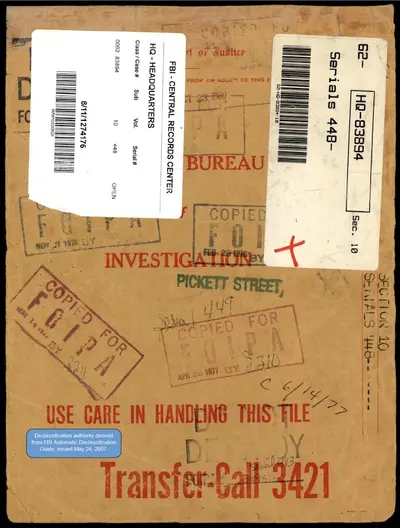
The documentation of this event was integrated into the broader intelligence-gathering apparatus of the era. The case was filed with the Federal Bureau of Investigation, which utilized a standardized procedure for managing such reports. Field offices in Knoxville, Albuquerque, Los Angeles, and other locations were tasked with routing UFO reports to headquarters under the Bureau’s standing protocols. These protocols were specifically designed for the protection of vital installations and the monitoring of any aerial activity that could pose a threat to national security or domestic stability.
The Incident
The primary account of the event comes from an 11-year-old boy, Johnny Sparks, who reported seeing two flying saucers in the vicinity of his home. According to the documentation, the objects were notably large, described as being larger than cars. Sparks noted that the objects emitted colored lights and produced a distinct humming noise during their approach. The trajectory of the objects was not purely aerial; the report indicates that the objects landed near the driveway of the residence. Furthermore, the boy observed that the objects featured spinning tops as part of their physical appearance or movement.
While the visual details provided by the witness were specific, the released document does not specify the total number of witnesses present during the event. The report relies heavily on the direct observations of the child, whose perspective captured the transition of the objects from high altitude to ground level.
Documented Testimony
The official file contains verbatim statements that provide insight into the immediate experience of the witness. The text records the boy stating, “I saw this flying object that people have been talking about. It had colored lights and was spinning.” The movement of the objects was a central element of the sighting, as the witness noted a significant change in proximity, stating, “WHEN I SAW THEM at first, it was up in the sky. Then I saw them laying right by my window.” The psychological impact of the encounter is also noted in the file, as the witness recorded, “I was too scared to wake anyone up.”
Analysis and Classification
This case is classified as a visual sighting reported by ground or air observers. In the context of mid-century aerial phenomena, such reports were frequently scrutinized for evidence of clandestine aerospace technology. The presence of humming noises and spinning components often led investigators to look for mechanical or propulsion-based explanations.
The current status of the Wichita sighting remains officially unverified. All records released under the PURSUE program are designated as unresolved by the All-domain Anomaly Resolution Office (AARO) by default. The federal government has not reached a conclusion regarding whether the events were anomalous or conventional, and the possibility of either remains open. Within the historical context of the Cold War, conventional candidates for such sightings included experimental aircraft, weather balloons—specifically those associated with the Project Mogul series in the late 1940s—and various atmospheric optical phenomena such as sundogs or lenticular clouds. Additionally, astronomical objects like Venus, the Moon, or meteors near the horizon were frequently cited as potential sources of misidentification in reports of this nature.