Kansas City UFO Sighting (January 6, 1950) — USAF Files
U.S. government documents record the sighting of two luminous, spherical objects over Kansas and Kansas cities in early 1950.
Background
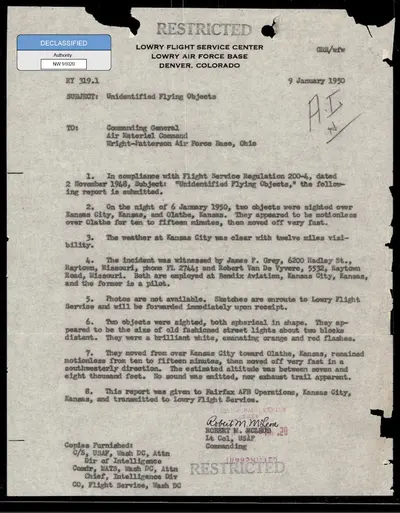
On January 6, 1950, in Kansas City, Kansas and Olatze, Kansas, U.S. government investigators recorded an unidentified-object incident later released to the public on May 8, 2026, as part of the Presidential Unsealing and Reporting System for UAP Encounters (PURSUE). This specific event occurred during a period of heightened public and military concern regarding unidentified aerial phenomena. The sighting is part of the first wave of “flying saucer” reports that swept the United States following the Kenneth Arnold sighting of June 1947 and the Roswell incident of July 1947. During this era, the midwestern United States frequently served as a backdrop for such reports due to its vast, open airspace and the presence of various military installations and research facilities.
The documentation for this event is found within U.S. Department of Defense records. The release of these files under the PURSUE program provides a rare glimpse into the raw data captured by investigators during the early Cold War. At the time, the phenomenon of unidentified flying objects was often analyzed through the lens of emerging aerospace technology and the geopolitical tensions of the era. The presence of unidentified lights in the sky was frequently scrutinized by both civilian observers and military personnel, as the potential for clandestine surveillance or new aerodynamic capabilities was a primary concern for national security.
What the document records
On the night of January 6, 1950, two spherical objects were observed over Kansas City and Olathe, Kansas. The objects appeared motionless for ten to fifteen minutes before rapidly moving off in a southwesterly direction. Witnesses described the objects as brilliant white with orange and red flashes, and estimated their altitude to be between seven and eight thousand feet. While the visual characteristics of the objects were detailed, the number of witnesses is not specified in the released document.
The behavior of the objects, specifically the period of stationary suspension followed by rapid directional change, is a recurring element in many mid-century aerial reports. Such maneuvers often stood in contrast to the predictable flight paths of contemporary commercial or military aircraft. The presence of colored flashes, such as the orange and red lights noted in this case, adds a layer of complexity to the visual description, as these light patterns are often studied to determine if they indicate propulsion systems, atmospheric friction, or simple optical illusions.
Type of case
The case is classified as a visual sighting reported by ground or air observers. This type of report relies heavily on the subjective perception of observers on the ground, making the verification of altitude, speed, and luminosity a primary challenge for investigators.
Status
All records released under the PURSUE program are designated unresolved by the All-domain Anomaly Resolution Office (AARO) by default. The federal government has not concluded that the events were anomalous, has not concluded that they were conventional, and has not ruled out either possibility. The lack of a definitive conclusion reflects the difficulty in reconciling eyewitness testimony with the technological limitations of 1950s radar and surveillance.
Conventional candidates for sightings of this period include experimental aircraft, weather balloons, especially the Project Mogul series in the late 1940s, and atmospheric optical phenomena such as sundogs and lenticular clouds. Additionally, astronomical objects including Venus, the Moon, and meteors near the horizon are often considered during investigations of this nature. The Kansas City sighting remains an open inquiry within the archival record, representing the ongoing ambiguity inherent in the study of unidentified aerial phenomena from the mid-twentieth century.