Stony Creek, Virginia UFO Sighting (July 23, 1963) — FBI Files
FBI records detail a 1963 inquiry from a witness named Bryant regarding unidentified aerial phenomena in Stony Creek, Virginia.
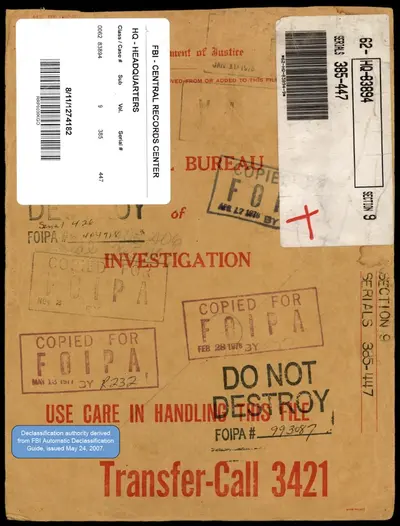
Background
On July 23, 196 and, in the small community of Stony Creek, Virginia, U.S. government investigators recorded an unidentified-object incident. The documentation pertaining to this event was later released to the public on May 8, 2026, as part of the Presidential Unsealing and Reporting System for UAP Encounters (PURSUE). This case originated during the height of the Cold War, a period characterized by intense aerial surveillance and heightened sensitivity toward any unidentified objects in the sky. The incident was investigated under the framework of the Air Force’s Project Blue Book or its preceding investigative programs, which were tasked with determining whether unidentified sightings represented national security threats or atmospheric anomalies.
During this era, the Federal Bureau of Investigation maintained a specific protocol for handling reports of unidentified aerial phenomena. Because such sightings were often perceived as potential indicators of Soviet technological advancements, UFO reports were frequently routed through various field offices. In the case of the Stony Creek incident, the FBI’s Knoxville, Albuquerque, and Los Angeles offices, among others, utilized standing protocols to direct such information to headquarters, particularly when the reports involved the proximity of vital military or government installations. This systematic approach ensured that any potential breach of airspace or unauthorized surveillance could be assessed by central authorities.
Incident Details
The primary evidence regarding the July 23, 1963, event consists of a letter from an individual identified as Bryant. This correspondence was received by the Sheriff’s Office in Stony Creek, Virginia, and contained a formal request for information concerning UFOs. The letter was postmarked within the state of Virginia and serves as a documented instance of Bryant actively seeking information regarding unidentified aerial phenomena. While the letter indicates an interest in the subject, the released document does not specify the total number of witnesses present during the sighting or the specific visual characteristics of the object in question.
The nature of the case is classified as a visual sighting, which typically involves observations made by ground-based or air-based observers. Such reports were common during the mid-twentieth century, as the proliferation of civilian aviation and improved optical equipment allowed for more frequent monitoring of the upper atmosphere.
Analytical Context
The status of the Stony Creek sighting remains officially unresolved. Under the current guidelines of the All-domain Anomaly Resolution Office (AARO), all records released under the PURSUE program are designated as unresolved by default. This classification indicates that the federal government has not reached a definitive conclusion regarding the nature of the phenomenon. The authorities have neither confirmed that the event was anomalous nor concluded that it was the result of conventional technology, leaving both possibilities open for investigation.
When analyzing sightings from the 1960s, researchers often consider several conventional candidates. During the Cold War, the deployment of experimental aircraft and high-altitude reconnaissance technology frequently led to misidentifications. Additionally, the legacy of the Project Mogul series—a program of high-altitude balloons designed to detect Soviet nuclear tests—contributed to a high volume of unidentified aerial reports. Other atmospheric optical phenomena, such as sundogs, lenticular clouds, or meteors appearing near the horizon, are also frequently cited as potential explanations. Astronomical objects, including the Moon or the planet Venus, were also common sources of visual confusion for observers during this period.