Fort Eustis, Virginia UFO Sighting (March 13, 1960) — FBI Files
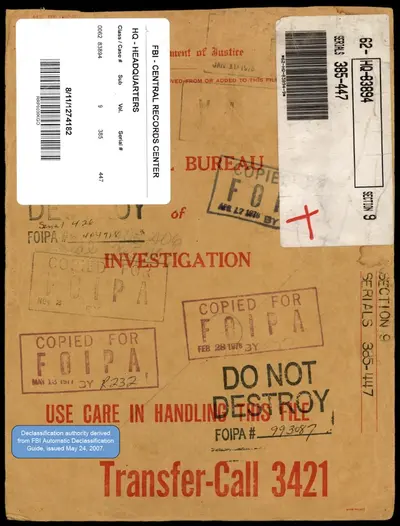
An FBI investigation into rumors of unidentified flying objects at Fort Eustis, Virginia, was documented in 1960 and released via the PURSUE program.
Background
On March 13, 1960, an unidentified-object incident occurred at Fort Eustis, Virginia, involving reports of objects in the sky that prompted interest from federal investigators. The details of this encounter were later released to the public on May 8, 2026, as part of the Presidential Unsealing and Reporting System for UAP Encounters (PURSUE). This case originated during the height of the Cold War, a period characterized by intense aerial surveillance and heightened anxiety regarding airspace security. During this era, the United States military and intelligence communities were deeply concerned with the possibility of Soviet technological advancements, particularly regarding reconnaissance capabilities and orbital capabilities.
The incident was investigated under the framework of the Air Force’s Project Blue Book or its predecessors, which served as the primary repository for Unidentified Flying Object reports during the mid-twentieth century. Because Fort Eustis is a vital military installation, the reporting of such phenomena followed strict bureaucratic channels. The Federal Bureau of Investigation (FBI) maintained protocols for handling reports that could impact the security of sensitive government sites. Consequently, various field offices, including those in Knoxville, Albuquerque, and Los Angeles, were tasked with routing UFO reports to headquarters to ensure that any potential threats to installations were properly vetted and documented.
The Investigation
The specific documentation regarding this event centers on the actions of an FBI agent who had recently transferred to the Fort Eustis area. Upon his arrival, the agent encountered rumors circulating within the local community and military circles suggesting that unidentified flying objects were, in fact, secret terrestrial weapons being tested by the United States government. The agent’s primary objective in investigating these claims was to investigate the validity of such rumors and ultimately dispel them, preventing the spread of misinformation that could impact morale or security.
To address these rumors, the agent initiated formal correspondence with the Combat Development agency located at Fort Eustis. He wrote to the agency specifically to inquire about the possibility that these sightings were related to classified domestic weapons programs. While the agent sought to provide a factual basis for the phenomena, the released document does not specify the exact number of witnesses who observed the objects. The investigation was focused more on the origin of the rumors and the potential for domestic technological interference than on the physical tracking of the objects themselves.
Classification and Analysis
The case is classified as a visual sighting reported by ground or air observers. In the context of the 1960s, such sightings were frequently analyzed against a backdrop of various known aerial phenomena. During this period, the presence of experimental aircraft, high-altitude reconnaissance technology, and even weather balloons—such as the Project Mogul series used in the late 1940s—provided common, albeit often unconfirmed, explanations for anomalous sightings. Furthermore, atmospheric optical phenomena, including sundogs, lenticular clouds, and the positioning of astronomical bodies like Venus, the Moon, or meteors near the horizon, were standard considerations in any investigation of unidentified lights.
As of the current archival status, all records released under the PURSUE program are designated as unresolved by the All-domain Anomaly Resolution Office (AARO) by default. The federal government has maintained a neutral stance regarding the Fort Eustis incident, neither concluding that the events were anomalous nor confirming that they were the result of conventional technology. The investigation remains a historical record of the intersection between local rumor-mongering and the rigorous, albeit often inconclusive, scrutiny of federal investigative agencies during the mid-twentieth century.