Fort Eustis, Virginia UFO Sighting (July 23, 1963) — FBI Files
FBI records detail a 1963 unidentified object sighting at Fort Eustis, Virginia, involving correspondence from Larry W. Bryant regarding UFO reports.
Background
On July 23, 1963, an unidentified-object incident occurred at Fort Eustis, Virginia, an event that remained within classified government archives until its release to the public on May 8, 2026. This disclosure was facilitated by the Presidential Unseulating and Reporting System for UAP Encounters (PURSUE). The incident took place during the height of the Cold War, a period characterized by intense aerial surveillance and heightened sensitivity regarding unauthorized incursions into United States airspace. During this era, the United States Air Force maintained various programs, most notably Project Blue Book, to investigate reports of Unidentified Flying Objects. These investigations were often integrated into broader national security frameworks, as the distinction between atmospheric phenomena and potential Soviet technological advancements remained a primary concern for military intelligence.
The geographic location of the sighting, Fort Eustis, is a significant military installation situated in the Virginia Peninsula. Given its role in supporting Army operations and its proximity to vital coastal and logistical infrastructure, any report of an unidentified object in this vicinity would naturally trigger high-level scrutiny. The reporting protocols of the time ensured that such anomalies were not merely handled by local authorities but were funered through established intelligence channels. The Federal Bureau of Investigation (FBI) maintained a specific role in this process, as its various field offices, including those in Knoxville, Albuquerque, and Los Angeles, were instructed to route UFO reports to headquarters. This procedure was part of the Bureau’s standing protocols designed to protect vital installations and monitor potential threats to national security.
Documented Incident and Investigation
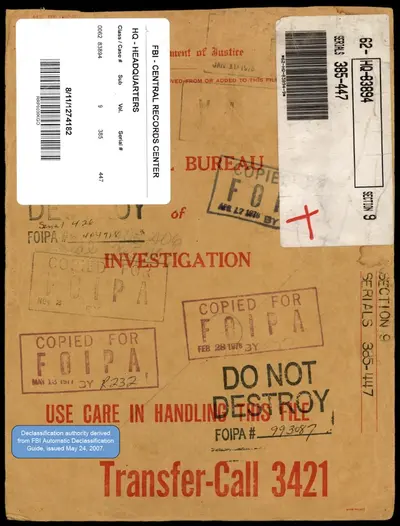
The primary documentation regarding this specific case originates from a letter sent by Larry W. Bryant. The correspondence was addressed to the Sheriff’s Office in Sussex County and was postmarked from Fort Eustis, Virginia. The contents of the letter pertained to various UFO reports, prompting the FBI to initiate an investigation into Bryant. The impetus for this investigation was not necessarily the content of the sighting itself, but rather the significant volume of correspondence Bryant was directing toward military officials. Additionally, the Bureau sought to respond to inquiries that were being directed to military personnel from other various agencies.
While the document details the investigative focus on the sender and the administrative handling of the reports, the released records do not specify the exact number of witnesses present during the sighting. The nature of the report is classified as a visual sighting, which typically involves observations made by ground-based or air-based observers. Such reports were common during the 1960s, often involving descriptions of lights or metallic shapes moving in patterns that appeared inconsistent with known commercial or military aviation of the period.
Analytical Context and Status
The classification of this case remains unresolved. Under the standards established by the All-domain Anomaly Resolution Office (AARO), all records released through the PURSUE program are designated as unresolved by default. This designation reflects a lack of definitive evidence to confirm or deny the anomalous nature of the event. The federal government has maintained a neutral stance, neither concluding that the objects were anomalous nor confirming that they were conventional in origin.
When analyzing sightings from the mid-twentieth century, investigators often consider several conventional candidates. These include the presence of experimental aircraft being tested in restricted corridors, or the lingering presence of high-altitude surveillance equipment such as the Project Mogul weather balloon series. Atmospheric optical phenomena, including lenticular clouds, sundogs, or the refraction of light through ice crystals, frequently produced deceptive visual reports. Furthermore, astronomical objects such as the Moon, Venus, or meteors passing near the horizon were frequent contributors to unidentified aerial reports. The Fort Eustis incident remains a subject of historical interest within the study of Cold War-era aerial anomalies, representing the intersection of civilian observation and federal security protocols.